
What Does a Venus Flytrap Actually Need From a Grow Light
- How Venus Flytraps Use Light in Their Natural Habitat
- Lighting Requirements for Indoor Venus Flytraps
- What a Grow Light Must Provide for Venus Flytraps
- Sufficient PPFD Output and Coverage Uniformity
- Full Spectrum with Optional UV-A Supplementation
- Long Photoperiod Support and Automation
- Low Heat Output and Reliable Thermal Management
- Source
Unlike most houseplants, Venus flytraps evolved in the open bogs of the Carolinas, where they grow under long hours of intense, direct sunlight. That natural habitat sets a much higher lighting requirement than many indoor growers expect.
For commercial nurseries, tissue culture labs, and retail growers, keeping plants alive is only the baseline. The real goal is consistent color, strong trap development, compact growth, and reliable sell-through quality.
That’s why lighting matters. Indoors, Venus flytraps need more than a basic grow light. To produce healthy, marketable plants, the lighting system must deliver the right spectrum, enough intensity, and a stable photoperiod that matches the plant’s natural growing conditions.
How Venus Flytraps Use Light in Their Natural Habitat
Venus flytraps (Dionaea muscipula) are high-light plants. In the wild, they grow in the open coastal bogs of North and South Carolina, where they receive 6–12 hours of direct sunlight per day with little shade or canopy cover.
Thus, Venus flytraps are not adapted to low-light interiors, shaded greenhouses, or weak decorative grow lights.
Although Venus flytraps are carnivorous, they still rely primarily on photosynthesis for energy. Insects only provide supplemental nutrients, mainly nitrogen and trace minerals. Without enough light, the plant cannot maintain healthy growth, regardless of feeding.
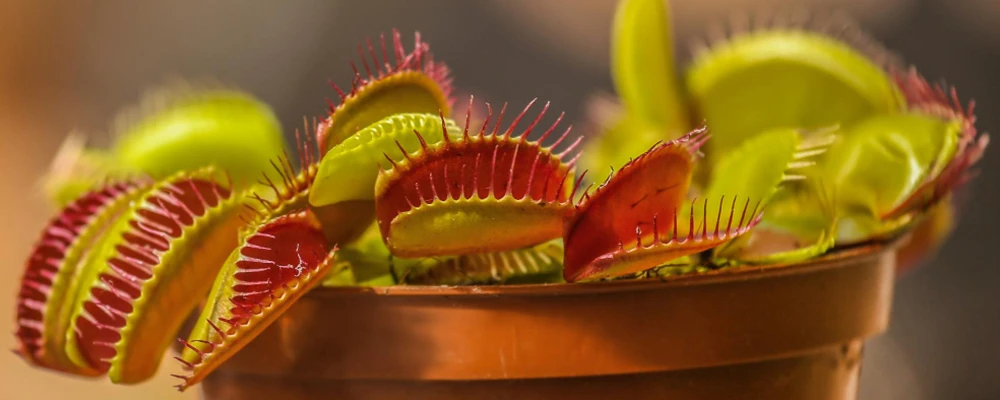
When light levels drop below their requirement, plants develop elongated, pale green leaves that stretch toward available light sources. Traps become smaller, weaker, and slower to close.
For indoor production, a proper LED grow light for Venus flytraps must deliver sufficient intensity, an appropriate spectrum, and a stable photoperiod to support compact growth, strong trap coloration, and consistent commercial quality.
Lighting Requirements for Indoor Venus Flytraps
Growing Venus flytraps indoors means replacing the strong, full-spectrum sunlight they receive in their natural habitat.
Light Intensity
Venus flytraps are high-light plants and require much stronger illumination. Low light is one of the main reasons indoor Venus flytraps fail. When you see pale green traps, weak or elongated leaves, slow trap response, or reduced trap size, that means the intensity drops below the plant’s requirement.
The International Carnivorous Plant Society (ICPS) recommends roughly 15,000–25,000 lux of white LED light for indoor cultivation. In horticultural terms, that equals approximately 200–400 µmol/m²/s PPFD at canopy level.
For Daily Light Integral (DLI), the practical target range is around 10–25 mol/m²/day, depending on growth stage and photoperiod.
Light Spectrum
Venus flytraps respond best to full-spectrum white light that mimics natural sunlight.
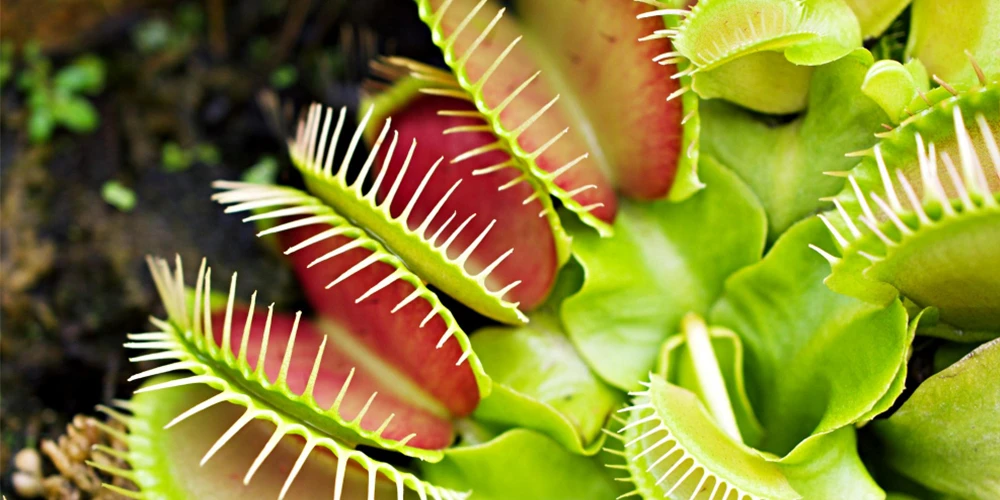
For commercial Venus flytraps, a plant with deep, ruby-red traps is usually a premium product. The vibrant red interior of a Venus flytrap is caused by anthocyanins, pigments that act as a biological "sunscreen." As noted in research published in MDPI Plants regarding flavonoid biosynthesis [1], high-energy blue photons are the primary signal that triggers the plant to produce these pigments.
UVA can also contribute to coloration and antioxidant activity. Indoor growing environments contain very little natural UV compared to outdoor sunlight, so adding a controlled amount of UV-A may help improve pigmentation in some cultivars.
Photoperiod
Photoperiod controls the plant’s seasonal growth cycle.
During active growth in spring and summer, Venus flytraps typically perform best under 14–16 hours of light per day. Longer days support stronger photosynthesis, faster trap development, and higher biomass production.
In winter, the plant requires a true dormancy period. Without seasonal rest, Venus flytraps gradually weaken and decline over time.
During dormancy, growers should reduce the photoperiod to around 10–12 hours and lower temperatures at the same time. These environmental signals tell the plant to slow growth, stop producing large traps, and store energy in the rhizome for the next growing season.
What a Grow Light Must Provide for Venus Flytraps
Now that we understand the lighting requirements of Venus flytraps, the next question is: what should a grow light actually deliver?
From an engineering and product design standpoint, a suitable grow light must perform well in four key areas: light intensity, spectrum quality, photoperiod control, and thermal management.
Sufficient PPFD Output and Coverage Uniformity
The most critical requirement is delivering adequate photon flux to the plant canopy.
For indoor Venus flytrap cultivation, the target PPFD range is typically 200–400 µmol/m²/s.
But peak intensity alone is not enough. Coverage uniformity matters just as much, especially in commercial propagation trays or retail production racks.
A well-designed fixture should provide stable PPFD across the entire growing area and minimal hotspots directly under the LEDs.
Uneven lighting creates uneven crops. Some plants become compact and colorful, while others stretch and lose quality. For commercial growers, that inconsistency quickly becomes a production problem.
Full Spectrum with Optional UV-A Supplementation
Venus flytraps perform best under full-spectrum white light that closely resembles natural sunlight.
Within that spectrum, blue wavelengths are especially important for compact growth and trap coloration. Strong blue output helps stimulate anthocyanin production, which gives the traps their deep red interior.
UV-A can also play a supporting role. Controlled UV-A exposure may improve pigmentation, antioxidant activity, and secondary metabolite production in some cultivars.
We provide UV-A supplemental bars and fixtures with multi-channel spectrum control to meet your different needs.
Long Photoperiod Support and Automation
During active growth, Venus flytraps generally require 14–16 hours of light per day. Just as important, they also need a consistent dark period each night to support respiration and normal metabolic function.
Running lights continuously is not beneficial. Over time, excessive photoperiods can stress the plant, disrupt dormancy signaling, and reduce trap quality.
Therefore, the LED grow lights should support the photoperiod control and automation.
Our lighting system can support stable daily scheduling, automated on/off control, consistent light cycles across multiple fixtures, and integration with greenhouse or grow room control systems.
Low Heat Output and Reliable Thermal Management
Venus flytraps naturally grow in humid bog environments, typically around 50–70% relative humidity. Excessive heat from poor lighting systems can quickly destabilize that environment.
A properly engineered LED system should maintain low operating temperatures through efficient heat dissipation, stable driver performance, and durable housing design.
In commercial manufacturing, thermal reliability should also be validated through standardized testing. Our evaluation methods include IEC/EN 60598-1 safety testing and IEC/EN 60068-2-14 thermal cycling tests to verify long-term fixture stability under real operating conditions.
Atop Lighting is a trusted ODM and OEM partner. We develop customized lighting systems based on actual crop requirements. We support you with spectrum customization, fixture development, optical layout, and professional light planning.
If you are developing grow lights for carnivorous plants or other specialty crops, contact us.
Source
[1] MDPI Plants: "Impact of Light Quality on Flavonoid Biosynthesis in Horticultural Crops" (2022).