
What Are Multi-Channel LED Grow Lights and Why They Matter
When you look through a horticultural lighting catalog, you will often see “multi-channel” listed in a grow light category.
A channel is an independent electrical circuit within the fixture. A multi-channel LED grow light groups different wavelengths, or colors, of LEDs into separate circuits that can be controlled independently. In practice, this means you can adjust the intensity of each wavelength group instead of running the entire fixture at one fixed spectrum.
Most products on the market use either dual-channel or 4-channel designs. Each channel usually corresponds to a spectral range, such as white, red, blue, or far-red.
The purpose of this design is control. With multiple channels, growers can adjust the light recipe to match different crop stages, such as vegetative growth, flowering, or finishing, without changing fixtures. When used correctly, this improves crop consistency and can increase yield.
What a “Channel” Actually Is
In an LED grow light, a channel is a group of LEDs wired to the same power circuit and controlled as one unit. When you dim a channel, every LED on that circuit changes output together. LEDs on other channels are not affected.
A channel is usually assigned to a specific part of the spectrum. This can be a narrow wavelength band, such as red or blue, a broader range, such as cool white, or a specific function, such as UV used for plant stress responses.
It is important to separate channel count from LED count. They are not the same. A fixture can have 500 LEDs on a single channel, meaning all LEDs are controlled together. Another fixture might have 200 LEDs split across four channels, allowing independent control of different spectral groups.
Common Channel Configurations in the Market
1-channel LED grow lights use a fixed spectrum. All LEDs are controlled together, so there is no ability to adjust individual wavelength groups. These fixtures are still common, but the focus here is on multi-channel designs.
Multi-channel means spectrum adjustable. In the current market, the most common configurations are 2-channel, 3-channel, and 4-channel systems.
2-Channel
A 2-channel setup is the simplest step up from a single-channel fixture. It adds basic spectral control without adding much cost or complexity. For many growers, this is enough to adjust lighting between vegetative and flowering stages.
Channel combinations vary by manufacturer. In most cases, one channel provides a broad white base, and the second channel adds a targeted spectral adjustment. Here are some examples:
- White + blue (around 450 nm)
- White + deep red (around 660 nm)
- White + far-red (around 730 nm)
- White + green (500 to 600 nm)
- White + UV-A
3-Channel
A 3-channel system is where you start to get meaningful spectral control. Each channel can be used for a distinct function, rather than simple adjustment. Compared to 2-channel systems, 3-channel fixtures give growers more precise control.
For example, White + red + far-red allows control over photosynthesis and plant morphology. Far-red can be used for end-of-day treatments or to influence stretch.
Another common configuration is White + IR + UV. This setup supports growth while allowing controlled UV exposure, which can affect plant structure and secondary metabolite production.
4-Channel
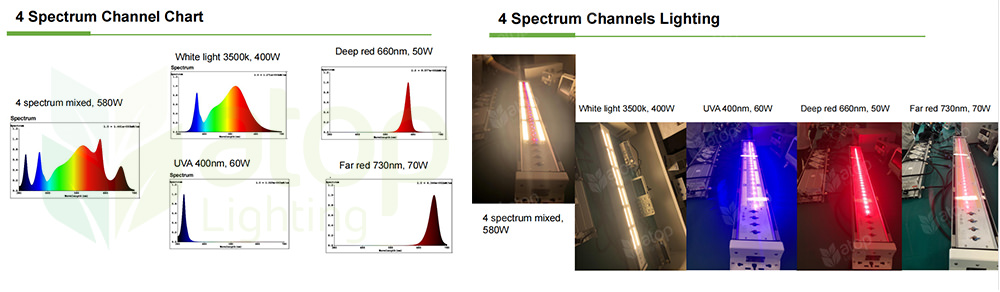
4-channel LED grow lights are typically used in research settings or high-value crop production. They allow growers to build and adjust a more precise light recipe for each growth stage.
In one example, a customer required a 4-channel solution to meet the specific lighting demands of medical cannabis cultivation. The goal was to adjust spectral output across different growth stages, from seedling growth through harvest.
We provide the 4-channel LED grow lights with a configuration of White + deep red + far-red + UVA. The result? Our client was satisfied as it improved crop consistency and increased yield.
How Multi-Channel Control Affects Real-World Performance
Multi-channel control does not increase the total output of a grow light. What it does is change how that output is used. By separating LEDs into independent channels, growers can adjust the spectrum and intensity instead of running the entire fixture at full power all the time.
Spectrum by Growth Stage
Plants do not require the same spectrum throughout their lifecycle. A multi-channel system allows growers to adjust spectral output to match each stage, from seeding growth to flowering and finishing.
Controlled studies show measurable effects when specific wavelengths are applied at the right time. For example, a 2025 study in Plant Physiology and Biochemistry reported that intermittent far-red supplementation in lettuce increased biomass by 11.7% and increased leaf number. [1]
Multi-channel fixtures make it possible to apply these targeted treatments without changing equipment.
Energy Efficiency
Multi-channel systems also improve how efficiently energy is used. Instead of running all LEDs at full output, growers can operate only the channels they need, at the required spectrum and intensity.
This reduces wasted light and lowers energy consumption per unit of yield. For commercial growers, that directly affects operating cost, which is often driven by energy use.
When Multi-Channel Makes Sense, and When It Doesn’t
More channels mean more control. They also mean higher cost and more complexity. Multi-channel is not always better. It depends on the application and the user.
When Multi-Channel Is Worth It
Multi-channel fixtures make sense for medical cannabis operations, high-value crops, research, and trial facilities.
These growers track performance closely. They adjust inputs based on data and are able to apply different light recipes across growth stages. For them, spectral control is a tool, not a feature they ignore. In these cases, the added cost of multi-channel LED grow lights can be justified by improvements in yield, quality, or consistency.
When Single-Channel Is the Smarter Choice
Single-channel fixtures are often the better option for small to mid-scale operations, entry-level commercial growers, and buyers who prioritize simplicity and reliability.
A fixed spectrum, when properly designed, can perform well across the full crop cycle without adjustment. It reduces setup time, limits user error, and keeps costs under control.
Pushing multi-channel fixtures to customers who will not use the extra control creates problems. It adds unnecessary cost and often leads to dissatisfaction.
Let’s Build the Right Fixture for Your Market
We design and manufacture LED grow lights for OEM and ODM projects. That includes fixed-spectrum and multi-channel systems, based on your price point and your customers’ technical requirements.
Share your application, target crop, and market positioning. We will help you build a fixture that fits, without overengineering or unnecessary cost.
Atop, Your Trusted ODM & OEM Partner
Reference:
[1] Liu, Y.; Ye, R.; Gao, X.; Lin, R.; Li, Y. Intermittent Supplementation with Far-Red Light Accelerates Leaf and Bud Development and Increases Yield in Lettuce. Plants 2025, 14, 139. https://doi.org/10.3390/plants14010139