
Peak Intensity Won't Save a Bad Light Distribution Design
Most LED grow lights are marketed using three headline numbers: PPF output, wattage, and efficacy. These figures are easy to compare, but they do not show how a fixture will perform in a real grow.
Some growers look at PPFD next. PPFD measures how much light reaches the canopy at a given point. It is useful, but only a single peak PPFD value does not represent the whole growing area.
What actually determines performance is light distribution. The key question is simple: how evenly are usable photons delivered across the entire canopy?
If the distribution is poor, the fixture creates hot spots and dark zones. In high intensity areas, plants receive more light than they can use. This wastes energy and can lead to light stress. In low intensity areas, plants do not get enough light, which slows growth.
The result is an uneven crop and operational problems for growers.
Why Peak Intensity Is a Misleading Performance Metric
Peak light intensity can look impressive, but it says very little about how a fixture performs in a real grow.
The reason is simple. Crops do not grow at a single point. No grower runs one plant under one fixture in isolation. Real operations use rows, benches, and dense canopies. Light needs to cover the full area and reach below the top layer of leaves to be effective. Peak intensity does not address any of this.
That is why relying on a single high PPFD value is not enough, and why many serious evaluations do not focus on peak numbers alone.
What Bad Light Distribution Looks Like
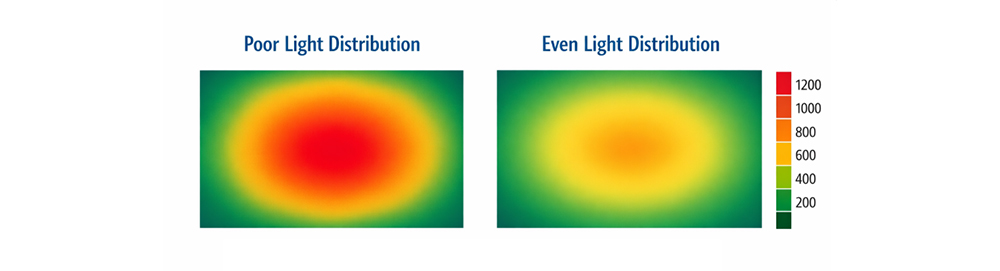
A fixture with poor light distribution creates an uneven footprint. The center becomes a hot spot, while the outer areas fall into low light.
You can see this clearly in a PPFD map. The peak may reach 1200 μmol per square meter per second, but that level is often limited to a small area directly under the fixture. Move to the outer areas, and the intensity can drop sharply.
For the grower, this creates a split environment. Plants under the center receive more light than they can use. They may reach saturation or show signs of stress. Plants just a short distance away do not receive enough light to support proper growth.
Uneven light shows up quickly in plant structure and quality. Here are some common visible symptoms:
- Etiolation: Plants at the edges stretch toward the light source. Stems become long and weak, and they struggle to support the final yield.
- Photo inhibition: In high intensity zones, plants can reduce their photosynthetic activity as a defense response. Growth slows even though energy input is high.
- Loss of crop quality: In high value crops, excess intensity and heat in the center can degrade sensitive compounds such as terpenes and cannabinoids. This reduces both quality and market value.
What Light Distribution Means
Light distribution describes how usable plant light, within the PAR range, is spread across the canopy. The key questions are simple. Where does the light go, and how evenly is it delivered?
It is not only about coverage across a bench or row. It also includes how light moves through the canopy, from the top leaves down to lower flowering or fruiting sites. Good distribution supports the whole plant, not just the surface.
Distribution is evaluated using uniformity ratios. The most common are U1, which compares minimum to maximum, and U2, which compares minimum to average. These ratios show how balanced the light levels are across the target area.
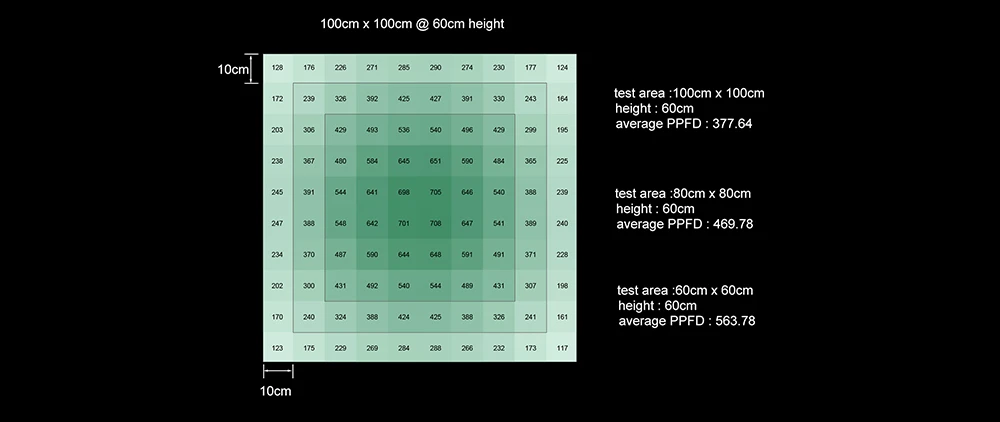
In the horticulture lighting industry, growers look at PPFD maps. These maps show the light level at each point in a grid at a set mounting height. A well-distributed fixture shows consistent values from center to edge, without sharp peaks or steep drop-offs.
Higher uniformity means the crop receives light more evenly.
Factors That Determine Light Distribution
Light distribution is not set by a single component. It is the result of LEDs' design, optics, installation, and the growing environment. Each step affects how photons are delivered to the canopy.
Here are the main factors that control distribution.
LED layout and fixture geometry
The placement of diodes defines how light overlaps before it reaches the crop.
When diodes are packed into the center of a board, the output concentrates in a small area. This creates a strong center intensity and weak edges. When diodes are spread evenly across the fixture, the light blends more smoothly and covers the canopy with better balance.
Fixture shape also matters. A long bar fixture distributes light differently from a square panel, even at the same output. Bar designs tend to improve coverage over rows and benches because they spread the source over a larger area.
Optics and beam angle
Optics control how light leaves each diode.
A narrow beam angle pushes light straight down. This increases intensity under the fixture but reduces coverage. A wider beam angle spreads light over a larger area, which improves uniformity but lowers peak intensity.
Secondary optics, such as lenses or reflectors, can be used to shape the distribution. They can focus light deeper into the canopy or help spread it more evenly.
Mounting height
Mounting height directly affects coverage and uniformity.
Photometric data is always based on a defined distance from the fixture. Change that distance, and the distribution changes with it.
An LED grow light designed for 2.5-meter mounting that gets installed at 1.5 meters will produce a smaller, more intense coverage area with worse edge uniformity.
So that is why following the recommended mounting height is important.
Reflective environment
The grow space itself is part of the distribution system.
Reflective surfaces return stray photons back into the canopy. Materials such as Mylar, Orca film, or even flat white paint can improve coverage, especially at the edges. Dark or absorbent surfaces reduce effective distribution.
In enclosed spaces like grow tents, reflectivity can noticeably improve edge PPFD and overall uniformity.
How Atop Approaches More Even Light Distribution
Considering the factors that affect the light distribution can be annoying for you; that is where we come in. At Atop, we provide lighting simulation, customized lighting solutions, and under-canopy lighting.
Under canopy lighting
Top lighting does not reach every part of the plant. As the canopy becomes dense, lower zones receive less usable light.
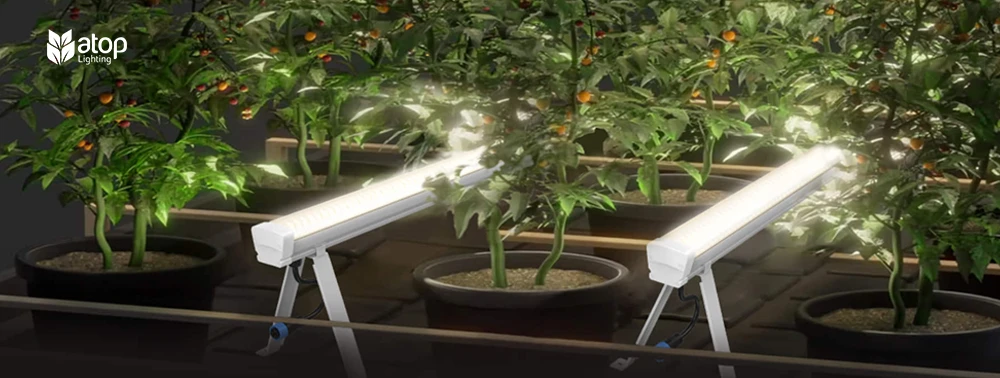
Under canopy lighting addresses this by placing light sources within the plant structure. This delivers light directly to lower leaves and fruiting sites, improving overall light use across the full plant.
It also allows top fixtures to run at levels suited for the upper canopy, without pushing excess intensity to compensate for poor penetration.
We have developed under-canopy lighting solutions. The under-canopy bars use a 120-155 degree beam to support lower canopy development. The inter-canopy bars provide 240-360 degrees of output for uniform coverage from top to bottom, which is effective in vertical and high-density growing systems.
Lighting simulation
Lighting simulation builds a virtual model of the system before anything is installed. It allows us to test layout, fixture count, spacing, and mounting height against real project conditions.
We use AGi32, an industry-standard lighting simulation tool. We input the actual project parameters, including grow area dimensions, target light levels, and system power. From there, we model the fixture layout and review the PPFD distribution and uniformity across the canopy.
Our optical team can complete a simulation within 12 hours once we have the project details.
At Atop, we ask questions before any projects.
We start with the right questions before any design work begins.
- What is the mounting height range
- What crop type and canopy density are we working with
- What level of uniformity is required
- How will the fixtures be spaced in a real installation
These are basic questions, but they define how a fixture will perform after it leaves the factory.
Customized lighting solutions
A general-purpose fixture delivers general results. If the application is specific, the design should be specific as well.
We adjust spectrum design, optics, fixture geometry, and coverage targets based on the actual use case. This applies to different crops, greenhouse structures, and mounting conditions.
For companies entering a new crop category or market segment, this approach reduces risk.
If you are developing a new grow light product or reconsidering your current manufacturing partnership, we are happy to start with your product brief.