
Most LED Grow Lights Fail From Bad Thermal Management. Here's How We Test Ours
When people talk about thermal management in LED grow lights, the first thing that comes to mind is the heat sink
That’s what most manufacturers promote. But for commercial horticulture lighting, a heat sink alone doesn’t prove anything.
In real use, greenhouses and vertical farms, fixtures run 12–18 hours a day, cycle on and off, and operate in warm, humid conditions. That environment creates constant thermal stress, which directly impacts lifespan.
So thermal management isn’t about whether a fixture has a heat sink. What matters is whether the fixture can maintain stable temperatures over time, and how that performance is verified.
The real question isn’t “Does it have a heat sink?” It’s “How was it tested, and did it pass under realistic conditions?”
How Poor Thermal Management Causes LED Grow Light Failure
Thermal failure in LED grow lights is straightforward physics.
Under the Arrhenius Law, every 10°C increase in junction temperature roughly doubles the rate of material degradation. Higher junction temperature means faster lumen loss, accelerated driver stress, and a shorter service life, and the degradation compounds it does not accumulate gradually.
The heat load is significant from the start. Only 40–50% of input power becomes usable plant light. The remaining 50–60% becomes heat, generated directly at the LED junction and inside the driver.
Grow rooms make this harder to manage. Ambient temperatures sit at 30–40°C with limited airflow and high humidity. Lights cycle ON and OFF daily. Each cycle involves a thermal expansion and contraction event across every solder joint, interface, and component in the fixture. Repeated hundreds of times per year, that mechanical stress is as damaging as the heat itself.
This is not a component problem. It is a system problem, and it has to be tested that way.
Thermal Management Is More Than Just a Heat Sink
Most buyers evaluate thermal management by looking at the heatsink. Its size, its fin density, its aluminum grade. That is understandable as it is the most visible part of the system.
It is also the wrong place to start.
A heat sink only dissipates heat that actually reaches it. Before that happens, heat must travel through the solder joint, into the MCPCB, across the thermal interface material, and every one of those layers has its own thermal resistance. A bottleneck at any point raises junction temperature regardless of heatsink size.
Driver placement matters too. A driver mounted directly against the LED array absorbs heat from the fixture while generating its own, a combination that degrades capacitors and shortens driver life significantly. Remote driver placement is a thermal decision, not a mechanical one.
Effective thermal management means every layer of that stack, from junction to ambient, all is engineered and verified to work together. The only way to confirm that is through structured testing under real-world conditions.
The Industry Standards Behind Thermal Testing
There are established standards to check whether a grow light is safe and how it performs thermally. But they don’t all test the same thing, and that distinction matters.
The three most relevant are IEC/EN 60598-1, IES LM-80 / IES TM-21, and IEC/EN 60068-2-14.
IEC/EN 60598-1
This is the baseline safety standard for luminaires. Its thermal test checks that component temperatures stay within safe limits during normal operation, mainly to prevent fire risk or immediate damage.
What it doesn’t do is evaluate long-term reliability. It won’t tell you how solder joints, thermal interfaces, or drivers hold up over time.
IES LM-80 and TM-21
These focus on lumen maintenance and lifetime projection. Testing is done under steady-state conditions, continuous operation at a fixed case temperature for at least 6,000 hours.
They’re useful for understanding LED degradation and are required for DLC qualification. But they don’t simulate real operating conditions like on/off cycling or fluctuating temperatures.
IEC/EN 60068-2-14
This is where thermal reliability testing becomes realistic. It defines how products are exposed to repeated high–low temperature cycles, including ramp rates, dwell times, and cycle counts.
This type of testing exposes fatigue failures, like solder cracking, material expansion, and interface breakdown, that steady-state tests miss. It’s much closer to what actually happens in a grow room.
How Atop Tests the Thermal Performance of LED Grow Lights
As an OEM/ODM partner in horticulture lighting, Atop runs thermal testing in our in-house TÜV SÜD–recognized lab. Every fixture goes through a defined test sequence before release.
We combine temperature testing under IEC/EN 60598-1 with IEC/EN 60068-2-14 to evaluate both performance and reliability.
Temperature Rise Test — IEC/EN 60598-1 Clause 12.4
This test establishes steady-state thermal performance.
We measure 18 points simultaneously, including driver Tc, driver case, LED case temperatures across multiple positions, PCB, housing, and ambient.
Testing is conducted at both 25°C and 40°C ambient temperatures. The 40°C condition reflects real operating environments in commercial grow rooms.
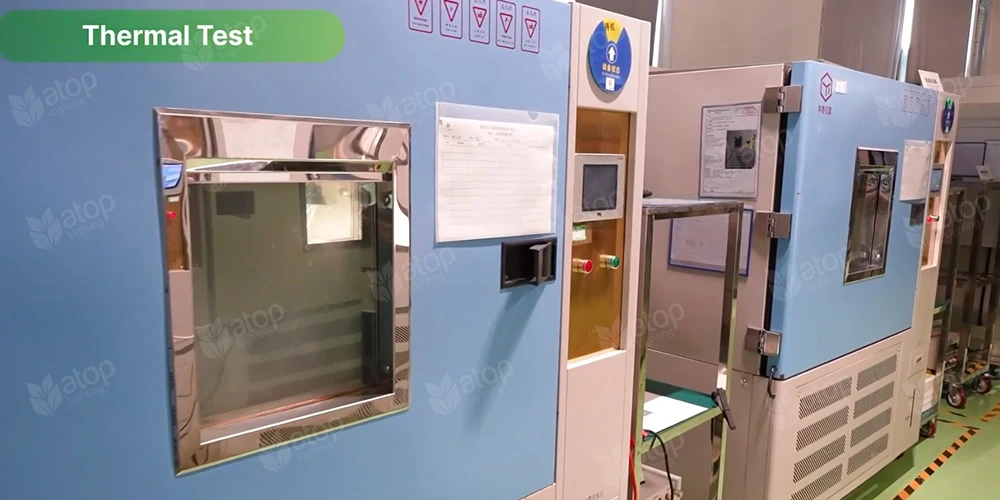
Operational Thermal Cycling Test — IEC/EN 60068-2-14
This test evaluates reliability under repeated thermal stress.
The powered fixture is placed in an environmental chamber and cycled between 0°C and 50°C. Each extreme is held for 3 hours. At the end of each dwell, the fixture is switched ON and OFF to verify proper operation under stress.
After 4 full cycles, the fixture is inspected for mechanical and functional issues, including deformation, material degradation, and startup failure.
Material Storage Cycling Test — IEC/EN 60068-2-14
This test targets material durability during transport and storage.
The unpowered fixture is cycled between −40°C and +70°C, with 3-hour dwell times across 4 cycles.
This is a more demanding temperature range, a 110°C swing, and it targets material failures that only appear when plastics, adhesives, solder joints, and encapsulants are stressed at the boundaries of their specification.
For OEM and private-label partners, your brand reputation is on the line with every shipment. We treat that responsibility seriously. The tests are the validation behind the product.
If you need full test reports for evaluation, contact us.
Atop Lighting, Your Trusted ODM and OEM Partner.