
Why Thermal Management Defines LED Grow Light Performance
Heat is a quiet but critical factor that determines whether an LED grow light performs as rated or gradually loses performance over time. Even with today’s highly efficient LED diodes, a significant portion of the electrical power supplied to the LEDs is still converted into heat at the LED junction.
If this heat is not effectively transferred away from the semiconductor package and into the surrounding environment, it can lead to several problems: faster lumen depreciation, shifts in the light spectrum, reduced efficiency, and a shorter lifespan for the components.
This is why thermal management is so important in LED grow light design. Effective heat management determines how hard a fixture can safely be driven, how long it can maintain its light output, and how consistently it performs under different environmental conditions.
What Heat Really Is in an LED Grow Light
Every watt that enters an LED grow light has only two possible destinations: it becomes photons, or it becomes heat. In an LED grow light, about 40-50% of input energy is converted into photosynthetically useful photons. The remaining 50%-60% is released as heat. This is not radiant heat; it is conductive heat. Most of it is concentrated at the LED junction.
The junction is where the p-type and n-type semiconductor layers meet inside each diode. It's the smallest, most thermally sensitive part of the entire fixture, and it's where temperature has the greatest consequences. Engineers track this as Tj — junction temperature.
Why does Tj matter so much? Because LED performance degrades non-linearly with heat. For every 10°C rise in junction temperature above the rated threshold, LED lifespan can drop by as much as 50%. Photon output falls.
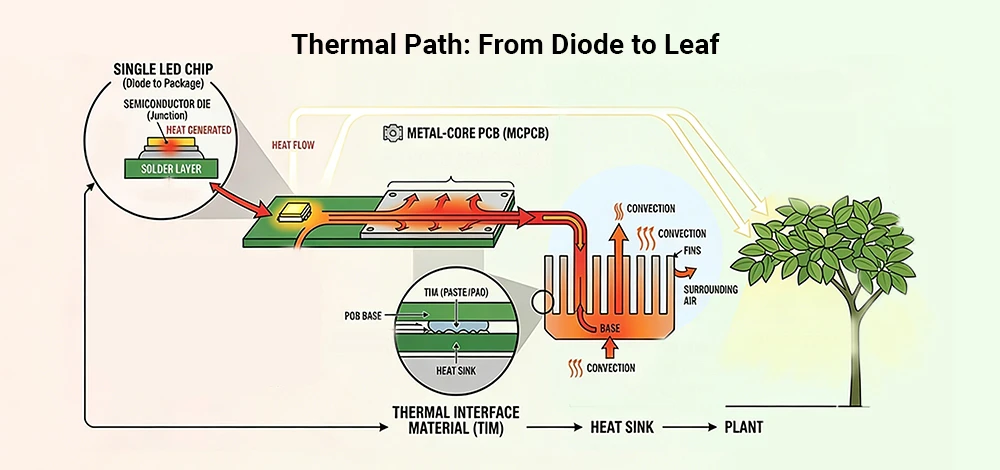
The Full Thermal Path: From Diode to Leaf
This pathway begins at the LED junction, where the unused portion of electrical energy is converted into heat. From there, the goal of thermal management is simple: move the heat away from the junction as quickly and predictably as possible.
Heat first moves through the LED’s internal structure, including the semiconductor die, solder layers, and substrate, until it reaches the base of the LED package.
From the package, heat transfers into the printed circuit board (PCB). The PCB material plays a major role in how efficiently heat spreads. Standard FR4 boards used in many electronic devices have a thermal conductivity of about 0.3 W/m·K, which is too low for high-power LEDs.
To address this, most professional LED grow lights use metal-core PCBs (MCPCBs), typically aluminum-based, with thermal conductivity in the range of 1 to 4 W/m·K. In more advanced designs, copper-core boards can provide much higher conductivity, allowing heat to spread more effectively.
From the PCB, heat must pass through a thermal interface material (TIM) before reaching the heat sink. Surfaces that appear smooth actually contain microscopic irregularities that trap air, and air is a poor conductor of heat.
Thermal interface materials, usually a high-grade paste or pad, fill these microscopic gaps and allow heat to transfer efficiently between the PCB and the heat sink.
The heat sink is where thermal energy finally moves from conduction into convection, transferring heat from the solid metal into the surrounding air. Its effectiveness depends on several factors, including fin design, material quality, surface area, and airflow around the fixture.
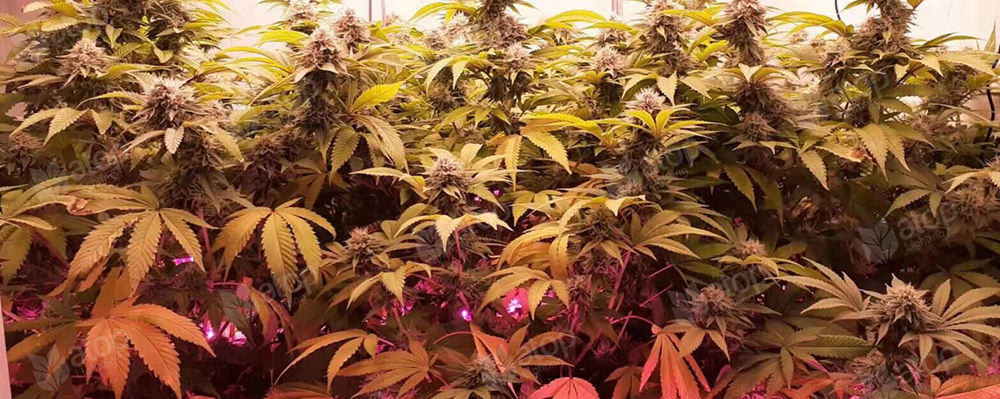
Finally, the thermal path reaches the plant environment. While the fixture manages its internal heat, the emitted light energy is still absorbed by the plant canopy. Because of this, controlling leaf temperature remains critical, since plant physiology is highly sensitive to temperature changes.
How Thermal Management Defines LED Grow Light Performance
Heat generated inside an LED fixture follows a thermal pathway that starts at the LED junction and moves through the package, PCB, thermal interface material (TIM), and heat sink, before finally dissipating into the surrounding air.
Effective thermal management keeps the LED junction temperature under control, allowing the fixture to maintain its performance over time. The internal heat management also influences the growing environment, because the light energy emitted by the fixture interacts directly with the plant canopy.
Lumen Depreciation
As the junction temperature increases, the LED produces fewer photons. This gradual reduction in light output is known as lumen depreciation.
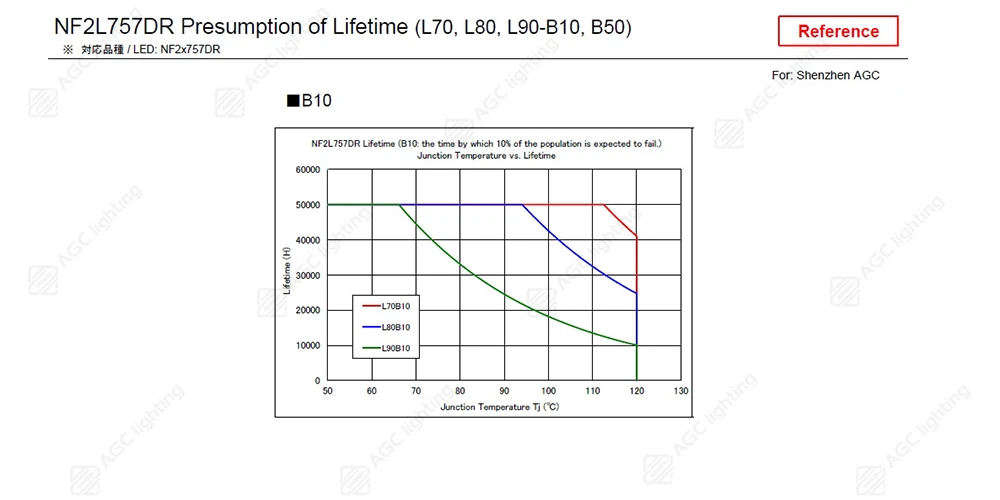
All LED fixtures experience lumen depreciation, but the rate of decline is strongly influenced by thermal management. When heat is removed efficiently, LEDs operate at lower junction temperatures and maintain their light output for much longer.
The industry commonly measures lifetime using the L70 rating, which represents the number of operating hours until the fixture reaches 70% of its initial light output. Higher-performance fixtures may achieve L80 or even L90 ratings, meaning the LEDs retain 80% or 90% of their original light output over the specified lifetime.
Spectral Drift
As the temperature at the LED junction increases, the emitted light can shift slightly toward longer wavelengths. This effect is known as spectral drift.
In many lighting applications, this shift is small and often unnoticed. However, in CEA, precise light control is critical because plant development responds strongly to specific wavelengths.
This is especially important for deep red and far-red light, which influences plant processes such as flowering, stem elongation, and canopy structure.
When junction temperature rises, even a 10°C increase can shift the peak wavelength by about 1–2 nm. While this may seem minor, it can move the light output away from the 660 nm absorption peak that plays a key role in phytochrome Pfr conversion, the photoreceptor system plants use to regulate growth and flowering.
For light-sensitive crops such as cannabis, lettuce, and tomatoes, these small spectral changes can lead to measurable differences in flowering timing, plant morphology, and marketable yield.
Cooling Strategies in Horticultural Lighting
As we have seen, heat travels along a thermal path from the LED junction through the package, PCB, thermal interface material, and heat sink. If this heat is not effectively removed, it can increase junction temperature and lead to lumen depreciation, spectral drift, and reduced fixture lifetime.
Once heat reaches the outer structure of the fixture, it must be dissipated into the surrounding environment. In horticultural lighting, there are two main cooling approaches: passive cooling and active cooling.
Passive Cooling
Passive cooling relies entirely on natural convection and radiation to remove heat, without using any moving parts. This method depends heavily on the thermal design of the fixture, especially the heat sink.
Heat sink fins release thermal energy into the surrounding air through natural airflow. The design of these heat sinks is critical. Larger surface areas, optimized fin spacing, and vertical airflow channels can significantly improve heat dissipation.

Active Cooling
Active cooling uses mechanical systems to increase heat removal. These systems generally fall into two categories: air-based cooling and liquid cooling.
Air-based active cooling uses fans or blowers to force air across the heat sink, increasing the rate of convective heat transfer. Under controlled conditions, this approach can remove heat very effectively.
However, in commercial greenhouses or vertical farms, active air cooling introduces additional risks. High humidity, airborne particles from growing media, and continuous long operating cycles can accelerate bearing wear and motor degradation. If a fan fails, cooling performance drops quickly.
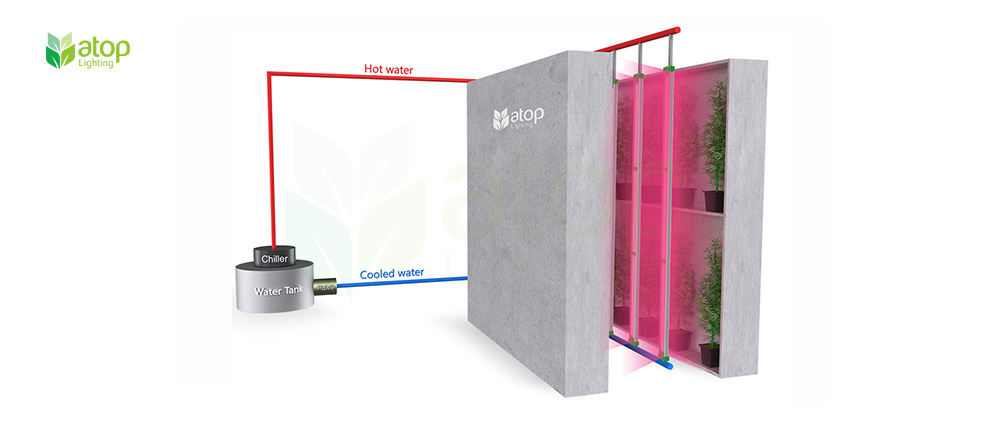
Liquid cooling removes heat by circulating a coolant through cold plates mounted directly to the LED modules.
Water has a much higher heat capacity than air, allowing it to absorb and transport significantly more heat. This makes liquid cooling particularly useful in high-power or high-density lighting systems, such as vertical farming installations where fixture spacing is tight, ambient temperatures are elevated, and heat loads per square meter are high.
Here is a table for the comparison with passive and active (air-based and liquid-based) cooling methods:
|
|
Passive |
Active: Air-Based |
Active: Liquid-Based |
|
Thermal capacity |
Medium |
High |
Highest |
|
Moving parts |
None |
Fans/blowers |
Pump + coolant circuit |
|
Humidity tolerance |
Excellent |
Poor |
Good (sealed system) |
|
Best application |
Greenhouse, vertical farm, general CEA |
Controlled indoor, low humidity |
Ultra-dense vertical farm |
Atop Lighting works with ODM and OEM partners at every stage of product development. Our support covers thermal architecture design, heat sink optimization, full fixture qualification, and customized liquid-cooling solutions when required.
Contact our team to learn more.