PPA, PCT, EMC, or Ceramic? LED Substrate Selection in Horticultural Lighting
LED package substrates determine how well a grow light survives heat, humidity, and agricultural chemicals.
There’s no single best package material for grow lights, but there is the right one for your sales channel, your target prices, and the environment the fixture will live in.
Ceramic-based packages handle the most heat and stay stable the longest, and they cost the most. PPA is the cheapest and works well for lower-power fixtures. PCT and EMC sit in the middle, while EMC covers most products.
What Does an LED Substrate Do in a Grow Light?
An LED substrate serves two distinct mechanical and thermal functions depending on the manufacturing level: it acts as the crystalline base for the semiconductor die (chip level) and as the carrier package that routes electrical current and draws heat away from the diode (package level).
In controlled environment agriculture, this component faces operating conditions like the continuous high ambient humidity levels (60%-85%), airborne agricultural chemicals, extended daily operations (12-20 hours), and high package operating temperatures.
When an LED package degrades under these stresses, the reflective cavity discolors, thermal resistance increases, and the silver plating corrodes. The result is rapid photon flux depreciation long before the driver or housing fails.
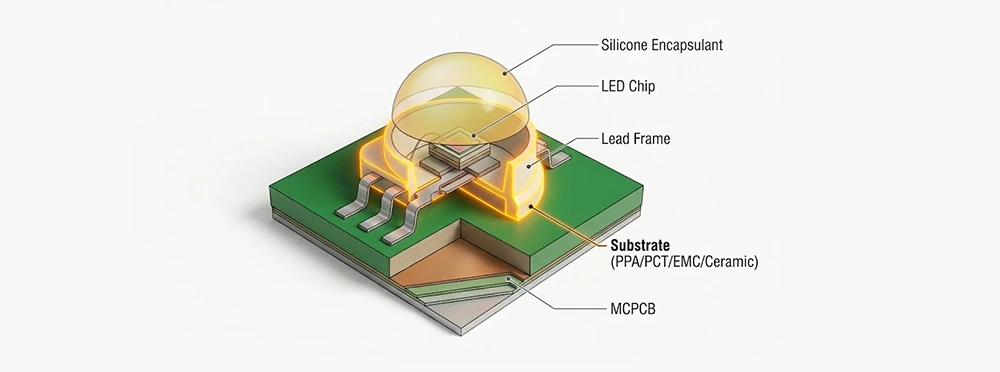
Four Primary Substrate Materials, and Where Each One Fits
|
Substrate Material |
Material Class |
Thermal Conductivity (W/m·K)
|
Max Operating Junction Temp (Tj)
|
Sulfur & Chemical Permeability |
Application |
|
PPA |
Polyphthalamide (Thermoplastic) |
~0.5 to 1.5 |
~100°C |
High (Porous bond line) |
Desktop seed starters, retail consumer bars |
|
PCT |
Polycyclohexylenedimethylene Terephthalate (Thermoplastic) |
~1.5 to 2.0 |
~115°C |
Moderate |
Vertical farm light bars, leafy green racks, mid-tier commercial |
|
EMC |
Epoxy Molding Compound (Thermoset) |
~2.5 to 4.0 |
~150°C |
Low (Hermetic resin matrix) |
High-output commercial top lighting, greenhouse supplemental white arrays |
|
Ceramic |
Aluminum Oxide (Al2O3) / Aluminum Nitride (AlN)
|
20 to 30 (Al2O3)
170 to 200 (AlN)
|
>175°C |
Zero (Impermeable inorganic) |
660nm deep red, 730nm far red, UV-A/B channels, compact high-bay COB |
PPA (Polyphthalamide)
PPA is a melt-processable thermoplastic resin. It dominated early SMD packages due to its rapid injection-molding cycle times and low raw-material cost.
However, PPA degrades rapidly under direct blue light (450 nm) and elevated temperatures. The polymer chains oxidize, turning the reflective white cup yellow or light brown. Once the cup yellows, photon absorption increases, generating localized heat and accelerating photon output loss.
In commercial horticulture, PPA is unsuitable for primary production fixtures. Its use is restricted to low-cost consumer retail kits where fixtures run for limited seasons.
PCT (Polycyclohexylenedimethylene Terephthalate)
PCT is a modified thermoplastic polyester that offers higher heat and UV stability compared to PPA. It tolerates continuous junction temperatures up to 110°C to 115°C without immediate discoloration.
PCT represents a practical balance between cost and performance.
A mid-power package built on a PCT carrier costs roughly half of an equivalent EMC package. While its molecular matrix is more permeable to gaseous contaminants than thermoset resin, it performs reliably in controlled, low-chemical indoor farms when operated at moderate drive currents.
EMC (Epoxy Molding Compound)
EMC is a thermosetting epoxy filled with fused silica particles. Unlike thermoplastics that melt when heated, thermoset materials undergo chemical cross-linking during transfer molding. Once cured, EMC will not melt or deform even at temperatures exceeding 150°C.
EMC packages exhibit strong chemical resistance, low moisture absorption, and thermal expansion properties that match copper lead frames. This minimizes internal mechanical stress during thermal cycling. For white full-spectrum LEDs (such as standard 3030 and 2835 formats), EMC is the standard choice for professional greenhouse fixtures.
Ceramic (Al2O3 and AlN)
Ceramic substrates are inorganic plates produced via Direct Plated Copper (DPC) or Direct Bonded Copper (DBC) processes.
Because ceramics contain no organic binders or polymers, they are immune to photo-oxidation, blue-light degradation, and ultraviolet yellowing.
Alumina provides thermal conductivity an order of magnitude higher than plastics (24 W/(m·K)), while aluminum nitride reaches up to 200 W/(m·K).
For high-power grow lights, UV-A/Far-Red chips, vertical farms, and hot environments where the ambient temperature is already pushing the limits, ceramic is the optimal choice.
Matching LED Substrates to Your Product Line and Target Market
The selection comes down to matching your fixture's bill of materials to where your customers actually grow, what they spray, and the price point your sales channel demands.
To build competitive, reliable fixture portfolios, you can structure substrate selection into three practical production tiers.
Tier 1: Commercial CEA Flagship
Maximum reliability and low-risk warranties are the key for this tier, so it is recommended to use EMC white LEDs (LM301H class) + High-power ceramic 3535 deep reds (660nm).
EMC packages use a cross-linked thermoset resin that forms a tight, gas-resistant seal against the metal lead frame. This prevents airborne sulfur from creeping in and turning the internal silver reflector black. Meanwhile, high-power 660nm red chips generate intense localized heat; mounting them on ceramic submounts ensures low thermal resistance so your red spectrum does not fade prematurely over years of heavy cycling.
This is best for 600W to 1000W+ greenhouse top lights, licensed commercial cannabis facilities, and projects requiring a long warranty under harsh conditions.
Tier 2: Commercial Value Line
The high-volume margin builder is critical in this tier. The combination of high-grade PCT 2835 white LEDs (under-driven) + Ceramic 3535 deep reds fits this tier well.
Utilizing high-grade PCT for the high-volume white diodes, we cut the LED package cost. However, it never compromises on the deep red diodes; those stay on ceramic 3535 packages to safeguard against thermal drop-off.
This is best for multi-tier vertical racks, indoor leafy green and herb farms, inter-canopy lighting, and commercial brands competing aggressively on upfront price.
Tier 3: Distribution & Consumer Entry
Fast inventory turnover is the main goal for the distribution and consumer entry tier. So this tier uses standard PCT 2835 white LEDs + PCT 2835 red diodes.
Using an all-PCT layout keeps production costs at absolute rock bottom. Because fixture wattages and daily run-hours are lower in this segment, our thermal management design keeps diode operating temperatures well within the safe zone for quality thermoplastics.
It is the best for amazon private labels, retail grow shop brands, home hobbyist tents, and low-wattage propagation bars (<100W)
Need to balance target costs with verified field longevity for your next grow light line?
Consult us to review custom LED package configurations, spectral ratios, and board-level protection options for your OEM/ODM programs.