
Designing LED Lighting for Land-Based Seaweed Cultivation
Land-based seaweed farming is moving beyond small-scale trials. More operators are shifting production into tanks, raceways, and closed recirculating systems because open-water sites are limited, weather is less predictable, and customers increasingly expect consistent quality and year-round supply. Once seaweed is grown indoors, sunlight is no longer free. Light becomes a controllable production input that must be designed, measured, and managed.
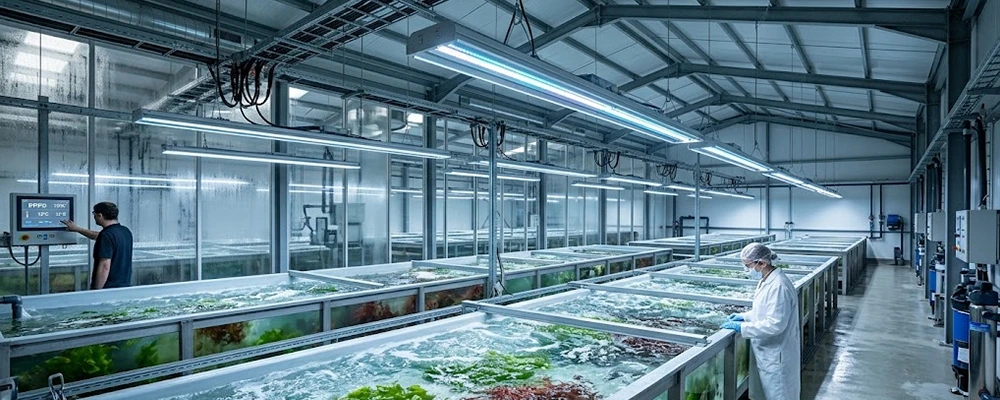
Seaweed is also not simply another crop under a conventional grow light. Designing a lighting system for land-based aquaculture requires engineers to account for light attenuation through the water column, biomass density, water turbidity, species-specific pigment absorption, and the humid, corrosive operating environment. The fixture must deliver enough usable light throughout the culture volume, not just at the water surface.
Why Light Becomes the Limiting Factor Indoors
In outdoor or near-shore systems, sunlight provides a large and relatively uniform source of photosynthetically active radiation. In tanks, raceways, and recirculating systems, light availability changes quickly with water depth, biomass concentration, and turbidity.
A fixture can produce high irradiance at the water surface while the lower part of the culture receives much less usable light. As seaweed density increases, self-shading adds another layer of attenuation. The result is a common indoor cultivation problem: the system may appear well lit from above, while a large portion of the biomass is receiving insufficient light for efficient photosynthesis.
This is also where one of the most common lighting design mistakes occurs: treating seaweed like a terrestrial plant.
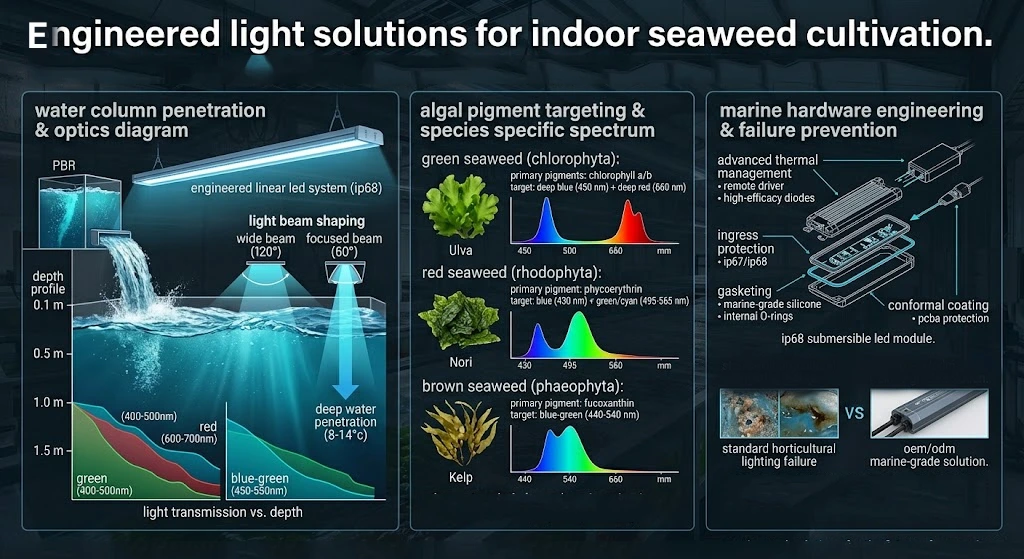
Terrestrial horticulture often relies heavily on red and blue wavelengths because these wavelengths are strongly absorbed by chlorophyll and are effective for many land-based crops. However, underwater light behaves differently. Water absorbs longer wavelengths more strongly than shorter wavelengths, while suspended particles and dissolved organic matter can further change the spectral distribution and reduce total light penetration.
As a result, a spectrum that performs well above a dry plant canopy does not automatically perform well throughout a seaweed culture volume.
Spectrum: What Actually Performs
Chlorophyll remains central to photosynthesis, so blue and red wavelengths matter. However, seaweeds also contain different accessory pigments depending on the species.
- Green seaweeds rely mainly on chlorophyll a and b and have spectral characteristics that are relatively similar to terrestrial plants.
- Red seaweeds use phycobiliproteins such as phycoerythrin, which allow them to use green and other wavelengths more effectively.
- Brown seaweeds contain fucoxanthin, which broadens their usable light range and contributes to their characteristic response to blue and green light.
In practice, pure monochromatic light is rarely the best choice for overall biomass production. Broad or multi-peak spectra, including white light with adequate blue and red output, can provide more consistent results across different seaweed species and cultivation conditions. Pure red light can be less effective, particularly in deeper or denser cultures where red wavelengths are attenuated more quickly by the water column. Green light should not be treated as wasted energy. For species with accessory pigments that absorb green wavelengths, it can contribute to photosynthesis.
A blue-to-red ratio around 1:2 can be used as an initial engineering reference, with some green contribution where appropriate. It is not a universal target. The optimum spectrum depends on species, culture depth, biomass density, water quality, and the production objective. A system optimized for maximum biomass may require a different spectrum from one designed to increase a specific pigment, protein, or other target compound.
This is where fixed-spectrum fixtures can become restrictive. If an operation grows multiple species or changes its production targets, a spectrum that works well for one process may not be ideal for another. Dynamic LED systems allow operators to adjust spectral output without replacing the fixture, making them more practical for flexible production environments.
Water also changes the spectrum that reaches the biomass. Longer wavelengths, particularly red, are attenuated more rapidly, while blue and some green wavelengths can penetrate farther into the culture. As water depth, turbidity, or biomass concentration increases, the difference becomes more important. The spectrum should therefore be evaluated at the location of the seaweed, not only at the fixture or water surface.
Intensity and Photoperiod Are Not Secondary
Many controlled macroalgae cultivation studies operate within an approximate range of 50 to 150 µmol m⁻² s⁻¹ at the biomass, although the appropriate level varies widely by species and growth stage. Too little light can limit photosynthesis and biomass production. Excessive irradiance can cause photoinhibition or unnecessary energy consumption, particularly in species adapted to lower-light environments.
Surface irradiance alone does not tell you whether the culture is receiving enough light. The relevant measurement is the PPFD reaching the biomass. In deeper or denser cultures, light can decrease substantially between the surface and the lower portions of the culture. Measurements should therefore be taken at representative biomass locations and under actual operating conditions, including the water depth and typical culture density.
A 12-hour light and 12-hour dark cycle is a practical starting point for many species. However, photoperiod should be treated as a process variable rather than a fixed rule. Some green seaweeds can perform well under longer photoperiods, while certain red and brown species may respond better to more moderate light exposure. Extending the photoperiod indefinitely does not necessarily increase productivity. It increases energy consumption and may create additional process or biological challenges without producing a proportional increase in biomass.
The more useful metric is the daily light integral, or DLI. DLI combines light intensity and photoperiod to describe the total amount of photosynthetically active light delivered over a 24-hour period.
For example, increasing PPFD from 100 to 150 µmol m⁻² s⁻¹ is not the only way to increase daily light exposure. Extending the photoperiod can also increase DLI. The correct balance depends on how the species responds to light and how much light the culture can use efficiently.
For commercial systems, consistent light delivery is generally more useful than short periods of very high intensity followed by long dark periods. The objective is to provide the biomass with an appropriate and repeatable light dose while avoiding unnecessary electrical consumption.
Lighting Needs Shift Through the Growth Cycle
Lighting requirements can change as seaweed moves through different stages of its production cycle.
Gametophytes, spores, and early-stage cultures may require lower irradiance and tighter control of the spectral balance. Blue light can also influence development and maturation in some species, so simply increasing intensity to accelerate growth is not always the correct approach.
During vegetative growth, the priority typically shifts toward stable biomass production. A balanced multi-peak spectrum and consistent PPFD can provide a more practical operating condition than aggressive spectral or intensity changes.
As cultures approach reproduction or another target developmental stage, lighting may need to be adjusted again. Depending on the species and production objective, reducing irradiance or changing the spectral balance can help manage stress and developmental timing. These responses are species-specific, so lighting recipes should be validated through controlled trials rather than applied as universal rules.
For commercial cultivation, the lighting system should be capable of following the biology of the process. If intensity and spectrum cannot be adjusted as the culture develops, operators are forced to use a compromise setting across every stage.
Programmable LED control provides a more practical solution. Operators can establish different lighting recipes for inoculation, early growth, biomass production, and conditioning, then repeat those recipes from batch to batch. In a multi-stage production system, this is less about adding features and more about maintaining process control.
Surviving the Indoor Marine Environment
Land-based seaweed systems expose lighting equipment to conditions that are harder on electronics than a typical horticultural environment. Salt, high humidity, water splash, condensation, and, in some installations, temporary immersion can accelerate corrosion and cause electrical failures.
Corrosion often begins at connectors, fasteners, cable entries, and other points where moisture and salt can penetrate. Poorly protected drivers can also become a failure point. At the same time, salt deposits, biofilm, and other buildup on the optical surface can reduce light output and change the distribution of light reaching the culture.
For this reason, mechanical and environmental protection needs to be considered alongside optical performance. Material selection, ingress protection, sealing, cable management, connector design, and access for cleaning all affect long-term system reliability.
An IP rating is useful, but it should not be treated as the entire environmental specification. The actual installation conditions matter. A fixture exposed to continuous salt spray, condensation, cleaning chemicals, and frequent washdown may require a different construction from one mounted above a relatively protected tank.
Electrical safety is also critical in a wet, conductive environment. Proper isolation, grounding, protection devices, cable routing, and installation practices need to be defined as part of the lighting system design. These requirements can influence fixture dimensions, mounting position, connector placement, and service access just as much as the optical design.
Heat Management in Cold Water Culture
Many commercially valuable seaweed species are cultivated in relatively cool water. In these systems, the lighting system cannot be designed independently from the thermal management strategy.
LEDs are more energy efficient than many older lamp technologies and convert a larger share of electrical input into useful light. However, the remaining electrical energy still becomes heat. The LED package, circuit board, driver, and other electronics all require a thermal path to the surrounding environment.
If too much heat is transferred into the culture water, water temperature can rise and increase the load on the cooling system. For species with narrow temperature requirements, this can directly affect growth and culture stability.
One practical approach is to separate the driver from the fixture and place it outside the humid or wet zone where possible. Proper thermal management at the LED board, adequate heat-sinking, and careful fixture positioning can further reduce unnecessary heat transfer into the culture.
Fixture placement also matters. A high-output light mounted directly over a shallow tank can transfer heat to the water differently from a fixture mounted farther away or outside the water. The thermal impact should therefore be evaluated as part of the complete system, including the lighting load, water volume, ambient conditions, and cooling capacity.
In cold-water cultivation, the goal is not simply to maximize LED efficiency. It is to deliver the required light to the biomass while keeping the lighting system from working against the temperature conditions required by the culture.
Designing the LED System Around the Culture
A reliable land-based seaweed lighting system requires more than selecting LEDs with the right nominal wavelength. The design needs to connect the biology of the species with the optical, electrical, mechanical, and thermal requirements of the installation.
That includes selecting appropriate LED wavelengths and binning, determining optical distribution through the water column, designing the PCB and fixture layout for uniform coverage, managing heat, protecting electronics from salt and moisture, and providing control over intensity and spectrum when the production process requires it.
For operators planning a land-based aquaculture facility or developing a proprietary photobioreactor system, these requirements should be defined before the fixture is finalized. A custom lighting design can then be built around the actual culture depth, species, biomass density, water conditions, mounting geometry, operating temperature, and production targets.
If you are developing a land-based aquaculture facility or proprietary PBR system, contact our team to review your technical requirements and evaluate a custom LED solution.