
Cannabis Grow Room Lighting Requirements for GMP Compliance
For cultivators targeting pharmaceutical-grade, export-ready, or premium markets, GMP (Good Manufacturing Practice) compliance is now a baseline requirement across many regulated cannabis supply chains.
Lighting is often not the first item on a GMP checklist. Lighting requirements sit primarily under GACP (Good Agricultural and Collection Practices) during cultivation. Even so, what happens at this stage directly impacts downstream GMP performance. It plays a direct role in product consistency, documentation integrity, and batch-to-batch repeatability.
In cannabis cultivation, lighting directly influences plant morphology, cannabinoid synthesis, terpene expression, and overall crop uniformity. When lighting is inconsistent or poorly controlled, chemical profiles become harder to stabilize, and batch variability increases.
In this blog, we will explore the lighting requirements for a GMP-aligned cannabis grow room and the key parameters to support compliant, reproducible production.
Why Lighting Is a Critical Process Parameter Under GMP
GMP sets the rules for producing medicines in a way that ensures consistent quality, safety, and repeatability.
In pharmaceutical cannabis production, GMP does not start at extraction or packaging. It starts earlier, in cultivation, through GACP. GACP defines how the plant is grown and handled before it becomes a pharmaceutical input.
The key difference is how the crop is viewed. Under GACP and GMP-aligned systems, cannabis is not treated as a general agricultural product. It is treated as the starting material for an Active Pharmaceutical Ingredient (API). Once that shift happens, the cultivation environment becomes part of a controlled production process, not just a grow operation.
Equipment inside the grow room is treated as part of a controlled production environment that must support reproducible, documented output.
Because of this, lighting systems are not considered auxiliary equipment. In GMP-aligned facilities, they are treated as production equipment that directly influences product quality.
Common Regulatory Expectations Relevant to Lighting
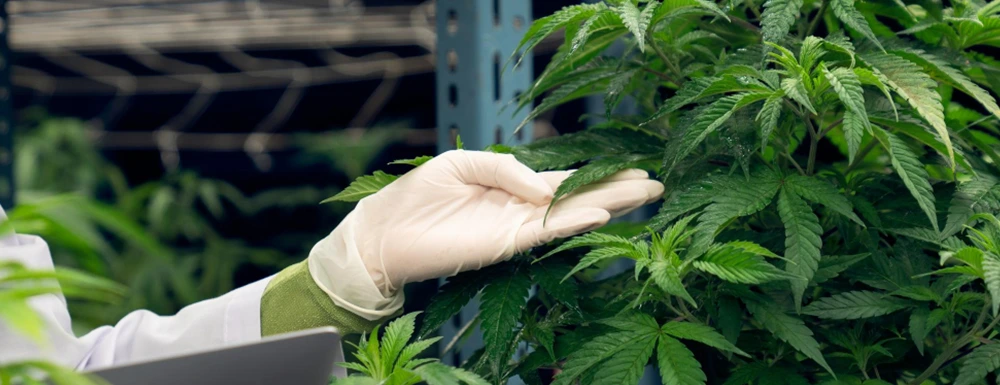
When auditors from authorities or guideline bodies such as the EMA, WHO GACP, or PIC/S Annex 7 review a cultivation facility, lighting is assessed as part of the controlled production environment. The focus is not on horticultural performance alone, but on whether the equipment supports pharmaceutical-grade hygiene, consistency, and traceability.
Across these frameworks, the expectations for lighting systems are generally consistent:
- Cleanability and hygienic design: Fixtures must be designed so they can be cleaned and disinfected effectively.
- Material compatibility and chemical resistance: Construction materials should be non-toxic, corrosion-resistant, and able to withstand routine exposure to cleaning agents used in controlled environments.
- Support for controlled and repeatable growing conditions: Lighting systems must help maintain stable environmental conditions.
- Physical safety and contamination prevention: Fixtures must be designed to reduce the risk of physical contamination.
Key Lighting Requirements for GMP-Compliant Cannabis Grow Rooms
From a regulatory standpoint, lighting systems must do three things well: reduce contamination risk, deliver consistent and repeatable growing conditions, and support cleaning and validation procedures.
That means GMP-aligned LED horticulture lighting system is about design for hygiene, stability, and control.
Hygienic Design for Cleaning and Sanitization
LED grow lights must be designed for repeated cleaning cycles without degradation, residue buildup, or structural failure.
Smooth, sealed surfaces
All external surfaces should support routine wipe-down using standard disinfectants.
Non-toxic materials
Construction materials should be non-toxic and should not migrate into the product.
Ingress protection
Minimum IP65 is typically required in controlled cultivation environments.
Chemical resistance and material stability
Materials must remain stable when exposed to common sanitation agents, including alcohol-based solutions, quaternary ammonium compounds, and hydrogen peroxide-based disinfectants.
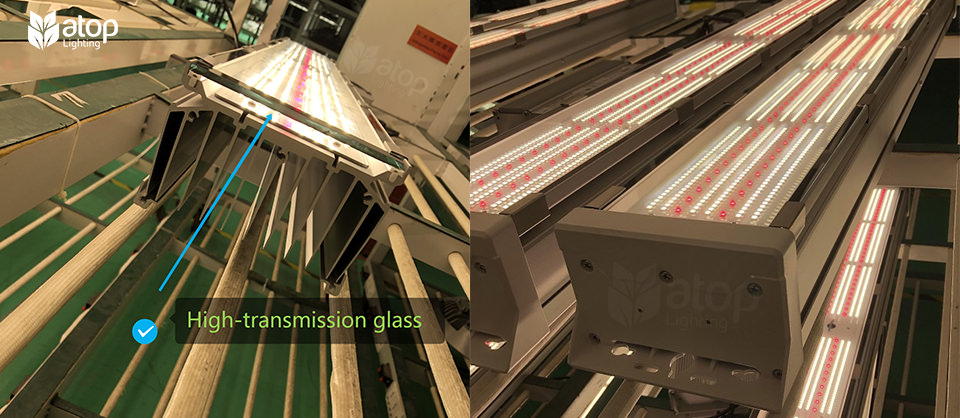
Our products fully meet these requirements. Some of our products feature chemically resistant glass lenses. Glass maintains high light transmission while offering strong resistance to cleaning agents, humidity, and thermal cycling. It also reduces the risk of surface breakdown over time.
Spectrum Stability and Consistency Over Time
In GMP-aligned cultivation, the goal is to produce repeatable cannabinoid and terpene profiles across batches.
Stable spectrum over time
LED output must maintain consistent wavelength distribution throughout the fixture lifetime. Spectral drift or uneven diode degradation leads to changes in plant morphology and chemical expression.
Controlled output decay
Light output should follow predictable degradation curves (LM-80 / TM-21 referenced in general LED practice). Sudden or uneven drop-off is not acceptable in controlled production environments.
Full-spectrum design with stage control
Cannabis responds to different spectral ratios across growth stages. Full-spectrum lighting is the baseline, with multi-channel control used to adjust ratios during vegetative and flowering phases.
UV supplementation
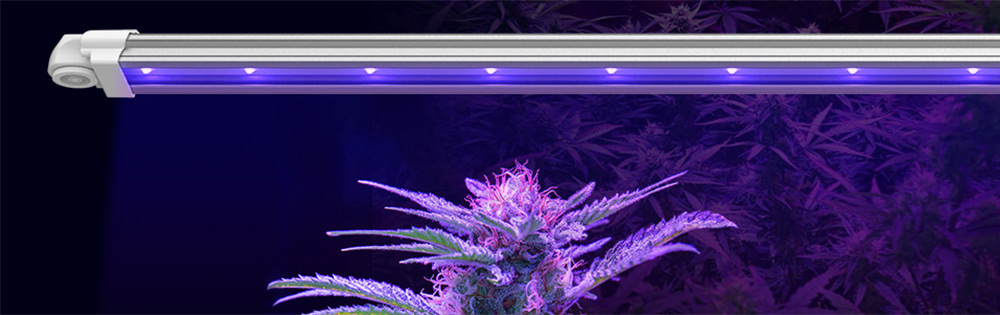
UV light can influence secondary metabolite expression, but it must be applied in a controlled and validated way.
Light Intensity, Uniformity, and DLI
Enough and uniform lighting is one of the most critical factors for reproducible plant development and audit-ready consistency.
Peak number is less concerned while the consistency across the canopy between batches is more concerned.
Target light intensity ranges for different growing stages:
- Vegetative stage: 300–600 µmol/m²/s PPFD
- Flowering stage: 600–900+ µmol/m²/s PPFD
- Canopy uniformity: typically within ±10–15% variation across the target plane
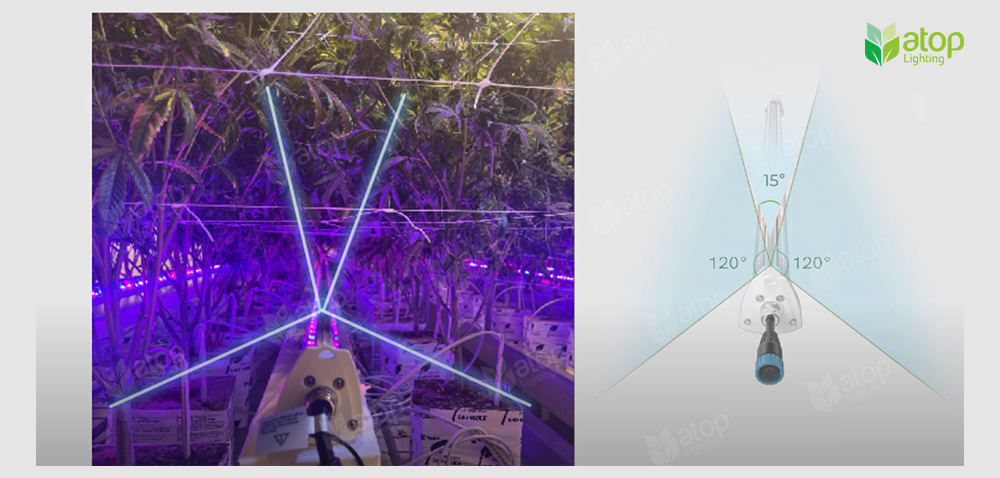
In dense or multi-tier environments, distribution matters as much as intensity. We provide inter-canopy lighting that helps reduce shading effects from upper canopy layers and improves consistency in lower bud development, supporting more uniform batch quality.
DLI should also be controlled and documented, as it provides a complete view of total photon delivery over time, not just instantaneous intensity.
System Integration and Operational Control
Modern GMP-aligned cultivation facilities operate as controlled environment agriculture (CEA) systems. Lighting is part of an integrated environmental control system.
At minimum, lighting systems should support:
- Digital control of intensity, photoperiod, and spectral channels
- Integration with environmental control platforms (HVAC, CO₂, irrigation)
- Data logging of key parameters such as PPFD, run time, and spectrum settings
- Alarm or fault reporting for deviations from set parameters
This level of integration supports two core GMP requirements: traceability and repeatability. If you cannot reconstruct how a crop was lit, you cannot reliably validate how it was produced.
There are many requirements to consider when designing a lighting system for a GMP-compliant grow room. Each project also varies depending on facility design, cultivation method, and validation requirements.
If you are working on a GMP or GACP-aligned project, or evaluating lighting partners for a regulated cultivation facility, our engineering team can support you in system selection or custom development.
Contact us to discuss your project. Atop Lighting is your trusted OEM and ODM partner for horticulture lighting systems.
Disclaimer: This Content Is Intended For Educational Purposes Only. We Do Not Endorse Or Promote Illegal Activities Related To Cannabis.