
PMMA vs PC vs Glass Optics for LED Grow Lights
What do commercial growers expect from LED grow lights? Higher efficiency and consistent crop performance with lower energy use.
When we evaluate grow light performance, we usually focus on the LED chips, driver quality, thermal management, and overall fixture efficacy. Those factors matter, but we often overlook one key element: the secondary optical system.
As a trusted ODM and OEM partner, our LED grow lights are available with thermoplastic optical lenses, mainly PMMA and PC materials. Glass is another common option used in some horticulture lighting.
The optical material directly affects light transmission, beam distribution, and long-term output stability. Low-quality optics can yellow, haze, or crack over time, leading to measurable light loss and reduced lighting performance.
In this article, we compare PMMA, PC, and glass lenses for LED grow lights, and explain how each material affects efficiency, durability, and long-term lighting performance.
How Lenses Work in LED Grow Lights
In LED grow lights, secondary optics are used to protect the LEDs, improve PPFD, and create more uniform light distribution across the canopy.
First, lenses protect the LED package and circuit components. They act as a physical barrier against high-humidity environments, sulfur treatments, dust, and chemical foliar sprays commonly found in commercial grow facilities.
Second, lenses control and shape the light distribution. A bare LED chip typically emits light in a wide 120° beam angle. Without optics, a large portion of the light spreads outside the target growing area before reaching the canopy.
Optical lenses redirect the light into a more controlled beam pattern, helping concentrate photons where plants actually need them. This improves canopy penetration, increases usable PPFD, and delivers more uniform coverage across the cultivation area.
For example, our greenhouse lighting uses the lens with optical angle of 110º*140º, effectively transmit light for the plants.
However, optics are also exposed to continuous high-energy light, especially in the blue and UV spectrum that are important for plant growth. Over time, this exposure can degrade optical materials.
That is why lens material selection matters in horticulture lighting. PMMA, PC, and glass each have different strengths in transmission efficiency, heat resistance, impact resistance, and long-term reliability.
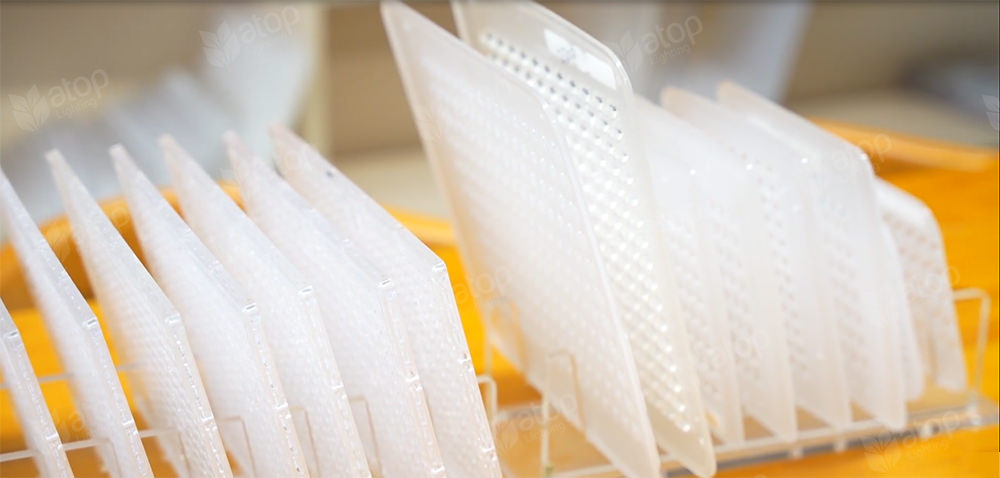
PMMA Lens: Higher Light Transmission and Good UV Stability
PMMA (polymethyl methacrylate), commonly known as acrylic, is used in LED grow light optics because of its high light transmission, good UV stability, and precision molding capability.
One major advantage of PMMA is its optical clarity. PMMA lenses typically provide 92–93% light transmission, making them one of the most transparent optical plastics available.
PMMA is also well suited for injection molding. It can be manufactured into complex optical structures with high precision, allowing brands to create specialized beam angles and micro-optic designs for different cultivation applications.
Another advantage is its resistance to UV and blue light degradation. PMMA has good molecular stability under high-energy light exposure and is less prone to yellowing over time compared to many other plastics.
However, PMMA also has limitations.
Its heat resistance is lower than PC and glass. It is also relatively rigid and brittle.
Chemical resistance is another concern in horticulture environments. Exposure to aggressive cleaning agents, sulfur treatments, or certain solvents can cause “crazing”, fine microscopic cracks on the lens surface.
PC Lens: Higher Heat Resistance and Impact Strength
PC (polycarbonate) lenses are known for their high mechanical strength and heat resistance. Compared with PMMA, PC is more durable under harsh operating conditions, although its optical transmission is slightly lower.
PC features an initial internal transmission rate of approximately 88% to 90%, slightly lower than PMMA.
One of the biggest advantages of PC is thermal stability. PC has a much higher heat deflection temperature than PMMA and can withstand temperatures around 120°C to 135°C without deforming.
This makes PC well suited for high-power LED grow lights, such as 600W+ greenhouse top lighting.
PC also offers excellent impact resistance. For large commercial facilities where fixtures may be exposed to vibration, handling stress, or accidental impact, this added durability is important.
Another advantage is chemical resistance. In horticulture environments, fixtures are regularly exposed to humidity, sulfur treatments, fertilizers, and cleaning chemicals. PC is generally more resistant to environmental stress cracking and chemical-related damage.
But PC is more prone to yellowing over long-term exposure to heat, blue light, and UV radiation. As the material ages, optical transmission gradually decreases.
Glass Lens: Stable Optical Performance and Maximum Chemical Resistance
Glass lenses offer the best long-term optical stability among the three common LED grow light optical materials. They provide high light transmission, excellent thermal resistance, and outstanding chemical durability. However, they also increase fixture weight and manufacturing cost.
Glass typically delivers light transmission in the 92–94% range. Its smooth and stable surface also helps reduce internal reflection and scattering losses, allowing more usable light to reach the plant canopy.
One of the biggest advantages of glass is long-term optical stability. Glass does not yellow, haze, or degrade under prolonged exposure to blue light, UV radiation, or high operating temperatures. This helps maintain consistent PPFD output and spectral quality throughout the fixture lifespan.
Glass also offers extremely high thermal resistance. For very high-power horticulture fixtures, such as 800W or 1000W greenhouse lights, glass optics eliminate the risk of thermal distortion.
Another major advantage is chemical resistance. Commercial grow facilities often use sulfur vaporizers, foliar sprays, disinfectants, and high-pressure cleaning processes. Glass is highly resistant to these chemicals and does not easily react with moisture or environmental contaminants.
However, glass is is heavier than both PMMA and PC, which increases fixture weight. For brand owners, this increases the logistic and shipping costs. This also becomes important in large-scale greenhouse installations where hundreds or thousands of fixtures are deployed.
PMMA vs PC vs Glass, How to Choose the Right Optic
The table below summarizes the main performance differences between PMMA, PC, and glass optics used in LED grow lights.
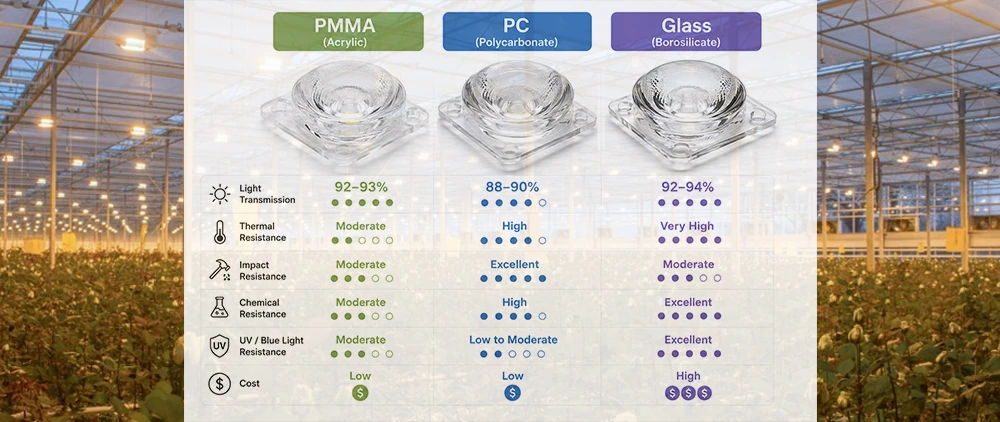
Each optical material has different strengths, and the right choice depends on the application, operating environment, and target product positioning.
PMMA is often selected when high light transmission and precise optical control are the priority. It is widely used in indoor grow lights where operating temperatures are more controlled and maximum fixture efficacy is important.
PC is commonly used in commercial horticulture lighting because it offers a strong balance of heat resistance, impact durability, and chemical resistance. It performs well in demanding greenhouse environments and high-power fixtures where mechanical reliability matters.
Glass is typically used in premium horticulture fixtures and high-power greenhouse lighting systems. It provides the best long-term optical stability and chemical resistance, making it suitable for facilities that prioritize fixture lifespan, stable PPFD output, and reduced maintenance over many years of operation.
How We Approach Optic Selection
At Atop, we have been designing and manufacturing horticulture LED fixtures for ODM and OEM partners for more than 9 years.
Optic material selection is one of the earliest engineering decisions in a grow light project because it directly affects fixture efficacy, long-term reliability, manufacturing cost, and maintenance performance.
We do not use a one-material-fits-all approach. Our production capability includes PMMA, PC, and glass optical systems, allowing us to match the optic solutions to the technical and commercial goals of each project.
We also note that some brands in the market believe thermoplastic lenses can experience discoloration and reduced light output over time, and promote silicone optics as a reliable alternative for long-term optical stability. If your project requires this type of optical solution, feel free to talk with our team.
The right optic is not simply the material with the highest transmission. It is the material that maintains stable optical performance throughout the real operating life of the fixture.
Need help selecting the right solution for your LED grow light project? Contact our team.