
Warm White vs. Cool White: Which Grows Better Plants
White LED lights are often a strong choice for growing a wide variety of plants because their balanced spectrum closely resembles natural sunlight. One important aspect of white LEDs is color temperature, which describes how “warm” or “cool” the light appears.
So, which color temperature is better for plants, warm white or cool white?
Although both are types of “white” light, they differ in their spectral makeup. Warm white LEDs (approximately 2700–3500K) contain more red wavelengths, while cool white LEDs (5000–6500K) provide a greater proportion of blue light. These differences influence how plants grow.
The truth is, there isn’t a universal answer to which one is “best.” The ideal option depends on what you’re growing, the specific growth stage you want to support, and your overall production goals.
In this blog, we’ll clarify what color temperature really means and explain how warm white and cool white light affect plant growth, so you can choose the lighting that best fits your needs.
What is Color Temperature?
Color temperature is a way of describing the appearance of light on a scale from warm to cool. It is measured in Kelvin (K). Think of it as the difference between the cozy glow of a sunset and the crisp brightness of midday sun.
Warm white light typically ranges from 2700K to 3500K, producing light that appears slightly orange or yellow. This spectrum is rich in red wavelengths. Cool white ranges from 5000K to 6500K, appearing bright white with bluish tones, and emits a lot of blue light.

Here is a table about the relative spectral distribution for warm white and cool white lights.
|
Type |
Blue (400-500nm) |
Green (500-600nm) |
Red (600-700nm) |
Far red (700-800nm) |
|
Warm white |
7% |
28% |
53% |
11% |
|
Cool white |
26% |
49% |
22% |
3% |
Warm White for Plants
Warm white lighting (2700K to 3500K) provides a spectrum enriched in red and far-red wavelengths. This is similar to the light plants receive at sunrise and sunset. In commercial horticulture, this spectrum acts as a reproductive engine because it resembles the lower angle of the sun during late summer and early autumn, a period when many crops naturally transition to flowering and fruiting.
Red-enriched light is also the most efficient driver of photosynthesis. Research shows that plants convert red photons into chemical energy more efficiently than blue or green photons [1]. This higher efficiency often results in faster biomass accumulation and stronger fruit development.
Warm white light does come with a morphological consideration: increased stem elongation. The relatively low amount of blue light can trigger a mild shade-avoidance response, which produces longer internodes. This can be useful when improved airflow is needed, such as in dense cannabis flowers or tall tomato vines. In contrast, it can be a disadvantage in vertical farming systems where height is limited.
Cool White for Plants
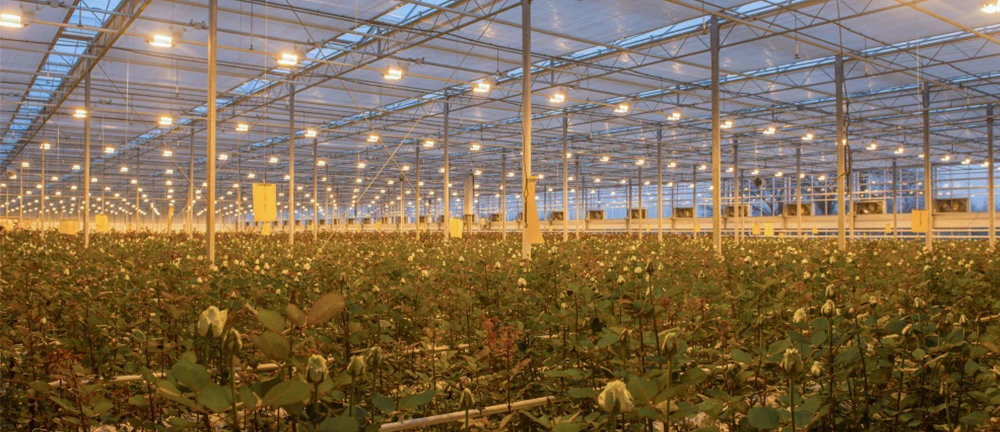
Cool white light, typically ranging from 5000K to 6500K, contains more blue wavelengths within the 400 to 500 nanometer range.
The primary advantage of cool white lighting is its strong influence on plant morphology. Blue photons activate cryptochromes, which are photoreceptors that limit stem elongation. This makes cool white lighting especially valuable for commercial propagators and vertical farming operations. Research from Michigan State University Extension shows that increasing the proportion of blue light relative to far-red light significantly suppresses internodal stretching [2]. The result is compact, sturdy transplants that are easier to manage and less susceptible to damage during transport.
Blue light also plays an essential role in stomatal opening, which supports gas exchange and transpiration. Because of these combined effects, cool white spectrums are widely used for vegetative growth, propagation, and leafy green production, where a dense, compact canopy is more desirable than rapid vertical expansion.
Warm White vs. Cool White
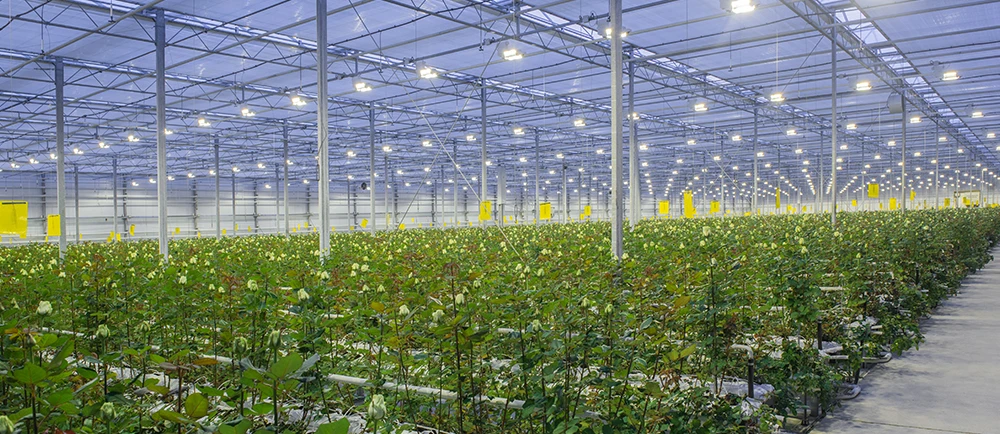
Warm white (2700K–3000K) emphasizes red wavelengths, ideal for flowering and fruiting. Cool white (5000K–6500K) provides more blue light, promoting leafy growth and strong stems.
|
Feature
|
Warm White (2700K - 3000K)
|
Cool White (5000K - 6500K)
|
|
Visual Color
|
Yellow/orange tint |
Blue/crisp white tint |
|
Dominant wavelength |
Red (600-700nm) |
Blue (400-500nm) |
|
Primary signal |
It is autumn (reproduce) |
It is spring (grow roots and leaves) |
|
Morphology effect |
Promotes stem elongation |
Promotes compact, stocky growth |
|
Best for |
Flowering, fruiting, canopy penetration |
Propagation, vegetative, leafy greens |
Dynamic Lighting, A Combination of Warm White and Cool White
You don't really have to choose between using only warm white or only cool white lighting. For operations that need one lighting system to support multiple growth stages or different crop types throughout the year, dynamic or tunable LED grow lights offer a far more versatile solution.
These systems can adjust their spectral output to meet the distinct requirements of seedlings, vegetative growth, flowering, and fruiting. They also make it possible to grow a wide range of plants under the same fixtures, which helps reduce equipment costs and simplifies planning.
We have developed a four-channel adjustable spectrum grow light solution for cannabis plants. This customized lighting offered different plant spectra in different growing stages, which improves medical cannabis quality and achieves higher yield.
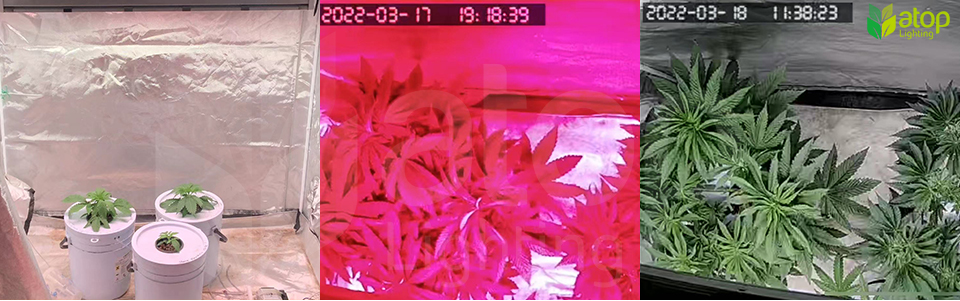
The standard products, like our Horti-Rock, also feature an adjustable spectrum. You can select from several channels, including a vegetative channel, a flowering channel, a vegetative plus UV and IR channel, and a flowering plus UV and IR channel. This flexibility allows a single fixture to satisfy the full spectrum needs of the crop, supporting healthier growth and enabling higher yields.

Need a dynamic lighting solution for your plants? Contact us.
Source:
- McCree, K. J. (1972). The action spectrum, absorptance and quantum yield of photosynthesis in crop plants. Agricultural Meteorology.
- Runkle, E. (2017). Blue Light & Plant Morphology. Michigan State University Extension.