
ODM or OEM for Your Grow Light Line
When expanding a horticulture lighting brand or equipping a commercial cultivation facility, building a custom fixture line is the standard route to get the exact mechanical, electrical, and optical specs you need.
The decision almost always comes down to two manufacturing models: OEM and ODM.
OEM means we build your design to your specification. ODM means we bring an existing, tested design that your brand can own, with room to customize.
At Atop, we’ve run both ODM and OEM since 2017. This post explains what each model involves for horticulture lighting and where the differences show up.
What OEM Means
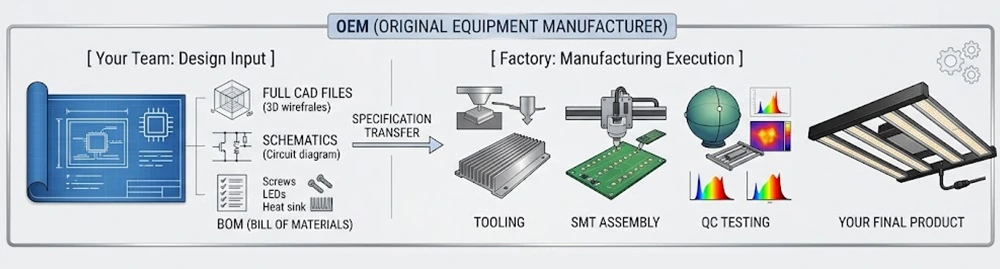
OEM means Original Equipment Manufacturer. It is the older, more literal arrangement. You hand us a design, schematics, BOM, mechanical drawings, spectrum targets, whatever level of detail you have, and we build it.
That means we are responsible for manufacturing. The intellectual property, the spec decisions, the R&D risk, all of that sits with you.
What we bring to an OEM relationship are sourcing, line setup, QC, and catching the problems that only show up once a design hits a real production floor.
So, OEM is the good choice when:
- You already have an engineering team that owns the product design.
- You need a specific spectrum, driver, or mechanical design that doesn’t exist off the shelf.
- You’re protecting a design as proprietary IP and don’t want it shared across other brands.
- You have the volume to justify custom tooling.
What ODM Means
ODM means Original Design Manufacturer. We already have a working design from chip layout, thermal management, driver, to housing and the whole fixture. These have been through our own R&D and testing.
You take that design, put your brand on it, and customize a defined set of things like spectrum ratio, wattage tier, housing color, packaging, sometimes firmware or dimming behavior.
With ODM, you don’t own the base design, and depending on the terms, that design may also be available to other brands.
ODM is the right one when:
- You’re a new or growing brand and don’t have in-house lighting engineers yet.
- You want to get to market in months.
- You want the R&D and reliability testing already done and proven in the field.
- Your differentiation is in brand, go-to-market, or customer relationship, not in owning proprietary hardware IP.
OEM vs ODM
|
|
OEM |
ODM |
|
Who owns the design |
You |
manufacturer |
|
Engineering Burden |
High (your internal team handles all R&D) |
Low to Moderate (shared technical review) |
|
Tooling & NRE Costs |
High |
Low to Moderate |
|
Development Timeline |
6 to 12+ months |
2 to 4 months |
|
IP Ownership |
Full ownership of mechanical and electrical designs |
Shared or private-labeled under commercial licensing agreements |
|
Best fit |
Established brands with engineering resources |
New or scaling brands prioritizing speed to market |
Neither OEM nor ODM is more correct
In practice, a lot of brands don’t pick one and stay there. They launch with ODM to get revenue and market feedback fast, then move specific SKUs to OEM once they know which product lines are worth the custom investment.
So, neither direction is more “correct”. What matters is matching the model to where your product line and your budget actually are.
Go with OEM if you have an experienced hardware engineering team, proprietary optical/mechanical designs you must own outright, and the budget to invest in dedicated tooling and extended testing cycles.
Go with ODM if you want to bring a reliable, high-performance fixture line to market quickly by building on proven thermal platforms and factory R&D, leaving your team free to focus on sales, customer support, and cultivation results.
Atop Lighting is your trusted ODM and OEM partner. Talk to our team about what you’re trying to build, and we can provide the right solution for you.
FAQ
1. Is ODM cheaper than OEM?
Almost always, at least upfront.
2. Can I switch from ODM to OEM later?
Yes, and it’s common.
3. Do I lose exclusivity with ODM?
Not necessarily, but it’s not automatic either.
4. Does ODM mean lower quality?
No. Quality depends on the manufacturer’s QC process, not on which model you chose.