
All Leaf and No Root? Getting Indoor Radish Lighting Right for Root Growth
Radishes present a strong business case for vertical farms and commercial CEA operations. They offer a fast 21 to 28 day crop cycle, high production density per rack, and rapid crop turnover.
But radishes create a specific lighting challenge: the crop is grown for its root, while the light is absorbed primarily by the leaves. An operation can therefore produce healthy, vigorous foliage without getting the root development needed for a marketable crop. The result can be small, misshapen, cracked, or poorly filled roots that are difficult to pack and sell.
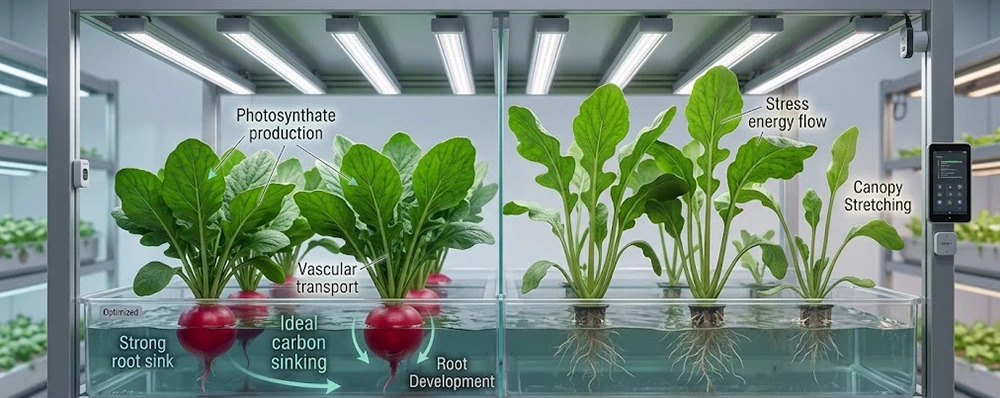
The key point is that light does not need to reach the root to influence root growth. Light drives photosynthesis in the leaves, producing the sugars and other assimilates that the plant can allocate to different parts of the crop. The lighting strategy therefore affects how much carbon the plant captures and how that carbon is distributed between leaf growth and root development.
Get that balance wrong, and you can end up with exactly the problem growers want to avoid: all leaf and no root.
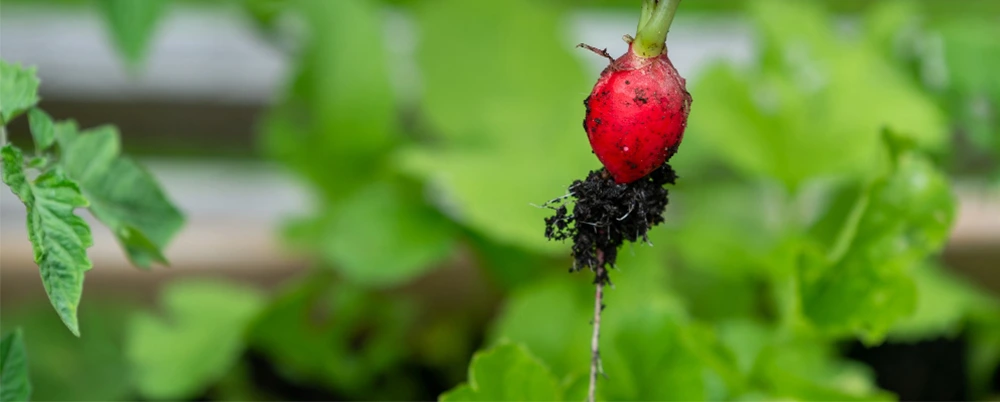
Why Do Radishes Play by Different Rules?
In all green plants, light drives photosynthesis in the leaves, producing the carbohydrates the plant uses for growth and development. What changes from crop to crop is where those carbohydrates are ultimately allocated.
In lettuce, most of the harvested biomass is leaf tissue, so strong leaf growth is the goal. In radishes, the plant needs to allocate a substantial share of its photosynthetic output to the swollen hypocotyl and root, which form the marketable portion of the crop.
This is where lighting strategy matters. Light does not directly reach the root and make it grow. Instead, it influences the leaves, where photosynthesis takes place, and therefore affects the supply of carbohydrates available for growth and storage. If the light environment promotes excessive canopy growth without supporting the crop's overall development, you can end up with vigorous tops and underdeveloped roots.
For a commercial grower, that means electricity is being spent producing leaf biomass that has little or no market value, while the part of the crop that generates revenue remains undersized.
The DLI Range That Supports Root Development
For indoor radishes, root diameter and fresh weight generally perform well at a daily light integral (DLI) of around 12 to 15 mol·m⁻²·d⁻¹.
Research from Iowa State University, reported in Greenhouse Grower, evaluated spring radish cultivars across a range of DLIs. Root diameter and fresh weight increased as DLI increased, reaching their strongest results at approximately 12 to 15 mol·m⁻²·d⁻¹. At higher DLIs, root diameter began to decline and the incidence of cracked roots increased. Above approximately 20 mol·m⁻²·d⁻¹, these negative effects became more pronounced.
For sole-source indoor production, growers can reach the target DLI by balancing light intensity with photoperiod. Extending the photoperiod can increase daily photon delivery without requiring a large increase in fixture output. However, photoperiod should still be managed within the crop's biological limits rather than used simply as a way to push DLI higher.
For greenhouse production, the same 12 to 15 mol·m⁻²·d⁻¹ range provides a useful reference for supplemental lighting during low-light periods. When natural radiation already pushes the crop well above this range, adding more supplemental light is unlikely to provide the same return and may warrant consideration of shading.
Spectrum Shapes Where the Biomass Goes
Light spectrum can influence plant architecture and how biomass is distributed between shoots and roots. For radishes, that makes spectral balance another tool for managing root development and crop shape.
Research indicates that a 2:1 red-to-blue ratio can produce greater root diameter, higher root volume, and a higher root-to-shoot ratio than a 1:1 ratio, particularly when light intensity is adequate and the photoperiod is 16 hours.
Spectrum also gives growers another way to manage radish shape. Replacing HPS fixtures with tunable LED lighting can provide more precise control over the spectral environment.
For growers targeting compact, round roots, increasing the blue component while limiting far-red can help maintain a shorter, more compact plant structure.
For elongated varieties such as Fresh Breakfast, the spectral strategy can be different. Increasing far-red can promote stem and petiole extension and may support greater root elongation.
Radishes reward precision more than brute force. Whether you need custom-engineered spectral ratios to suppress canopy stretch or slim waterproof form factors for multi-tier racks, our engineering team is here to help.
Reach out to our team to discuss our custom lighting solutions.