
What L/B Ratings Mean for Your Grow Lights (and What They Miss)
LED grow lights are often advertised with a 50,000-hour lifetime. The number sounds impressive, but it does not answer the question growers actually need to know:
How much light will the fixture deliver after years of operation?
A grow light can still be running while its output gradually declines. If the fixture no longer provides the PPFD levels crops require, plants may receive less usable light, potentially reducing yield and quality, while the energy costs remain the same.
This is where L/B ratings become important.
The L/B rating system helps describe how well an LED fixture maintains its light output over time and how many fixtures in a large installation are expected to remain within a certain performance range.
However, an L/B rating is primarily based on LED component testing under controlled laboratory conditions and does not fully account for the real-world factors that affect a grow light’s performance, such as operating temperature, fixture design, thermal management, driver reliability, and the growing environment.
What are L/B ratings?
L/B ratings are a standardized way of describing how LED lights lose brightness over time (typically 36,000 to 50,000 hours).
Rating Format: Lx / By at H hours
L is about brightness
“L” stands for lumen maintenance. It means how much light output a fixture still produces compared to when it was brand new. The number after the L is just the percentage of original output the fixture is guaranteed to still hit.
For example, L90 means the fixture is still putting out 90% of its original brightness, while L70 means it's down to 70%.
B is about consistency across the batch
B is the percentage of fixtures that are allowed to fall short of that L threshold. B10 means no more than 10% of fixtures are expected to dip below the rated brightness within the stated hours. B50 means up to half of them might.
So when you see L70B50 at 50,000 hours, it means: after 50,000 hours, at least 70% of the original light output should still be there, and no more than 50% of the diodes are expected to have fallen below that level.
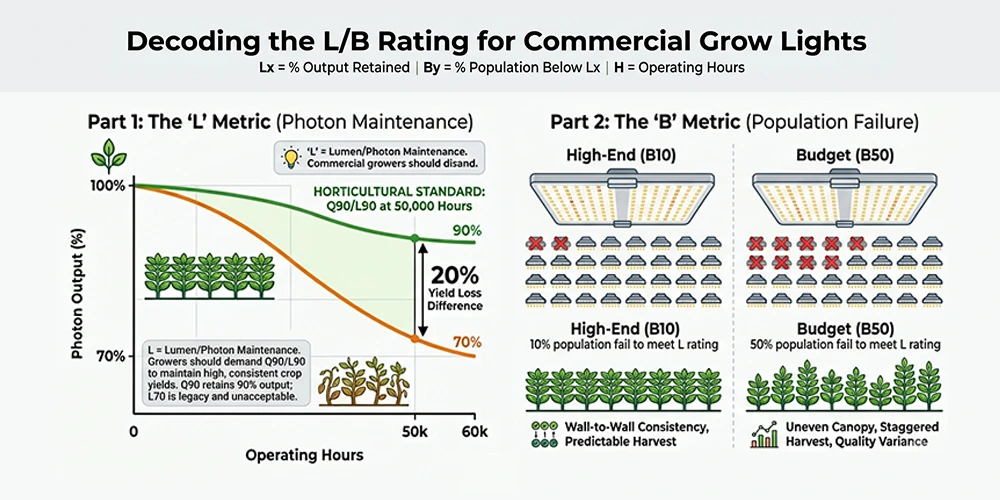
In horticulture, many manufacturers talk about Q90 instead of L90.
The “Q” stands for quantum/photon flux. Plants don’t care about lumens (which measure light as our eyes see it). They care about the photons they can actually use for photosynthesis. That’s why Q90 (maintaining 90% of photosynthetic photon output) is a more relevant standard for grow lights.
Quick Comparison Table of L/B values.
|
Rating |
Light remaining |
% Allowed below target |
Best for |
|
L70/B50 |
70% |
Up to 50% |
Basic applications |
|
L80/B50 |
80% |
Up to 50% |
Commercial horticulture |
|
L90/B10 |
90% |
Up to 10% |
Serious horticulture |
|
L90/B5 |
90% |
Up to 5% |
Premium grows |
Why L/B ratings matter
L/B ratings matter because they help predict two factors that directly impact a commercial growing operation: crop performance and total cost of ownership (TCO).
In most commercial horticultural applications, plant growth responds closely to the amount of photosynthetically active light delivered to the canopy. Maintaining consistent light levels helps growers achieve more uniform results in crop size, color, flavor, and potency.
Research from institutions such as Wageningen University & Research and Utah State University has shown that, within practical production ranges, a reduction in usable light can lead to a similar reduction in crop growth and yield potential. For example, an LED fixture rated at L70 is expected to maintain 70% of its initial light output at the end of its rated lifetime. This means the fixture has lost approximately 30% of its original output, not that the fixture has stopped working.
Across a large greenhouse or vertical farm, gradual light depreciation can have a measurable impact. If fixtures deliver less PPFD over time, growers may need to adjust their lighting strategy, increase operating hours, or accept lower production levels.
L/B ratings also influence total cost of ownership. A lower-cost fixture with faster lumen depreciation may reduce upfront investment, but the long-term costs can be higher due to reduced yield, higher energy consumption per unit of production, and more frequent replacement.
For commercial growers, consistency is critical. Production plans, labor requirements, and revenue forecasts are built around predictable crop performance. A lighting system that maintains its output over time helps protect the original production targets and reduces uncertainty throughout the facility’s operating life.
What L/B ratings miss
An L/B rating provides a useful baseline for diode durability, but relying on it alone creates four major blind spots for commercial farm directors and CFOs:
- Lumen vs. Photons
- Spectral shift
- Microclimate stress
- While-fixture decay
It measures total output, not spectrum.
L/B ratings are almost always calculated on total lumen output, one number that goes down over time. It evaluates lumens, a human visual metric heavily weighted toward green and yellow light 555nm.
But a horticultural fixture isn't emitting one kind of light. Plants process light across the PAR spectrum. They do not care about lumens; they depend on Photosynthetic Photon Flux (PPF) measured in micromoles per second (μmol/s).
As we mentioned before, manufacturers and the DesignLights Consortium (DLC) use the Q-rating (e.g., Q90/B10). The "Q" stands for Quantum/Photon Maintenance, tracking actual photon output retention across the PAR spectrum rather than human visual brightness.
It doesn’t measure spectral shift
Full-spectrum LED grow lights mix different color diodes, like white, deep-red, red, blue, etc.
Some colors, like deep-red, often degrade faster than white diodes under thermal stress. Over 30,000 to 50,000 operating hours, a fixture might technically retain 90% of its total photon volume, but its red-to-blue spectrum ratio shifts.
For crops where flowering response, morphology, or secondary metabolite production depends on spectral balance, that drift can matter well before the "official" rating shows any problem, and it's invisible if you're only looking at the blended number on a spec sheet.
It wasn't tested in your environment.
Tests are usually done at controlled temperatures (often 25°C). LED degradation is temperature-dependent: the hotter a diode runs, the faster it degrades.
Greenhouses and vertical farms often run hotter (temperatures near the fixture heat-sinks frequently exceed 30°C-35°C) and more humid than the general commercial spaces this testing standard was originally built around.
The sulfur evaporators, foliar spray drift, and chemical sanitation vapors corrode optical coatings and yellow silicone sealants long before the LED chip itself degrades.
It doesn’t measure whole-fixture decay
An L/B or Q/B rating evaluates the LED chip package only. It does not account for the rest of the light fixture. That ignores the driver, optics, wiring, and thermal system, all of which can fail or degrade faster in a humid, warm greenhouse.
The power supply (driver) contains capacitors and components that can fail or lose efficiency at 25,000 to 40,000 hours if poorly cooled.
Dust accumulation, UV degradation, and chemical oxidation cloud acrylic or polycarbonate lenses, blocking photons before they reach the canopy.
Heat-sink paste dries out over time, leading to thermal runaway that accelerates chip burnout.
It doesn't translate into cost.
An L/B rating is expressed in hours and percentages, not dollars, not yield, not crop cycles. Two fixtures with similar-looking ratings can have very different practical implications once you translate "L90B10 at 50,000 hours" into "how many growing seasons until I need to budget for replacement or supplemental lighting," and no manufacturer does that math for you.
L/B ratings (and their horticultural cousin, Q90) aren’t perfect, but they’re one of the best tools you have to predict how well the grow lights will perform over time.
This is exactly the kind of detail that gets lost when a brand sources lighting without visibility into how it’s actually engineered and tested. At Atop, this is where our OEM and ODM partners get an advantage: you're working directly with the engineering team that generated it.
Whether you're building out your own branded horticultural lighting line or looking for LED grow lights for a commercial grow operation, we're happy to walk through the actual test data behind our ratings.
Talk to our engineering team about your next lighting line