
What Is an Integrating Sphere, and Why Does It Matter for PPF Measurement
Have you ever compared two LED grow lights that look nearly identical, with the same wattage and a similar design, yet show completely different specifications?
On paper, these fixtures may appear the same, but their performance data, such as PPFD maps, spectrum charts, and PPF values, can vary significantly.
So how can you be sure that what is promised on a specification sheet is actually delivered in real-world performance?
The answer lies in how those numbers are measured.
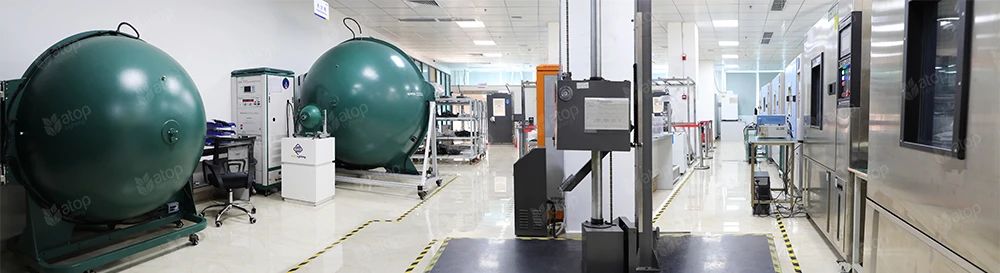
At Atop, we operate our own in-house laboratory, certified by SGS and TÜV. We use advanced testing equipment, including an integrating sphere, to accurately measure key performance metrics.
This ensures that every specification we provide is based on precise measurement, so you can trust that our product performance is grounded in physics, not marketing claims.
What is an integrating sphere?
An integrating sphere, also known as an Ulbricht sphere, is an optical instrument used to measure the total light output of a source, regardless of the direction in which the light is emitted.
It looks like a hollow metal sphere. The inside is coated with a highly reflective, matte white material, typically barium sulfate or PTFE. This coating does not reflect light like a mirror. Instead, it scatters light evenly in all directions.
As light enters the sphere, it reflects multiple times off the inner surface. With each reflection, the light becomes more evenly distributed until it is uniform throughout the entire sphere, regardless of the original beam angle or direction.
A detector or spectroradiometer inside the sphere then measures this uniformly distributed light. This allows for accurate measurement of key parameters such as total radiant flux, PPF, and spectral power distribution.
Because the integrating sphere removes the effect of directionality, it provides a true and reliable measurement of how much light a source actually produces.
What is PPF?
In general lighting, brightness is measured in lumens. In horticulture lighting, however, we use a different metric called PPF.
PPF stands for photosynthetic photon flux. It measures the total number of photons emitted by a light source every second within the 400 to 700 nanometer wavelength range. This range is known as photosynthetically active radiation (PAR), which is the light plants use for photosynthesis.
PPF is expressed in micromoles per second (μmol/s).
PPF represents the total amount of photosynthetically useful light a grow light produces. It describes the light’s overall output, regardless of how large an area the light covers.
How an integrating sphere measures PPF
To measure the PPF of a grow light, the fixture is placed inside the integrating sphere or mounted at its measurement port.
The light is then powered under controlled conditions, including stable voltage and a consistent ambient temperature, to ensure accurate and repeatable results.
Once the fixture reaches steady operation, a detector mounted inside the sphere begins collecting data. The sphere’s inner coating scatters the emitted light in all directions, allowing it to reflect multiple times until it becomes evenly distributed across the entire inner surface.
The detector measures this uniform light field, capturing the total amount of light produced by the fixture in all directions. From this data, the system calculates the total number of photons emitted per second, which is the PPF.
How we measure PPF at Atop Lighting
At Atop Lighting, we measure PPF using an integrating sphere, which captures the total light output of a fixture in all directions.
Unlike tools such as PAR meters, which only measure light at a specific point or angle, an integrating sphere collects all emitted photons. This provides a complete and accurate measurement of a fixture’s true output.
With this method:
- No photons are missed due to the beam angle
- There is no distortion from optics, reflectors, or lenses
- Results are not affected by fixture shape or geometry
- Measurements do not depend on distance or sensor placement
Our laboratory is equipped with a 2-meter integrating sphere, allowing us to test a wide range of lighting products with high precision.
By using integrating sphere testing, we move beyond theoretical specifications and provide data that is verified under controlled laboratory conditions.
Whether you are developing a custom spectral recipe or scaling a high-output fixture, our in-house testing ensures:
- Absolute accuracy: every photon is accounted for
- Regulatory readiness: data aligned with DLC, UL, and CE standards
- Batch consistency: reliable quality from the first unit to the last
Atop Lighting, your trusted ODM and OEM partner for horticulture lighting solutions.