
9 Tests for OEM/ODM Horticulture Lighting
At Atop, we provide OEM and ODM services. Your product is only as strong as the testing behind it. Before a single LED grow light ships under your brand, it passes through a rigorous, multi-stage validation process to ensure high quality.
Our laboratory is SGS and TÜV qualified, ensuring that all test results are reliable and compliant with international standards. The facility supports over 40 types of tests, covering electrical and optical performance as well as safety and long-term reliability.
Below, we highlight the 9 critical tests that every OEM/ODM horticultural lighting project must pass to ensure your brand consistently represents quality.
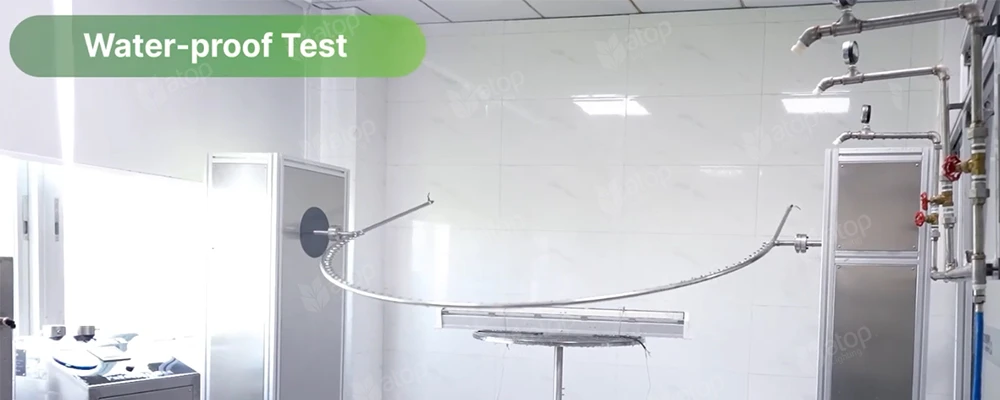
1. Waterproof Test
Horticultural lighting does not operate in a dry environment. On the contrary, it functions in moisture-rich conditions that can threaten electrical components. That is why waterproof performance is critical.
Water resistance in lighting is measured by IP (Ingress Protection) ratings defined under IEC 60529. For horticultural lighting, the relevant ratings typically range from IP65 to IP66.
- IP65 testing subjects the fixture to water jets from any direction at a flow rate of 12.5 liters per minute for at least 3 minutes.
- IP66 increases the severity to a powerful 100-liter-per-minute water jet.
After each test, the fixture is opened and inspected. Any internal moisture constitutes a failure.
2. Corrosion Resistance
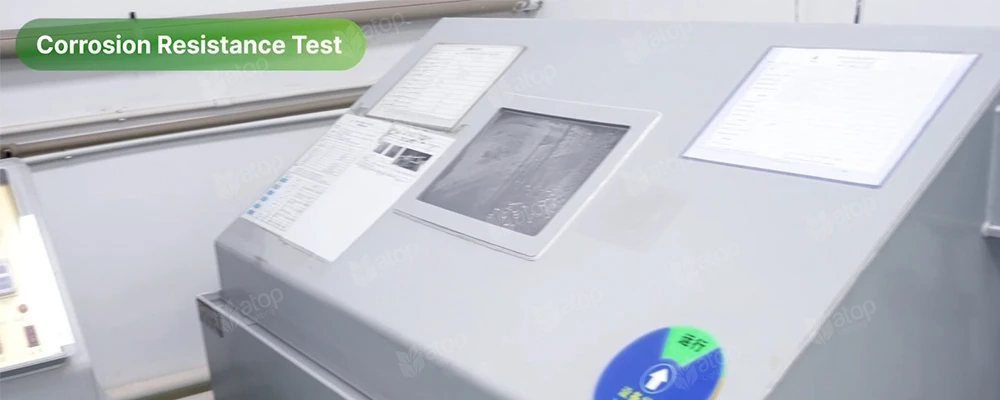
Greenhouses and indoor farms are not only humid but also chemically aggressive environments. Fertilizer solutions, sulfur-based pesticides and fungicides, and sodium hypochlorite can attack housing materials, compromise electrical connections, and gradually degrade optical reflectivity.
Corrosion resistance is validated through salt spray testing governed by ASTM B117 and ISO 9227. In this test, the fixture is exposed to a continuous fine mist of 5% sodium chloride solution inside a sealed chamber maintained at 35 °C. Engineers then evaluate how materials and protective coatings perform over time.
Our LED grow lights pass these corrosion resistance tests, ensuring stable performance and a long operational lifespan.
3. UV Aging
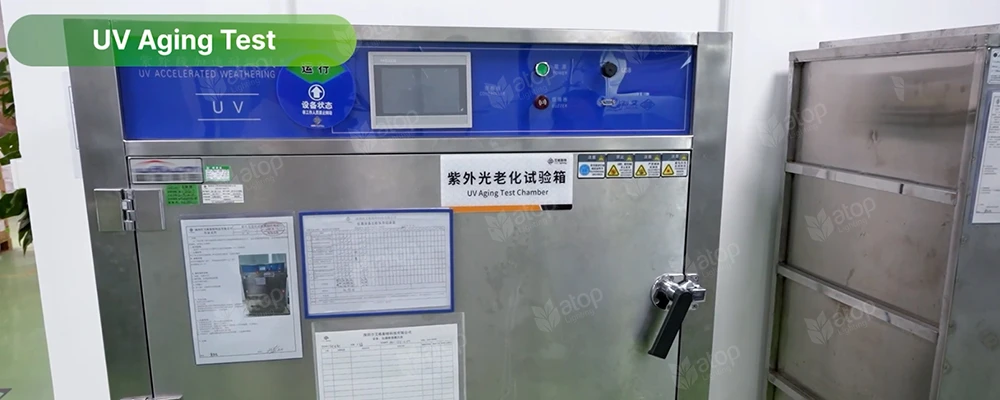
When an LED grow light operates, it continuously exposes its own housing, lenses, gaskets, and cable jackets to high-intensity light. UV degradation can cause PC or PMMA lenses to yellow and lose transmission efficiency, reducing PPFD output. It can also harden and shrink gaskets, opening pathways for moisture and chemical vapor. Cable jackets may chalk and crack, creating potential electrical hazards.
To verify durability, we compress years of real-world UV exposure into weeks of controlled laboratory testing by intensifying irradiance beyond natural sunlight levels. Typical horticultural lighting protocols simulate the equivalent of 3–5 years of UV exposure, representing the minimum expected product lifespan.
In addition to fixtures with PC or PMMA lenses that pass UV aging tests, we also offer grow lights with glass lenses, which provide superior stability, clarity, and higher resistance to yellowing over time.
4. Electrical Safety
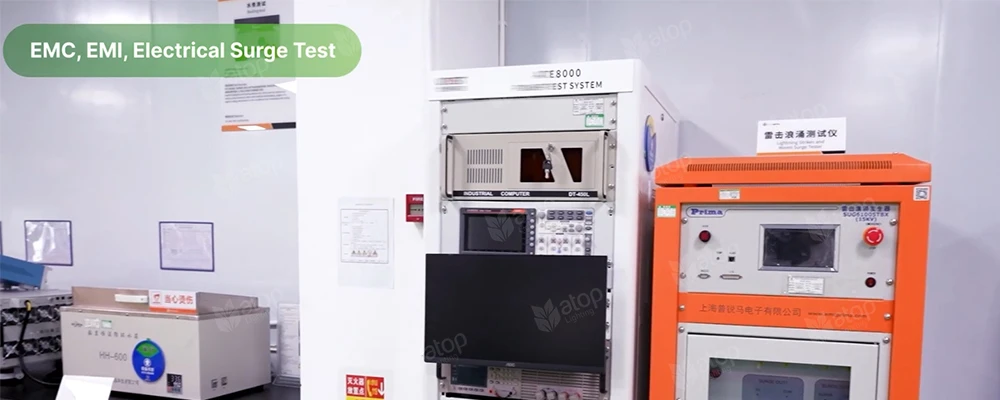
Modern growing farms are sophisticated ecosystems filled with sensitive electronic equipment. The LED driver, the power conversion core of every horticultural lighting fixture, naturally generates electromagnetic energy as a byproduct of its high-frequency switching operation. Without proper filtering and shielding, this energy can radiate outward and interfere with nearby systems.
EMC (Electromagnetic Compatibility) and EMI (Electromagnetic Interference) testing, governed by standards such as CISPR 15, EN 55015, and FCC Part 18, verifies that the fixture neither emits excessive interference nor malfunctions when exposed to external electromagnetic disturbances.
Electrical surge protection is also important for safety. Lightning strikes, utility switching events, and grid disturbances can send transient voltage spikes through power networks, potentially destroying unprotected driver components in an instant. IEC 61000-4-5 surge immunity testing confirms that the fixture can withstand these real-world events without damage or performance degradation.
5. Material Safety
Growers operating under organic or clean-green certification programs, food safety audits, or retailer supply chain requirements increasingly demand documented material safety verification from their equipment suppliers.
The RoHS Directive (2011/65/EU) and its updated successor, RoHS 3, restrict the use of ten hazardous substances in electrical and electronic equipment sold in the European market. These include lead, mercury, cadmium, hexavalent chromium, polybrominated biphenyls (PBB), polybrominated diphenyl ethers (PBDE), and four phthalate compounds added under RoHS 3. These substances are limited because of their well-documented toxicity and environmental persistence.
To ensure compliance, we conduct X-ray fluorescence (XRF) screening and detailed chemical analysis on complete fixtures. Every material, including PCB laminates, solder alloys, wire insulation, housing polymers, surface coatings, and LED packages, is evaluated against the restricted substance limits defined by the directive.
6. Integrating Sphere
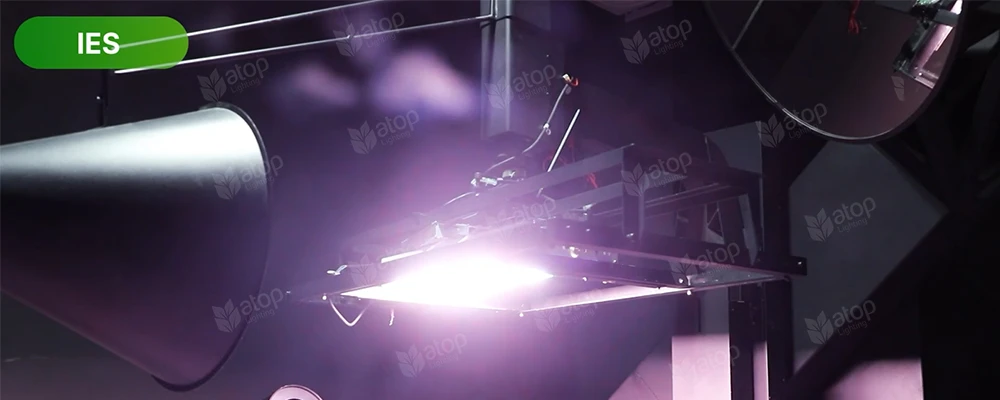
An integrating sphere is used to measure the total optical output of a lighting fixture in all directions (360 degrees). It captures key photometric and electrical parameters, including PPF (μmol/s), efficacy (μmol/J), spectral power distribution (SPD), total luminous flux, and input electrical data.
For horticultural lighting, integrating sphere measurements are conducted in accordance with IES LM-79. The DLC Horticultural Qualified Products List (QPL), which requires third-party LM-79 testing as a prerequisite for listing, has become an important market access credential in North America. This is especially true for commercial greenhouse and vertical farm operators, where energy costs are high, and utility rebate eligibility strongly influences purchasing decisions.
In our laboratory, we use a 2-meter-diameter integrating sphere capable of measuring total luminous flux and spectral power distribution across the 200 to 800 nm range. This coverage includes both visible and non-visible radiation, such as UV and IR, providing a complete optical performance profile.
7. PPFD Mapping
PPFD (Photosynthetic Photon Flux Density) measures the number of photosynthetically active photons that reach a specific point per unit area per second, expressed in micromoles per square meter per second (μmol/m²/s).
PPFD mapping shows where the light is actually distributed and whether every plant in the growing area receives the illumination it needs for optimal growth. This spatial analysis is critical for verifying uniformity and identifying potential hot spots or shaded zones.
The data collected during PPFD mapping allows us to simulate fixture performance within a specific greenhouse or vertical farm layout before a purchase is made.
This process enables accurate light planning for the client’s crop requirements, whether supporting high-DLI cannabis production or lower-light leafy greens, and helps ensure the installed system delivers the expected performance in real growing conditions.
8. Thermal Testing
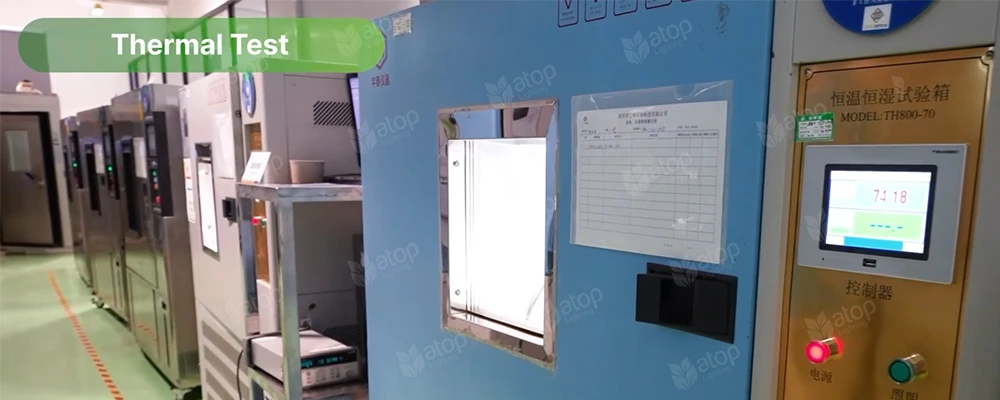
Commercial greenhouses often operate at ambient temperatures of 25 to 35 °C during peak growing seasons, which is warmer than the 25 °C standard test condition used in most general lighting standards.
Heat has a direct impact on performance and reliability. LED efficiency decreases as temperature rises. Driver components are more likely to fail under sustained heat. Optical materials can discolor or degrade. Thermal testing evaluates how effectively the fixture’s thermal design transfers heat away from critical components and dissipates it into the surrounding environment.
Thermal testing also provides the empirical basis for lumen maintenance projections that define the fixture’s expected service life. LM-80 testing measures the lumen depreciation of LED packages over extended operating periods, typically 6,000 to 10,000 hours, at specified junction temperatures. The resulting data is then extrapolated using TM-21 methodology to project when the fixture will reach L70 (70 percent of initial lumen output) or L90 (90 percent of initial lumen output).
In our laboratory, high- and low-temperature chambers are used to verify that fixtures can dissipate heat effectively even under extreme environmental conditions, which is essential for long-term LED reliability and performance.
9. Package and Installation Test
An LED grow light may pass lab validation but still arrive damaged if packaging and transport are not properly controlled. Safe installation is just as important as safe delivery.
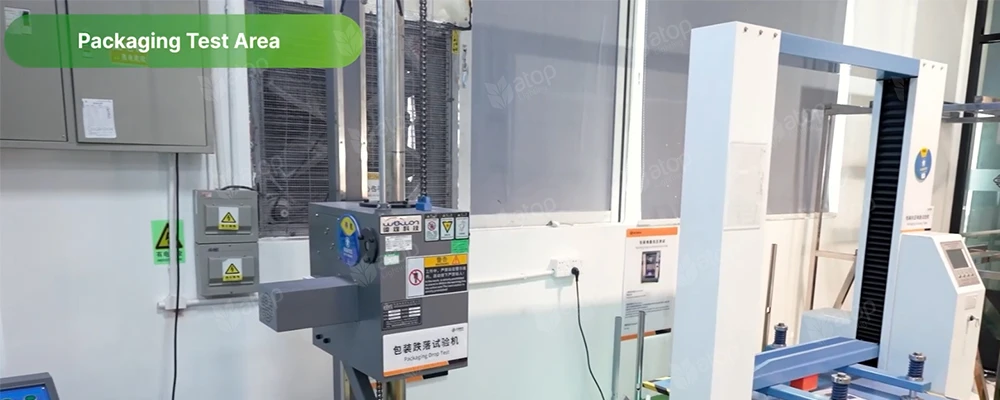
To protect product integrity, we perform drop tests, 3G vibration tests, and load and suspension tests before shipment.
Drop testing simulates common freight impacts, such as cartons hitting dock edges or slipping off conveyors, ensuring the packaging and fixture can withstand normal handling.
Vibration testing replicates continuous transport vibration, building vibration, and high-velocity airflow from industrial circulation fans. After testing, we inspect fasteners, optical alignment, electrical connections, and overall functionality to confirm nothing has loosened or shifted.
Our LED grow lights can be installed using hanging systems (ropes or chains) or fixed mounting to ceilings or shelves. Load and suspension testing verify the fixture remains securely mounted during operation, ensuring safe installation in real growing environments.
At Atop Lighting, every OEM and ODM project undergoes a comprehensive validation process. We consider this process the foundation of every product we develop and manufacture. Whether you need a fully customized horticultural lighting solution or want to expand an existing product line into new markets, we are here to help.
Atop Lighting, your reliable OEM and ODM partner.