
Cilantro Lighting Requirements for Indoor Production
Cilantro (Coriandrum sativum) is one of the most common herbs grown in indoor farms and vertical farming systems. It is also one of the more challenging crops to light consistently.
Unlike some leafy greens, cilantro has a short growth cycle and is sensitive to environmental stress. Excessive heat, improper light duration, or an unsuitable spectrum can trigger early bolting, where the plant starts flowering before harvest. Once cilantro bolts, leaf production decreases, texture changes, and market quality declines.
For indoor cilantro production, the right LED grow light must deliver the correct balance of light intensity, spectrum, photoperiod, and thermal management. A well-designed lighting system helps maintain vegetative growth, improve yield consistency, and meet the requirements of different growing applications.
Quick Answer: What Light Does Cilantro Need?
Cilantro needs 150 to 200 µmol·m⁻²·s⁻¹ PPFD for 12 to 16 hours a day, which works out to a daily light integral (DLI) of roughly 9 to 15 mol·m⁻²·d⁻¹.
It grows best under a red and blue dominant spectrum with a meaningful far-red component (roughly R:B:FR of 3:1:1).
But the final light recipe should be adjusted based on the crop variety, growing system, and production target.
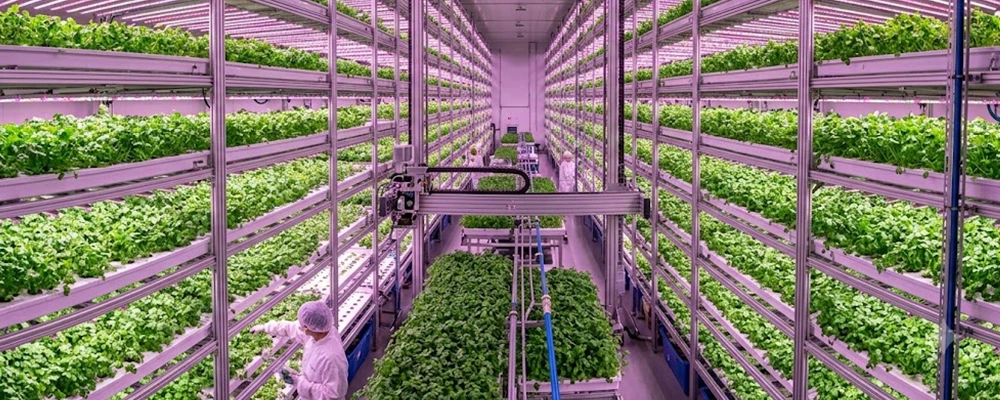
What Lighting Does Indoor Cilantro Need?
Light Intensity: Target PPFD
PPFD is the most useful measurement when designing or selecting a grow light because it shows how much usable light reaches the plant canopy.
Most culinary herbs, including cilantro, perform well when the daily light integral (DLI) reaches around 15 mol·m⁻²·d⁻¹ or higher when light is the limiting factor.
Research suggests that approximately 200 µmol·m⁻²·s⁻¹ under a 16-hour photoperiod provides a good balance between yield and energy efficiency. Increasing light intensity or extending lighting hours can increase production, but the improvement is not always proportional to the additional energy consumption.
For commercial indoor growing systems, the goal is not simply to increase light output. The goal is to deliver the right amount of light efficiently across the entire growing area.
Spectrum: Balance Yield, Plant Shape, and Shelf Life
Cilantro responds strongly to spectral balance, especially the relationship between red, blue, and far-red wavelengths.
A 2024 University of California, Davis study evaluated different red, blue, and far-red ratios for indoor cilantro production. The trial found that a spectrum with a higher far-red component, around R:B:FR = 3:1:1, produced higher fresh yield, taller plants, and greater leaf area compared with a red and blue spectrum without far-red.
However, higher yield does not always mean better commercial quality.
The same study found that the far-red-rich recipe produced shorter shelf life after harvest, while a red and blue dominant spectrum without far-red resulted in smaller plants but better storage performance.
This means the ideal spectrum depends on the application:
- Indoor farms focused on fresh weight may prioritize higher biomass production.
- Retail-oriented systems may require a spectrum that improves appearance and shelf stability.
- Home and appliance products may require a balance between growth speed, compact plant shape, and consumer experience.
Photoperiod: Avoid Excessive Lighting Hours
A 16-hour photoperiod generally performs better than shorter lighting schedules for cilantro production.
Continuous lighting can increase total yield, but the improvement becomes less efficient because plant productivity does not increase linearly with additional lighting hours.
For commercial systems, optimizing the light schedule can be just as important as increasing fixture output.
What Happens When Cilantro Does Not Get Enough Light?
Insufficient light causes cilantro to show several visible symptoms: elongated, leggy stems, pale or yellowing leaves, wider leaf spacing, and a plant that stretches toward the nearest light source. It also flowers (bolts) earlier under light stress, which shortens the usable harvest window and reduces cut yield.
A fixture's rated output does not always represent the actual light received by plants. Real-world PPFD depends on mounting height, beam angle, optical design, and light distribution.
A professional horticulture lighting solution should focus on uniform canopy coverage, not only maximum output numbers.
Cilantro Lighting in Hydroponic and Aeroponic Systems
Cilantro performs well in hydroponic and aeroponic growing systems, and much of the controlled-environment research on cilantro lighting has been conducted under these conditions.
In one UC Davis trial, cilantro seedlings were grown under approximately 156 µmol·m⁻²·s⁻¹ PPFD before being transferred into an aeroponic finishing system.
The light requirements themselves do not change between soil and hydroponic production. PPFD and DLI targets remain the main lighting factors.
However, controlled-environment systems allow growers to manage other variables such as nutrient concentration, pH level, root oxygenation, and water availability.
When these factors are controlled, lighting becomes one of the most important tools for influencing yield, plant structure, and quality.
How Many Watts of LED Light Does Cilantro Need?
Wattage alone is not a reliable method for selecting a horticultural LED fixture.
Electrical power tells you how much energy a fixture consumes, but it does not tell you how much usable light reaches the plants. Different LED packages, optical designs, and thermal systems can produce very different results at the same wattage.
The correct approach is to calculate power requirements based on:
- Target PPFD
- Growing area
- Fixture photon efficacy (µmol/J)
With a horticultural LED efficacy of approximately 2.5 to 3.0 µmol/J, achieving 150 to 200 µmol·m⁻²·s⁻¹ typically requires around 50 to 75 watts per square meter of canopy area, or approximately 5 to 7 watts per square foot.
Lower-efficiency LEDs or poor optical designs may require 10 to 20 watts per square foot to achieve the same PPFD level.
For product developers, specifying µmol/J instead of wattage helps ensure the lighting system delivers the required crop performance with better energy efficiency.
Designing the Right Cilantro Grow Light for Your Product
There is no single lighting recipe that works for every cilantro application.
A commercial vertical farm, a smart indoor garden appliance, and a retail-ready growing system may all require different priorities.
As an OEM and ODM horticulture lighting manufacturer, we help indoor farming companies, hardware brands, and CEA equipment manufacturers develop customized LED solutions based on their crop requirements, product design, and market goals.
From spectrum tuning and optical design to thermal management and fixture integration, the right lighting system starts with understanding how plants respond to light.
Contact us to discuss your grow light project and develop a customized LED solution.
Sources
- Currey, C.J. "Lighting Up Culinary Herbs." Produce Grower, June 2024.
- Akter, N. et al. "Impact of light spectral combinations on morphology, yield, and quality of indoor-grown cilantro." Frontiers in Sustainable Food Systems, 2024. doi:10.3389/fsufs.2024.1499954
- Alsahli, A.A. "Light effects on growth and essential oil quantity and constituents in some Apiaceae plants." African Journal of Agricultural Research, 2019. academicjournals.org