
UV & IR Light Supplementation Strategies for Growers
For years, most growers have used red and blue LED grow lights. Blue light helps plants grow leaves, while red light supports flowering. And that approach works well.
But as research has continued, we’ve discovered that plants benefit from more than just red and blue light. For example, green light helps light reach deeper into the plant canopy, supporting overall development.
More recently, attention has shifted beyond the visible spectrum - ultraviolet and infrared light. We can’t see these types of light, but they can play a big role in increasing plant yield, improving quality, and boosting resistance to stress.
In this blog, we’ll explore how UV and IR light affect plant growth and how adding them to your setup can help your plants grow stronger, faster, and better.
How UV Light Affects Plants
UV light makes up less than 10% of natural sunlight and can't be seen by the human eye, but it has a surprisingly strong effect on how plants grow and defend themselves.
UVA (315–400 nm)
UVA is the least energetic but has the longest wavelength, which means it can reach deeper into plant tissues. It helps plants produce more secondary compounds like flavonoids, anthocyanins, and terpenes, chemicals that can improve flavor, aroma, and color. UVA also helps strengthen plants by triggering natural defense responses, making them more resistant to pests, diseases, and environmental stress like drought or extreme temperatures.
UVB (280–315 nm)
UVB is more intense than UVA and can be stressful for plants if there’s too much of it. But when used in the right amount, it can actually boost plant health and quality. For example, in crops like cannabis, UVB light is especially useful. It helps increase the production of powerful compounds like THC and CBD by activating the plant’s natural chemical-making pathways. UVB can also enhance color, flavor, and the plant’s ability to fight off threats.
UVC (100–280 nm)
UVC has the shortest wavelength and the most energy. It’s not used to help plants grow, but it is excellent for sterilization. UVC light can kill bacteria, viruses, fungi, and mold by damaging their DNA and RNA. That’s why it’s often used in greenhouses and indoor farms to keep growing environments clean and reduce the risk of disease.
How Infrared (IR) Light Influences Plants
Infrared (IR) light includes a broad range of wavelengths beyond 700 nanometers (nm). It’s divided into far-red (about 700-800nm), near-infrared (about 800-1,400nm), mid-infrared, and far-infrared. However, MIR and FIR aren't commonly used in horticulture because they mostly generate heat rather than providing useful signals for plant development.
Far-Red Light (700–800 nm)
Far-red light plays an important role in regulating plant growth and structure. It activates phytochrome photoreceptors, which help plants sense light quality and adjust their growth accordingly. When plants detect a low ratio of red to far-red light (R: FR), they interpret it as shading from nearby plants, triggering a shade avoidance response. This causes stems to elongate and leaves to expand, helping the plant reach for more light. In some cases, this can increase overall biomass.
In contrast, a high R: FR ratio promotes more compact growth, increased branching, and stronger root development.
Far-red light also helps plants determine the right time to flower. Phytochromes measure changes in the R: FR ratio, especially at dawn and dusk, and respond to the duration of darkness. This information is used to regulate genes involved in flowering. In controlled environments, short pulses of far-red light can be used to manipulate day length perception and trigger earlier flowering.
Near-Infrared Light (800–1,400 nm)
Near-infrared light doesn’t directly influence plant development, but it does affect stress signaling and physiological responses. NIR light can influence stomatal behavior and help regulate leaf temperature, which in turn moderates water loss. When used correctly, IR light can help plants tolerate heat and drought stress, especially in high-light or high-temperature growing conditions.
Do Your Plants Need UV and IR Light?
Plants grown in greenhouses and vertical farms can certainly survive without supplemental UV and IR light. However, if you're aiming to improve crop quality and stand out in a competitive market, the addition of UV and IR light can make a significant difference. In fact, for many commercial growers, these light spectrums are becoming essential tools for maximizing plant performance and consistency.
In vertical farming, UVA light is often used to enhance the nutritional value and appearance of leafy greens like lettuce by increasing the production of compounds such as beta-carotene and phylloquinone. Strawberry growers working in controlled environment agriculture (CEA) settings frequently incorporate far-red light at the end of the photoperiod to help synchronize flowering. This leads to more uniform fruit development and improved overall yield.
The cannabis industry also relies on specific light treatments to optimize plant quality. UVB light stimulates the production of trichomes, which enhances cannabinoid and terpene content, while far-red light promotes faster flowering and stronger floral initiation. Similarly, growers of specialty herbs like sweet basil and oregano apply controlled doses of UV light to intensify pigmentation and boost the synthesis of aromatic compounds, resulting in more flavorful and market-ready crops.
How to Implement UV and IR Light
There are two main ways to add UV and IR light to your growing system, depending on your specific goals and setup.
One approach is to use dedicated UV or IR light fixtures to supplement your existing lighting. For example, our HL17 Horti-UV Pro allows you to customize the exact UV or IR spectrum to meet your plant's needs at different growth stages. Compact yet powerful at 30W, the Horti-UV Pro can be used alongside high-output multi-bar LED grow lights or installed independently to target specific areas or crops.
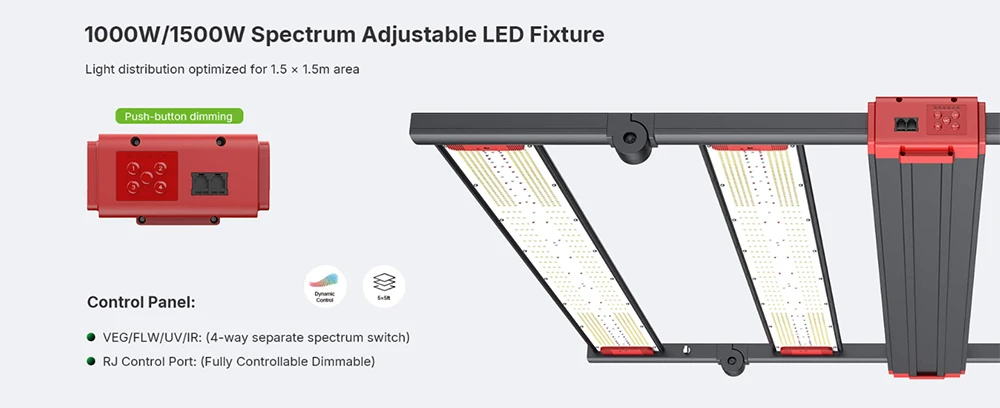
For commercial growers looking for a more integrated solution, we offer the BHL03 Horti-Rock. Designed for durability and high performance, the Horti-Rock features an adjustable spectrum that delivers uniform coverage and exceptional light distribution, ideal for vertical racking systems and indoor grow rooms. With this system, you can easily customize the light spectrum for both the vegetative and flowering stages, including independent control of UV and IR light as needed.
Ready to enhance your grow with UV and IR light?
Contact us.