
Use of LED Lights in Pest Management
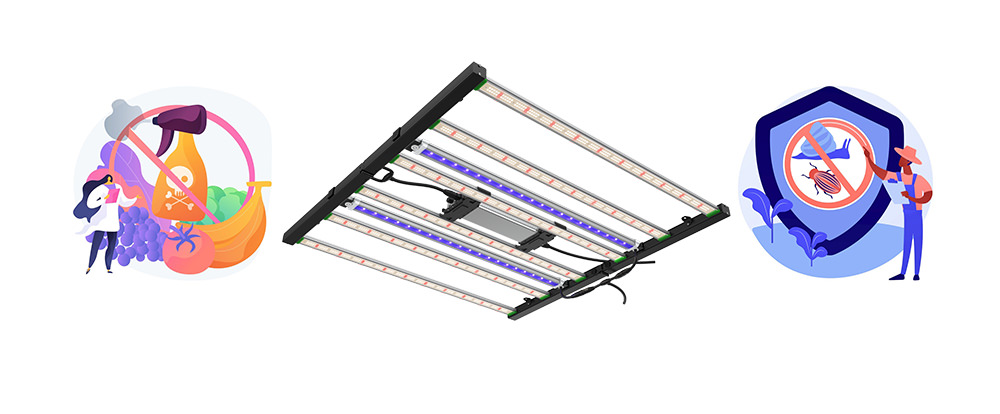
Pest management is critical in commercial greenhouses or indoor cultivation. Pests and insects will damage plants and cause serious economic loss. Various pesticides are common ways to fight pests and insects. But pesticides have potential toxicity to humans and plants. They can cause pollution to water and soil as well. So more and more growers utilize biological control, an IPM strategy, to manage pests and insects while reducing the use of pesticides.
Adding LED lights in biological control is one of the effective ways to reduce the use of pesticides. As is known, LED grow lights are used as the supplemental lighting or the sole light source for commercial growing, contributing to better plant quality, higher yields, and year-round production.
But the use of LED lights in pest management is rarely addressed. How do LED lights manage pest issues? Why LEDs but not other light sources? Find the answer in this post.
What are biocontrols
Biocontrols (biological controls) are methods that reduce the pest population through its natural enemies. Biocontrols are part of IPM (Integrated Pest Management), controlling pests with a reduction in the use of pesticides. Predators, parasitoids, and pathogens are the natural enemies of plant-eating pests. Introducing certain natural enemies into your greenhouses or indoor growing rooms can significantly reduce the pest populations. Biological controls provide a possibility to manage pest issues without the use of pesticides or chemicals.
Why are artificial lights attractive to pests?
Different pests have different phototactic behaviors, as well as the reasons for attraction towards light. Here are some common reasons for the attraction of pests to artificial lights.
Firstly, pests are attracted by artificial light because they regard artificial light as navigation. Before artificial light, pests kept themselves aligned with the help of the natural moon or stars at night. They take artificial light as navigation mistakenly, so they keep approaching artificial lights.
The second reason is that some pests are sensitive to UV light. Artificial UV lights will mistake them for flowers or sources of food. Thirdly, pests may mistake artificial lights as mating signals. Some pests, like fireflies, emit light for mating.
Why LEDs
Using artificial lights for managing pests and incest is not a new idea. The ability of UV light to kill microbes has been known for more than a century. Bug zappers have been used for many years to attract flying insects. Besides, fluorescent lights are still widely used to solve pest issues. Compared to fluorescent and incandescent lights, LEDs have various advantages.
High energy efficiency is the key reason for the broad selection of LED lights. To control pests effectively, artificial lights will be on for a long time. The long-term operation of artificial lights consumes many electricity, resulting in tremendous energy costs. LED lights use at least 70% less energy than conventional lights, which helps you save on your energy costs.
Another reason for using LEDs is that LED lights are programmable. This allows you to manage the pests with the most effective and efficient light spectrum, intensity, and photoperiod.
What kind of light is attractive to pests
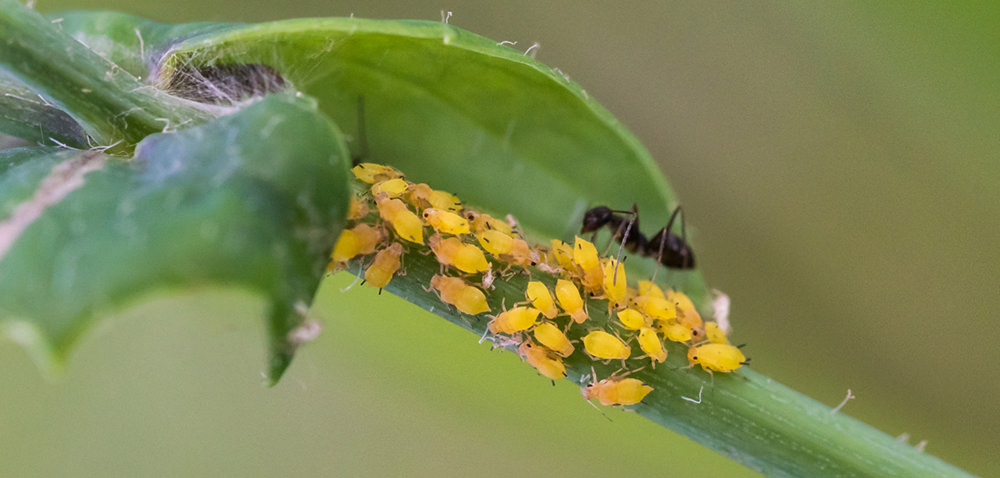
Unlike human eyes, pests and insects can see a broader band of the spectrum, ranging from 253nm to 650nm, about the UV and the ends of yellow light. Most pests see the wavelength range of 380nm to 420nm, the core range of UV-A light, every well. Therefore, UV-A light is the most attractive light to pests.
Except for wavelengths, pests have different attraction towards light of different brightness and heat. Brighter lights have a greater drawing distance to pests. Here is a short table about the light that is attractive to different pests and insects.
|
Pest and insect |
Light |
|
Whitefly |
UV, green - yellow |
|
Aphid |
UV, green - yellow |
|
coccinellids |
UV and red |
|
midge |
UV, blue, and green |
|
Kissing bug |
Blue |
|
honeybee |
UV and blue |
|
Red four beetle |
Green |
|
Orthopteran insects |
Blue and UV |
How LED lights manage pests
Similar to how factors that LED grow lights affect plants, supplementing LED lights can manage and affect the behaviors and dispersal of pests and insects through providing different light intensities, colors, and lighting hours.
Pests are sensitive to UV light
As mentioned earlier, different pests and insects are sensitive to different light colors. Most pests and insects are sensitive to UV light.
Many flying insects use artificial lights as navigation. If we cover the ground or greenhouses with a highly reflective mulching sheet that is covered by UV-blocking film, the normal orientation of flying insects will be disturbed by the light reflected from the ground. With the protection of reflected UV light, those flying insects cannot find or see plants. The use of UV light at night also helps control powdery mildew in cucumber and strawberry. Similarly, supplementing red light at night helps suppress downy mildew within the crops.
High light intensity is useful in mass trapping pests
In general, light intensity seems to have positive effects on beneficial insects. Providing supplemental lighting, even at low intensities, will help to break diapause in some beneficial insects. LED lights also benefit these insects by increasing mobility, dispersal, predation, or the rate of laying eggs. For certain unwanted pests and insects, lighting also affects their behaviors. According to the research, whiteflies are more attracted to blue sticky traps at higher light intensities. Thus, LED lights with higher intensities are useful in mass trapping of some pests and insects.
A certain light duration can influence circadian rhythms
Night-time treatment of LED lights for a certain duration can influence the circadian rhythms of pests and insects. Some pests and insects will move towards the stimulus of light (positive phototaxis) while others will move away from it (negative phototaxis). Exposing the pests and insects of negatively phototactic organisms to LED lights for a certain period can prevent them from entering growing rooms.
Moreover, exposing nocturnal pests and insects to LED lights for a certain duration at night can inhibit them from mating or flying. Providing LED lights to beneficial pests can break their diapause. For example, the flower bug goes through diapause in the winter months, and it needs at least 12 hours of lighting to break diapause. By supplementing LED lights, a light period of 12 hours or more can be achieved. Thus, beneficial pests and insects can predate plant-eating pests and insects.
Possible negative effects of LED lights on pest management
The main problem with the use of LED lights in pest management is will disturb the natural predator-prey balance. The increasing predators and reducing prey in greenhouses or indoor growing rooms can also affect the populations of other species in the surrounding areas. In addition, supplemental LED light (used for pest management) will cause light pollution, affecting the flower color and contrast at dusk and night.
When pest problems occur, you should check out why those problems occur first. What LED fixtures provide are effective tools to help you work with pest problems, but they cannot solve problems entirely. Pest management with LED lights also has negative effects.
Whether you want to add LED lights to improve plant growth or handle pest problems, consult a lighting expert for advice. If you need any help with lighting solutions, contact us.