
What Does Tc Mean on a LED Driver
Have you ever noticed the small marking on your grow light’s driver that reads “Tc = 75°C”? What exactly does “Tc” mean, and why does it matter?
The LED driver plays a crucial role in grow lights by converting AC power into the precise DC voltage and current needed to power the LEDs. They ensure consistent light output while protecting the sensitive electronic components inside.
However, LED drivers are highly sensitive to heat. Excessive temperatures can silently damage their internal electronics, significantly shortening their lifespan and compromising the reliability of the lighting system.
That’s where “Tc”, short for case temperature, comes in. It indicates the maximum allowed temperature on the driver’s cage during normal operation.
What is Tc
Tc stands for the case temperature. This rating marks the highest temperature that the driver’s enclosure can safely reach under continuous load, measured at a standardized test point on the housing.
Think of Tc as the thermal redline of the driver. Just as you wouldn’t run a car engine beyond its maximum RPM, exceeding the Tc rating pushes the LED driver into dangerous territory where component degradation accelerates exponentially.
Manufacturers determine Tc using thermal sensors coupled to the driver’s case. During testing, the driver is operated at full load within a controlled chamber, and temperature rise is tracked until it stabilizes. Most commercial LED drivers carry Tc ratings between 70°C and 90°C, with 85°C being the high-quality units.
The relationship between Tc, Ta, and the LED driver lifespan
Tc is not the same as Ta.
Ta refers to the ambient temperature, which is the temperature of the air surrounding the LED driver. It is typically measured directly on the surface of the driver’s housing.
In environments such as greenhouses and vertical farms, ambient conditions can vary widely. These conditions often result in higher Ta than what is found in standard indoor environments. When Ta increases, the case temperature of the LED driver also rises.
The increase in temperature has a significant impact on the lifespan of the driver. For every 10°C increase in operating temperature, the lifespan of the driver can be reduced by up to 50%. This is because internal components, including electrolytic capacitors and semiconductor switches, are highly sensitive to heat. Higher temperatures accelerate their wear and can lead to early failure.
Why Tc Matters in Commercial Growing Operations
In commercial horticulture, effective heat management is critical not only for plant health but also for equipment performance and operational reliability. Failing to manage heat can lead to overheating, reduced component lifespan, and unexpected system failures that disrupt your growing schedule.
It is a common misconception that a grow room operating within acceptable Ta ranges ensures safe and efficient operation. However, Tc is not the same as Ta. While most plants thrive in ambient temperatures between 10°C and 30°C, the internal temperature of electrical components can be much higher. A low ambient temperature does not guarantee a low Tc, especially when drivers operate under heavy loads or in areas with inadequate ventilation.
Exceeding the Tc limit does not always result in immediate failure. In most cases, performance degradation begins gradually. The efficiency of LED drivers decreases, meaning more energy is consumed without producing a proportional light output. This inefficiency directly increases electricity costs. At the same time, excessive heat can lead to spectral shift in LED chips, altering the light spectrum that crops depend on for optimal growth and development.
The financial consequences of poor thermal management can be severe. A single driver failure during a growth stage, such as flowering, may result in thousands of dollars in lost yield. If thermal stress affects multiple fixtures across your facility, maintenance becomes unpredictable and operating costs increase.
So understanding Tc is essential for protecting your investment, ensuring consistent crop quality, and maintaining an efficient and reliable growing operation.
Thermal management strategies
As previously discussed, a higher Ta contributes to an increase in Tc. Therefore, lowering the ambient temperature is an effective way to help keep LED grow lights operating within their specified Tc limits.
When considering thermal management, many growers immediately think of costly cooling systems. Fans can improve ventilation and air movement, while air conditioning systems can effectively reduce ambient temperatures. While active cooling is indeed effective, it is not the only solution.
Proper driver placement has a significant impact on thermal management. For example, our HB35 Horti-Top uses an external driver, which reduces the risk of overheating during prolonged sun exposure in greenhouses. By keeping the driver separate from the LED module, the system avoids heat accumulation, protecting the LEDs from thermal stress and extending their lifespan.
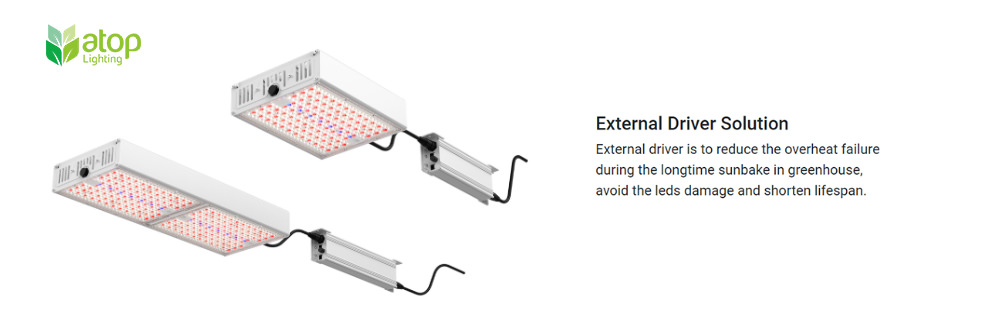
Components of LED grow light, such as heat sinks and thermal interface materials, also play a key role in enhancing heat dissipation. This is especially important in enclosed fixture designs where natural airflow is restricted and convection is limited.