
How Much Light Does Dill Need Under LEDs
Growing dill commercially comes down to two main goals: maximizing biomass and increasing essential oil concentration.
Under low light, dill tends to produce thin, elongated stems and weaker growth, with lower aromatic quality. With the right light level and spectrum, plants can stay more compact while producing stronger aroma and higher essential oil content.
The key is not just how much light dill receives, but also what kind of light it receives. Light intensity and spectrum both affect how dill grows, develops, and produces the compounds that give it its characteristic aroma.
How Much Light Does Dill Need?
For commercial dill production under LEDs, a practical starting point is 200 to 300 µmol/m²/s PPFD, a DLI of 12 to 20 mol/m²/day, and a 12 to 14 hour photoperiod.
Dill does not require the high light levels used for fruiting crops such as tomato, but it still needs adequate light to produce compact, marketable growth. When light levels are too low, dill tends to become more elongated and produces less shoot biomass.
Recommended LED Lighting Targets for Dill
|
Lighting Metric |
Target Value for Dill |
Impact |
|
DLI |
12 – 20 mol·m⁻²·d⁻¹ |
Supports shoot biomass and crop development |
|
Sole-Source PPFD |
200 – 300 µmol·m⁻²·s⁻¹ |
Suitable starting range when LEDs provide all crop light |
|
Supplemental PPFD |
100 – 150 µmol·m⁻²·s⁻¹ |
Helps maintain adequate daily light when greenhouse sunlight is limited |
|
Photoperiod |
12 – 14 hours/day |
Provides a practical balance between daily light delivery and crop development |
DLI Matters More Than PPFD Alone
PPFD tells you how much light reaches the canopy at a given moment. DLI tells you how much usable light the crop receives over the entire day. Both need to be considered when designing a dill lighting system.
For example, a PPFD of 250 µmol/m²/s for 14 hours delivers a DLI of approximately 12.6 mol/m²/day.
This is why simply increasing PPFD does not tell you whether the crop is receiving the right amount of light. You need to consider PPFD and photoperiod together.
For greenhouse production, supplemental lighting should also be based on the amount of sunlight already reaching the crop. The goal is to provide the required daily light level, not to maintain the same LED PPFD throughout every hour of the day.
Light Spectrum Affects Dill Flavor and Volatile Oils
Research suggests that light spectrum can influence dill growth as well as the concentration and composition of its essential oils and other bioactive compounds.
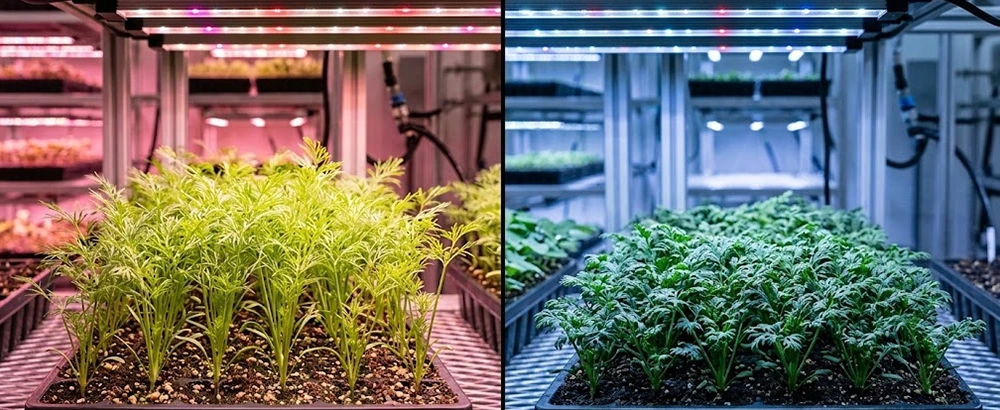
For general growth, red and blue light are both important. Studies using different red-to-blue ratios have found that red-heavy spectra can support strong biomass production and photosynthesis, while adding more blue light tends to produce shorter, more compact plants. A red-to-blue ratio in the range of roughly 60:20 to 50:30 has shown a good balance between growth and photosynthetic performance in some experiments. [2]
However, biomass is only part of the picture. Spectrum can also change the plant's chemical profile even when differences in height and fresh weight are relatively small.
In an Iowa State University study, researchers compared HPS lighting with two LED spectra, one predominantly red and another with a higher proportion of blue light. Plant height and biomass changed little between the treatments, but the concentration of several compounds changed substantially.
Under the predominantly red LED treatment, myrcene increased by about 322% and cineole by about 285% compared with HPS. Under the higher-blue LED treatment, quercetin increased by nearly three times, while myristicin and dillapiole increased by more than 80%. [2]
A 2024 study involving three dill cultivars also found that a red-blue LED treatment at approximately 75:25 improved pigments, phenolic compounds, and antioxidant capacity compared with natural greenhouse light. [3]
The practical takeaway is important for commercial herb production: spectrum can be used to influence crop quality, not just biomass. A lighting strategy designed for dill should therefore consider the desired balance between plant architecture, yield, aroma, and the specific compounds that contribute to product quality.
These results should not be interpreted as proof that one red-to-blue ratio is optimal for every dill production system. Cultivar, PPFD, photoperiod, temperature, nutrition, harvest stage, and other environmental conditions can all affect the plant's response. For commercial production, spectrum should be validated under the actual growing conditions rather than selected from a ratio alone.
What to Look for in an LED System
For commercial dill production, evaluate an LED fixture based on measured canopy-level performance, not wattage alone.
Key specifications include:
- PPFD and uniformity: The fixture should deliver the required light level consistently across the growing area, not just at the center of the canopy.
- Efficacy: Look for high photon efficacy, measured in µmol/J, so the system can deliver the required light with reasonable electricity consumption.
- Spectrum: A useful red and blue component gives growers more control over plant architecture, growth, and crop chemistry. The appropriate balance depends on the production goal.
- Optical design and form factor: Fixture height, beam angle, rack spacing, and canopy density all affect how efficiently light reaches the crop.
- Dimming and controls: Adjustable output allows growers to match light levels to crop stage, environmental conditions, and daily light requirements.
- System flexibility: For OEM and ODM applications, a tunable platform can be more practical than a fixed spectrum when the same fixture will be used for multiple herb crops.
If you are developing an OEM or ODM LED fixture for herb growers, whether for a dedicated dill application or a tunable platform for multiple herb crops, we can help you evaluate the optical, electrical, and spectrum requirements for the application.
Get in touch to discuss your project.
Source
1. Litwin, A.G, Currey, C.J., Wilson, L.A.(2020). Effects of Supplemental Light Source on Basil, Dill, and Parsley Growth, Morphology, Aroma, and Flavor.Journal of the American Society for Horticultural Science, 145(1),18-27.
2. Fraszczak, B, Gasecka, M., Golcz, A., Zawirska-Wojtasiak, R. (2016).The effect ofradiation ofLED modules on the growth of dill (Anethum graveolens L.).Open Life Sciences,11(1),61-70.
3. Changes in Morphological, Physiological and Phytochemical Traits of Different Dill Cultivars as Affected by Light-Emitting Diodes. (2024). Molecules,29(23),5506.