
A Look Inside the SMT Workshop Behind Horticulture Lighting Solutions
When discussing LED grow lights, most conversations focus on spectrum, efficacy, and price. However, the true quality of a lighting fixture often begins much earlier than what you see in the finished product. It starts with the circuit board assembly.
What happens on the production line directly influences how well the product performs in real applications.
At Atop, we operate an in-house SMT workshop. Before a grow light ever reaches a greenhouse or indoor farm, before it ever delivers its first PPFD reading, it starts as a bare board in this workshop. Our SMT production lines ensure that every single light-emitting diode (LED) is placed with micro-level precision. This internal control over the assembly process is what allows our lighting solutions to withstand the harsh indoor farming environments while maintaining optimal spectral output.
What is SMT, and why does it matter for LED grow lights?
SMT means Surface Mount Technology. It is a manufacturing process in which electronic components are mounted directly onto the surface of a PCB (Printed Circuit Board).
Compared with old through-hole assembly, SMT allows components to be placed with high precision and at a much higher speed. This results in more compact designs and more reliable electrical connections.
Today, SMT is widely used in high-performance LED products across the market.
For horticulture lighting, precision in the SMT process is especially important. If an LED is positioned even 0.1 mm off center during assembly, the lens may not sit properly on the fixture. This type of misalignment does more than affect appearance. It can shorten the lifespan of the product and lead to spectrum drift, uneven light distribution, and inconsistent PPFD output. These issues can ultimately affect your brand reputation and crop performance.
Equipment and process in our SMT workshop
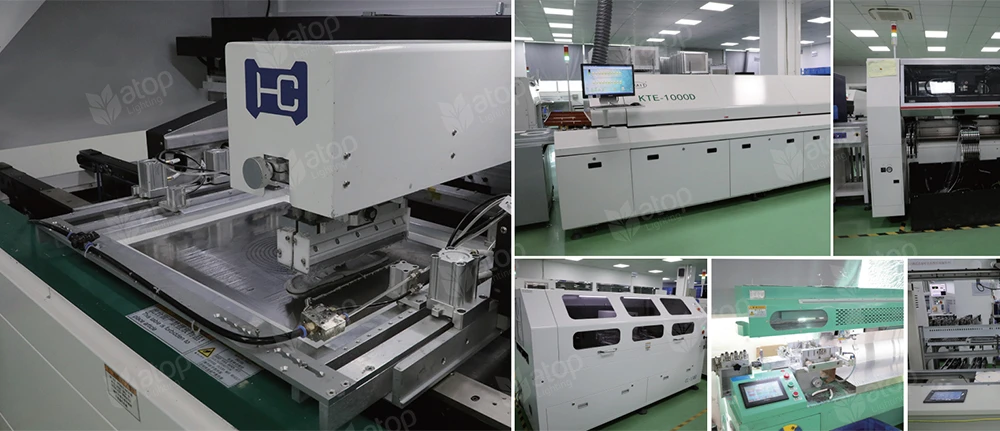
At Atop, we have invested in our own SMT workshop to maintain tighter control over quality, consistency, and product development. The SMT lines in our factory function as fully automated PCB assembly systems designed to place and solder thousands of LED chips with high precision.
Let’s take a brief look at the main equipment and processes in our SMT workshop.
Solder paste printing
The first step is applying solder paste to the board.
We use fully automatic, high-precision stencil printers to apply solder paste to the board. A stencil is accurately aligned with the PCB, and solder paste is deposited onto each pad with controlled pressure and speed.
This automated process helps eliminate the inconsistencies and errors that can occur with manual printing.
Solder paste inspection (SPI)
After printing, the boards pass through the SPI system. This equipment measures the height, volume, and alignment of the solder paste deposits.
We catch potential manufacturing defects at this stage. If the solder paste does not meet the required standard, the board is cleaned, and the printing process is repeated.
Pick and place
The pick and place machines form the core of the SMT workshop. Using high-speed operation and vision-guided positioning, these machines accurately place LEDs, resistors, capacitors, and driver ICs onto the PCB.
That is where the precise light recipes are. Whether your recipe requires a specific red to blue ratio or UV/IR integration, these machines pick and right and place the LEDs and components right, ensuring the intended spectrum and performance.
Reflow soldering
This process carefully controls temperature zones to melt and set the solder paste, forming stable, consistent joints.
The reflow profile is optimized for the thermal characteristics of horticultural LEDs, ensuring that components are securely bonded without being exposed to excessive heat.
Automated Optical Inspection
Our automated optical inspection system looks at each board with high‑resolution cameras. It checks alignment, polarity, solder quality, and other details that are easy to miss with the naked eye. This step catches tiny issues before they become big problems.
Each board is inspected and recorded in our quality control system, providing an additional layer of assurance for both you and your end users.
How our SMT workshop supports your project
Having an SMT workshop is only part of the story. What matters most is whether we can take your specific project, with its unique specifications, timeline, and production volume, and deliver it reliably. Our SMT capability is designed to provide practical support throughout your product development and manufacturing process.
Faster custom spectrum development
Many horticulture lighting projects require unique spectral combinations, such as different ratios of blue, red, UV, or specific LED bins. With our in-house SMT lines, we can assemble custom diode configurations without relying on external assembly partners. This allows us to prototype new spectrum boards within days, helping your team test and refine designs much faster.
Lower cost and higher reliability
For large-scale production, automation in our SMT workshop helps reduce manufacturing costs while maintaining consistent quality. Precise and repeatable assembly ensures uniform performance across thousands of units and improves long-term product reliability.
Responsive lead times
Speed to market is critical in the competitive horticulture lighting industry, where growing cycles and project schedules cannot be delayed. Our SMT lines are scheduled to support both urgent prototype runs and planned mass production, giving your team the flexibility to move quickly while maintaining high manufacturing standards.
Built around your specifications
As a trusted OEM and ODM partner, our role is not to push standard products but to build solutions based on your requirements. If you have preferred component brands, specific IPC workmanship standards, or particular testing procedures, we incorporate them into the production process from the beginning.
This strict adherence to component-level quality is a core reason why large-scale facilities rely on specialized solutions like our Inter-caopy lighting, where reliable, continuous lower-canopy lighting is critical to maximizing yield.
Tell us about your project. Our team is ready to help you turn your ideas into a reliable product.