Lighting Targets for Indoor Dwarf Tomatoes Production
Dwarf and micro-dwarf tomatoes stay short and yield high volumes of fruit. Varieties like Micro-Tom typically finish around 15-20 cm tall. This makes them a better fit for multi-tier vertical systems and plant factories with artificial light than indeterminate tomatoes that can easily climb past a meter.
But the compact size doesn’t change the need for proper lighting. Dwarf tomatoes have completely different lighting requirements than high-wire crops.
PPFD and DLI targets by growth stage
Dwarf tomatoes require a regular dark period to avoid leaf chlorosis and physiological stress. Here we take a 16-hour light and 8-hour dark photoperiod is standard. Here is the recommended PPFD and DLI based on this photoperiod.
|
Growth stage |
Target PPFD |
Approx DLI |
|
Seedling (0-2 weeks) |
100-200 µmol m⁻² s⁻¹ |
5.5-11.5 mol m⁻² day⁻¹
|
|
Vegetative |
300 µmol m⁻² s⁻¹ |
17 mol m⁻² day⁻¹ |
|
Flowing/fruiting |
300 µmol m⁻² s⁻¹ |
17 mol m⁻² day⁻¹ |
Dwarf tomatoes require high light levels to support fruit load
A vertical-system trial at Virginia Tech grew Micro-Tom, Jochalos, and Venus under three DLI levels: 16.9, 22.7, and 27.9 mol m⁻² day⁻¹ (roughly 260–430 µmol m⁻² s⁻¹ at an 18-hour photoperiod). Higher DLI increased fruit number, fruit weight, and Brix. Micro-Tom produced the most fruits; Jochalos produced the highest weight and sugar content.
The work confirms that dwarf tomatoes can perform in multi-tier setups, but the light level still has to be high enough to support fruit load.
More light doesn’t mean more tomatoes
A common misconception in commercial indoor farming is that more light means more profit. Higher PPFD usually increases total plant biomass; it does not always improve your FBRUE (Fruit Biomass Radiation-Use Efficiency). FBRUE means the ratio of harvested fruit weight to the electricity spent powering the LEDs.
A study from Chiba University published in Frontiers in Plant Science analyzed micro-dwarf tomatoes ('Micro-Tom') across different light levels during their reproductive stage: 200, 300, 500, and 700 µmol m⁻² s⁻¹. Higher PPFD produced more total biomass, as expected. The interesting part is the efficiency.
Fruit biomass radiation-use efficiency (FBRUE) and overall radiation-use efficiency (RUE) both peaked at 300 µmol m⁻² s⁻¹. When intensity rose from 300 to 700 µmol m⁻² s⁻¹, FBRUE dropped about 38 %. The plants simply converted photons into fruit dry matter less effectively. Leaf absorptance, photosynthetic quantum yield, and maximum photosynthetic rate all declined at the higher intensities.
Why does efficiency drop at higher intensities? At excessive light levels, leaf absorptance and photosynthetic quantum yield decrease. The plant shifts energy toward protection and stress management rather than driving photoassimilates into the fruit.
Red and blue vs. full spectrum
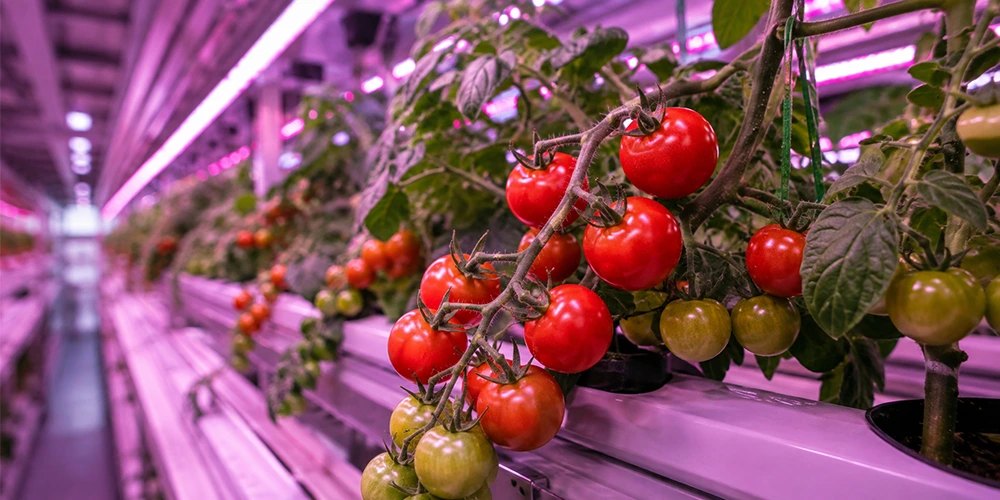
Red/blue mixes are used for efficient vegetative structure, and a broader white spectrum is introduced for flowering and fruiting. Supplementing low levels of UVA in the late fruiting stage can stimulate plant defense mechanisms, increasing soluble solids and antioxidant compounds like lycopene without sacrificing yield.
One study on the cultivar Microtom compared full-spectrum, red-blue, and fluorescent light. Full-spectrum increased polyphenols, flavonoids, tannins, ascorbic acid, and lycopene relative to the other treatments. Red-blue produced the highest carotenoid levels and antioxidant capacity but lower polyphenol content. The light recipe therefore changes the nutritional profile of the fruit, not just the total yield.
A separate plant-factory trial with ‘Red Robin’ and ‘Tiny Tim Red’ added UV-A to fluorescent lighting. UV-A reduced fruit cracking and raised soluble solids, acidity, and ascorbic acid. Carotenoid content and individual fruit size dropped slightly. Yield per plant stayed about the same.
For commercial production, the practical takeaway is straightforward: a customized LED grow light with dynamic lighting gives more flexibility than a fixed fixture. Multi-channel LED grow lights fit the lighting needs of dwarf tomatoes from seedlings to fruit.
Lighting targets for indoor dwarf tomato production
Dwarf and micro-dwarf tomatoes represent a practical future for indoor fruit production. Success comes down to efficiency: targeting 300 to 400 PPFD, maintaining a photoperiod that reaches a 17 DLI, and using dynamic LED grow lights that improve yield while reducing energy.
If you are developing a commercial indoor farming facility or designing LED grow lights for dwarf tomato production, reach out to our engineering team to discuss custom OEM/ODM fixture designs.