
Lighting Strategies for Boosting Indoor Kale Yields
More and more people are looking for fresh, locally grown food, and kale has become a popular choice for both growers and consumers. This leafy green is full of fiber, essential vitamins, and antioxidants. Kale also grows quickly, takes up little space, and works well in indoor or vertical farming setups.
But growing kale indoors is not just about providing enough light. It is about giving the plants the right light, at the right intensity, with the right spectrum, and at the right time during each stage of their growth.
Today, let’s explore the lighting strategies that improve your indoor kale yields.

Kale’s natural lighting needs
Kale is a cool-season crop that naturally grows during the moderate light conditions of spring and fall.
In outdoor environments, it needs at least 6 hours of direct sunlight each day. This amount of sunlight provides a strong Daily Light Integral (DLI), which is the total amount of light a plant receives over the course of a day.
To grow well and develop its best flavor, kale needs a high amount of light. For healthy, vigorous growth, the ideal DLI for kale ranges between 13 and 18 mol/m²/day.
When it comes to light quality, natural sunlight offers a full spectrum of wavelengths. This includes blue, red, green, far-red light, etc, all of which play a role in different stages of kale’s development.
Lighting strategies to maximize indoor kale yield
LED grow lights are now widely used to replicate natural sunlight and provide the energy kale needs to thrive. When planning your indoor lighting setup for kale, it’s important to focus on the light spectrum, intensity, and photoperiod.
The right light spectrum
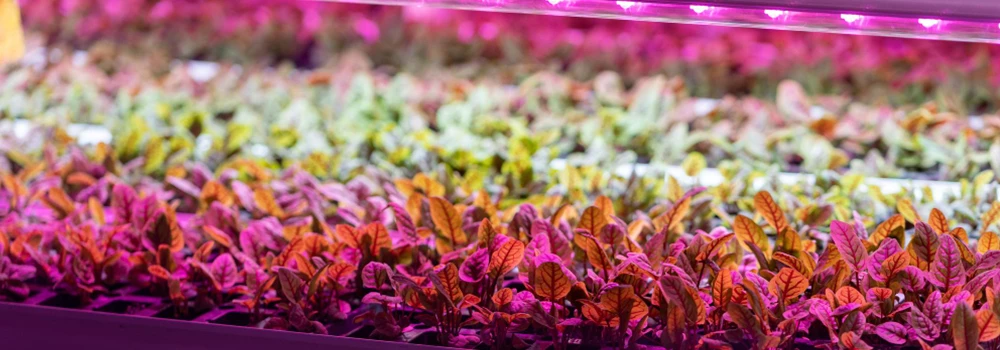
Most grow lights for leafy greens use mostly red light and a smaller amount of blue. A good mix is usually about 70 to 95 percent red and 5 to 30 percent blue.
Some studies have looked at how different colors of light affect kale, especially at the microgreen stage. One study tested four types of light: white, blue, red, and a purple mix of red and blue. The purple mix, 30 percent blue and 70 percent red, gave the best overall results. The plants were short but had longer baby leaves, and the blue light helped increase antioxidants, which is great for nutrition.
Another study tried switching light colors halfway through the growing period. Starting with white light and switching to red later made the plants heavier and taller. But it also made the leaves lighter and a bit yellow, which might not look as nice.
Besides red and blue, kale also benefits from green and far-red light. Green light helps light reach deeper into the plant, and far-red light makes the leaves and stems grow longer. This can help make the plants taller and more open, which looks better and improves marketability.
How much light and how long
When cultivating kale in a controlled environment, optimizing the photoperiod and light intensity is essential for maximizing yield.
One key parameter for light intensity is PPFD (Photosynthetic Photon Flux Density), which measures the number of photosynthetically active photons (within the PAR spectrum) that strike a square meter per second. However, PPFD values can vary significantly depending on the distance between the light source and the plant canopy; closer distances yield higher PPFD readings.
For kale, a typical PPFD range of 150 to 500 µmol/m²/s is considered suitable, depending on the growth stage and cultivar.
Kale requires a minimum of 6 hours of sunlight per day when grown outdoors. In indoor or controlled environments, however, kale needs longer light durations. It requires about 12 to 18 hours of artificial light per day to maintain optimal photosynthesis and growth.
To better capture the total daily light exposure, growers use Daily Light Integral (DLI), which quantifies the total amount of PAR light a plant receives over a 24-hour period. Unlike PPFD, DLI accounts for both the intensity and duration of light. For kale, an optimal DLI falls between 13 and 18 mol/m²/day.
Studies have shown that extending the photoperiod while using lower light intensities can lead to beneficial morphological outcomes, such as increased plant height and dry weight. This is particularly notable in kale cultivars like ‘Half Tall’ and ‘Scarlet’.
Environmental control for optimal indoor kale production
In a controlled indoor environment, the factors influencing yield go beyond lighting alone. Even with the best lighting strategies in place, achieving optimal plant growth also requires the right balance of other environmental conditions, such as temperature, humidity, air circulation, and CO₂ levels.
Here is a table about the environmental factors for optimal indoor kale production.
|
Environmental factor |
Recommended range |
|
Air temperature |
18-24°C (64-75°F) |
|
Relative Humidity (RH) |
55-65% |
|
CO2 Concentration |
700-1000 ppm |
|
Nutrient Solution pH (Hydroponics) |
5.5-6.5 |
|
Water Temperature (Hydroponics) |
18-21°C (65-70°F) |
|
Airflow |
Gentle, consistent air movement |
At Atop, we offer lighting solutions tailored for a variety of indoor leafy greens. Feel free to contact us and explore our case studies to see how we’ve helped growers succeed.
Reference
- Singapore Food Agency. (2024, July). Effect of light spectrum on leafy vegetables.
- Wojciechowska, Renata, Anna Dąbrowa, and Anna Kołton. 2023. "How Monochromatic and Composed Light Affect the Kale ‘Scarlet’ in Its Initial Growth Stage." Acta Scientiarum Polonorum Hortorum Cultus 22 (3): 93–100.
- Lee, Seom, Chang Ha Park, Jin Kyung Kim, Kyungmin Ahn, Haejin Kwon, Jae Kwang Kim, Sang Un Park, and Hyeon Ji Yeo. "LED Lights Influenced Phytochemical Contents and Biological Activities in Kale (Brassica oleracea L. var. acephala) Microgreens." Antioxidants, n.d.
- Blanche, James Travis, "Examining physiological and photosynthetic effect of LED lighting on lettuce and kale microgreens" (2023). Theses and Dissertations. 5829.
- Valoya. (n.d.). Optimizing kale (Brassica oleracea) growth: Effects of photoperiod and light intensity.