
Is Indoor Weed Better Than Outdoor?
The argument over indoor versus outdoor cannabis has been going on for decades.
Indoor growers stand by consistency, trichome production, and shelf appeal. Outdoor growers point to stronger terpene profiles, lower production costs per gram, and the fact that cannabis evolved under natural sunlight for thousands of years.
But in today’s mature and highly competitive market, the real question for licensed commercial operators is not whether indoor weed is “better” than outdoor. It is which growing method makes the most sense for the business, the target market, and the overall cost structure.
The market has changed. Wholesale cannabis prices in states like California and Colorado have dropped heavily over the past five years. Energy costs continue to rise. Product testing standards are stricter than before.
At the same time, horticulture lighting technology has improved quickly. Because of that, the quality gap between a well-run indoor facility and a well-managed outdoor crop is no longer as obvious as it used to be.
Market Economics and Commercial Positioning
For commercial cannabis operators, the main business question is simple: What is the real cost per gram of sellable flower, and what wholesale price can that flower consistently achieve?
Indoor farms, outdoor cultivation, and greenhouse operations each have very different financial models. Capital costs, operating costs, labor, yield consistency, and product quality all affect long-term profitability.
|
Financial Metric |
Indoor Farm (Multi-Tier) |
Outdoor Cultivation |
High-Tech Hybrid Greenhouse |
|
Capital Expenditure (CapEx) |
High (HVAC, LED, Automation) |
Low (Basic Irrigation/Tractors) |
Moderate to High (Glass, LEDs) |
|
Operating Expenses (OpEx) |
High (Energy, Facility Labor) |
Low (Seasonal, Ag-Labor) |
Balanced (Optimized Power/Sun) |
|
Wholesale Pricing Floor |
Premium ($1,500 – $2,500+/lb) |
Commodity ($200 – $400/lb) |
Variable ($600 – $1,200/lb) |
|
Annual Harvest Cycles |
5 – 6 Continuous Cycles |
1 Seasonal Harvest |
3 – 5 Light-Deprivation Cycles |
Indoor: Higher CapEx/OpEx with Premium Pricing Potential
Indoor controlled environment agriculture (CEA) requires high initial CapEx. Climate controls, automated fertigation, and LED grow lights represent a significant upfront asset investment. Furthermore, ongoing OpEx remains high due to continuous electrical draws for multi-tier environmental maintenance and specialized facilities labor.
But indoor cultivation mitigates financial risk through premium market positioning. Indoor facilities consistently produce visually attractive flower that commands top-tier wholesale pricing ($1,500 to $2,500+ per pound).
Outdoor: Lower Production Costs with Greater Market Pressure
Outdoor cultivation has the lowest production cost structure. But low production cost does not always mean strong profitability.
Outdoor biomass faces intense market saturation, frequently bottoming out at commodity pricing of $200 to $400 per pound. Environmental exposure also creates more production risk. Heat waves, rain, pests, mold, and seasonal variability can all reduce crop quality or total yield.
Greenhouse: Hybrid Economics with Supplemental Lighting
Commercial greenhouse represents the middle ground of cultivation economics, balancing the low operational costs of utilizing natural sunlight with the environmental protection of an indoor build.
The true economic driver of a modern greenhouse is the integration of high-efficiency supplemental LED lighting. With properly designed LED systems, growers can stabilize daily light integral (DLI), extend photoperiod control, and maintain more consistent year-round production.
This allows greenhouse facilities to improve crop consistency and flower quality without taking on the full energy burden of a fully indoor operation.
Photobiology and Environmental Control
Light is one of the main drivers of cannabinoid production, terpene expression, flower density, and overall crop quality in cannabis cultivation. How growers manage light and other environmental factors directly affects both yield and market value.
Indoor: Precision PPFD, Spectral Tuning, and Year-Round Cycles
Indoor cultivation allows for absolute control over PPFD and DLI.
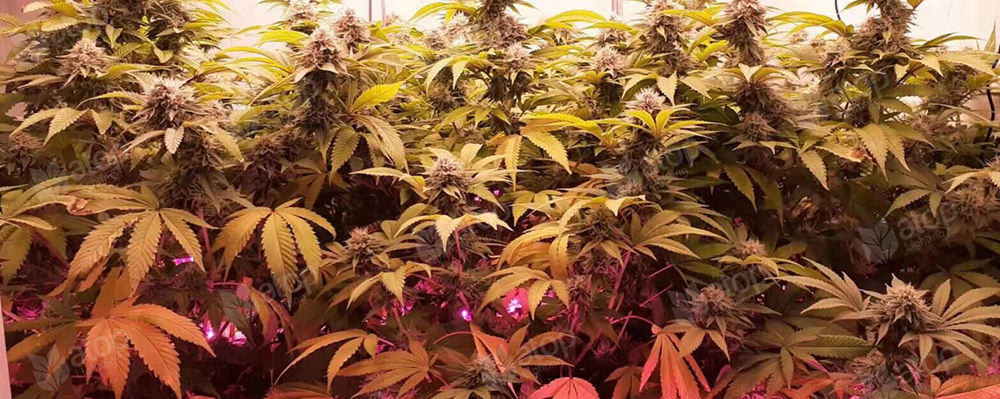
During flowering, many commercial indoor farms target PPFD levels between 800 and 1,000+ μmol/m²/s. With proper environmental management, these light levels can support high flower density and strong cannabinoid production.
Dynamic and multi-channel LED grow lights give operators more control over plant structure, flowering response, and secondary metabolite production.
Outdoor: Solar Variability, Seasonal Limits, and Terroir Effects
Outdoor cultivation relies completely on natural sunlight and seasonal weather patterns. This creates variability that growers cannot fully control.
The main advantage of outdoor cultivation is the sun itself. Natural sunlight delivers a full-spectrum light source, including UV-A and UV-B radiation
Ultraviolet exposure acts as a natural stress factor for cannabis plants. In response, plants may increase trichome production and secondary metabolites as part of their protective mechanisms.
Climate, elevation, temperature swings, and soil conditions also influence terpene expression and overall plant characteristics.
This combination of environmental factors creates what many growers refer to as terroir, meaning a distinct regional expression in aroma, flavor, and plant performance.
Greenhouse: Controlled Environment with Sunlight + LEDs
Greenhouses use the sun as their primary light engine while maintaining structural environmental control.
The main limitation is seasonal light availability. During winter months or in northern growing regions, natural DLI levels often fall below what commercial cannabis crops need for premium flower production.
This is where supplemental LED lighting becomes critical. Instead of replacing sunlight, supplemental LEDs help close the lighting gap when natural conditions are no longer sufficient for consistent commercial yields.
Risk & Compliance
Risk management is a major part of commercial cannabis production. In regulated markets, a single failed lab test can force operators to destroy an entire harvest batch. That can mean hundreds of thousands of dollars in direct losses, along with supply disruptions and damage to brand reputation.
For large-scale cultivators, reducing contamination risk and maintaining consistent compliance standards are just as important as maximizing yield
Indoor: Reduced Microbial/Pesticide Risk and Seamless Batch Replication
One of the biggest advantages of indoor cultivation is environmental control and biosecurity.
Indoor facilities isolate the crop from outside contamination sources such as airborne spores, pests, pollen, dust, and changing weather conditions. Most commercial indoor operations use multi-stage HVAC systems with filtration, humidity control, and positive air pressure to reduce contamination risk inside flowering rooms.
Indoor cultivation also gives operators tighter control over irrigation and nutrient delivery. Crops are typically grown in controlled substrates using automated fertigation systems, which helps reduce variability between batches.
Outdoor: High Contamination Exposure and Failed Test Costs
Outdoor cultivation operates in an open environment, which increases exposure to contamination risks that growers cannot fully control.
Cannabis flowers naturally produce sticky resin and dense trichome coverage. While valuable for cannabinoid production, these resinous surfaces can also collect airborne particles from the surrounding environment.
Outdoor crops may be exposed to dust, wildfire ash, fungal spores, insects, pollen, and regional pollution. Weather events such as rain and high humidity can also increase mold and mildew pressure during flowering.
Even growers following strict organic cultivation practices may still face contamination risks from neighboring farms, pesticide drift, or heavy metals present in water and soil sources.
As testing requirements become stricter across legal markets, these environmental variables create additional operational risk for outdoor cultivators.
Regulatory Implications for GMP, ISO, and State Compliance
As the cannabis industry matures, regulatory standards are increasingly moving closer to pharmaceutical and food manufacturing requirements. This is especially true for operators targeting medical markets, export programs, or long-term institutional partnerships.
Good Manufacturing Practices (GMP) require documented control over cultivation inputs, environmental conditions, sanitation procedures, and product traceability throughout the production cycle.
Indoor facilities are generally better suited for GMP compliance because they are built around controlled environments.
Indoor cultivation facilities can also integrate standard operating procedures designed around ISO cleanroom standards. Air filtration, room pressure control, and controlled personnel movement help operators maintain cleaner production environments and reduce contamination risk during cultivation and post-harvest handling.
Matching the Production Model to Your Business Goals
There is no universal answer to whether indoor is better than outdoor. There is only the right model for your market position, your capital structure, and your risk tolerance.
Indoor suits operations competing on premium flower, year-round production, and compliance-heavy regulatory environments. The higher CapEx and OpEx are justified when your cost per gram is managed tightly, and your wholesale relationships value consistency above price.
Outdoor suits operators serving the extraction and biomass market at scale, where cost of production matters more than shelf appeal. In the right climate, with the right genetics, outdoor remains the most capital-efficient way to grow cannabis.
Greenhouse with supplemental lighting is where the most interesting commercial growth is happening right now. For operators who need flexibility without the full capital commitment of indoor, it is worth serious evaluation.
If you choose indoor farms or greenhouses for growing cannabis, lighting remains one of the most important variables you can control.
Ready to talk through your lighting setup? Contact our team to discuss your cultivation goals and facility requirements.
Disclaimer: This Content Is Intended For Educational Purposes Only. We Do Not Endorse Or Promote Illegal Activities Related To Cannabis.