
Choosing Greenhouse LED Grow Lights: Why Atop Lighting
LED grow lights are crucial to plants that grow in areas where lighting is insufficient, as they can help in the growth of plants that are indoors. These plants don't have access to natural light, as some parts of the house have no windows, resulting in a dark indoor growing environment.
To this end, we have energy-efficient LED grow lights, which are economical in their use and also help the plant grow better than traditional light does. LEDs are small electronic components. Different coloured lights are due to different semiconductor materials. When electric currents flow through LEDs, they emit diverse light because of different component materials and different proportions of various LED beads.
The first generation of LEDs was less advanced in terms of the limited selection of colors. With LEDs being researched and developed, LEDs are more advanced with higher levels of brightness and wider spectral ranges, even including ultraviolet, an invisible light.
Atop Lighting has a series of LED grow lights suitable for horticulture, greenhouse, or what is known as LED grow lights.
LED grow lights use LED chips in an efficient way to produce plant-growing light. Although there are many similar shapes of agricultural light facilities in the market, it is possible that the spectral colors and the emitted photon flux are different. Except for the quality of LED chips, which determines the light is the design of lamps. It’s essential to comprehend which kind of LED grow lights is best for your plants. Compared to other grow light suppliers, the LED grow lights of Atop Lighting have the ability to be customized to meet the needs of the plant.
How do LED grow lights work?
Different LED grow lights are directly related to intended purposes. The LED horticulture light emits photosynthetic photons that influence plants' growth and flowering, maybe root formation as well.
- Red light helps the growth of stems and enlarges the area of leaves, and also has an effect on the flowering period and seed germination.
- Blue light affects the chlorophyll content and the thickness of leaves. It is one colour light we need to carefully use, since if the proportion is inappropriate, it will suppress certain plants.
- Green light is beneficial to the leaves in the lower canopy because it has a better penetration rate.
- Far red promotes extension growth. Plants exposed to this light tend to produce larger leaves than those not exposed to the light in the spectrum. What's more, it also influences the height of plants. For some plants, far-red light promotes flowering.
A spectrum that comprises all the colors necessary for plant development would be referred to as a full spectrum, which resembles sunlight in composition, as sunlight has all the components required for whole plant growth. When manufacturers develop LED agriculture lights, they actually try to emulate sunlight rays.
Different lights may be required for different stages in the plants' development. At the flowering stage, a plant may require different light treatment compared to the vegetative state. LED grow lights are the result of the lighting research on the effects on plants. It makes a customizable spectrum possible. It can be adjusted to suit the needs of the plants. The light spectrum, which is the colour combination of the light, plays an important role in LED grow lights.
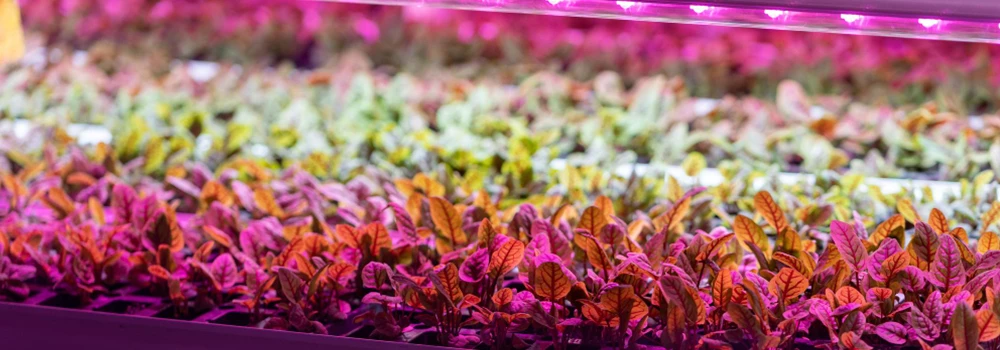
How to find the right LED grow light for plants?
Spectrum and the structure of the lighting fixture are two souls of LED grow lights. In order to be sure about which LED grow lights to use, it is essential for LED grow light manufacturers to have an in-depth study that can determine the fact that the indeed lighting needs of each plant species. That is what we call spectrum research. It is an extremely large project. This would necessitate the manufacturers using all kinds of methods and undertaking a lot of research prior to producing in large-scale LED grow light so as to ensure that all requirements for the plants are provided exactly. A good structure makes them a high-quality product, enabling them to be used in a planting environment.
Through massive research, Atop Lighting has a rich and valuable experience in the field of LED horticulture light encapsulation, as well as a special insight into lighting requirements that are particular to the plant's growth. We not only provide mature LED horticulture light products along with an effective spectrum but also give customizable grow light solutions in terms of light structure and spectrum.
What are the advantages of growing with LED grow lights?
Growing plants using LED grow lights has proved to be cost-efficient, because compared to traditional lights, the electricity consumption of these lights is less. Additionally, using traditional grow lamps will produce needless heat. This will have a bad influence on the plants' growth and environmental control.
Growers need to arrange extra ventilating devices to reduce the temperature indoors, which leads to a higher cost. LED grow lights are different from traditional grow lamps. They produce less heat and are more effective. What's more, LED grow lights are environmentally friendly, smaller in size, and react faster.
The advantages of the LED grow lights compared to traditional HPS lights can be summarized into:
Less Electricity Consumption
LED grow lights use only half of the energy used by conventional HPS lamps. For example, the 600W LED grow light of Atop Lighting replaces a 1200W HPS grow light perfectly. This enables farmers who may use the technology in large-scale production to accrue immense benefits in the short-term and long-term.
Durability
LED grow lights are more durable in terms of life span as compared to traditional HPS. While HPS lamps can last for about 2 years or less, the LED lights can last up to 5 years, giving the farmer more value for their money. If the project were a large-scale project, the benefits accrued would be immense.
Portable
LED agriculture lights have a special structure design, a removable locker. This has the effect of enabling those who grow indoor plants to be able to have more flexibility in lighting the area should be lit.
Safety
If a large quantity of high-power HPS grow lights is used in a growing room, this will increase the danger of a fire. Growers need to install a tremendous number of fans or AC units to offset the increase in heat. However, using an LED grow light is different from that of HPS. This is because LED grow lights run cooler than traditional bulbs. This can significantly reduce the chances of a fire hazard in your grow room. When compared to traditional HPS lamps, LED grow lights not only minimize the amount of power needed for the lights themselves, but also emit less heat. These feature LED grow lights' safety.
Adaptable
LED grow lights can be connected to apps on mobile phones or remote controls, which enable control of these lights by group and can manage all lights on a terminal device. The emitted time of plants, dimming or making them brighter, is all adaptable. This is crucial as it allows growers to adjust the lighting needs of the plants.
Environmental Safety
Given that LED grow lights produce less heat, this makes them more environmentally safe, as it makes the environment unsuitable for bacteria and mold growth. Their counterparts, traditional HPS, provide a lot of heat, which makes plants susceptible to mold, making farmers incur pesticide costs
LED grow lights are a viable option for anyone seeking to grow plants indoors, as they are affordable and safe to use. Different LED grow lights are recommended for different plants; hence, consultations before setting up the LED lighting infrastructure for your indoor farms are recommended to ensure you get the right lights for your projects.