
What Is High Red Spectrum and How Does It Affect Plant Growth
In the market, high-red spectrum configurations are widely adopted in large-scale production of cannabis, tomatoes, and strawberries.
High-red spectrum, sometimes called high-red light, refers to the higher proportion of red photons, typically in the 600–700 nm range in a light spectrum.
This part of the spectrum matters in commercial horticulture because plants respond strongly to it: red light drives photosynthesis efficiency, influences plant architecture, and directly affects flowering behavior.
But more red is not always better. The outcome depends on crop type, growth stage, and production targets.
What High-Red Spectrum Means
When a grow light is described as having a high-red spectrum, it means a significant share of its total photon output is concentrated in the 600–700 nm range. In most commercial designs, 660 nm deep red accounts for the majority of that output due to its high photosynthetic efficiency and mature diode performance.
At the fixture level, this shows up as a noticeable red peak in the spectral power distribution (SPD). A high-red light may have 60% or even 80% of red.
The key point is proportion, not absolute output. A high-red spectrum increases the ratio of red photons within total PPF, rather than simply adding more photons across all wavelengths.
From a market perspective, high-red light is widely used in cannabis production, including both top lighting and under-canopy lighting. The driver is straightforward. Red-heavy spectra support high efficacy fixtures and deliver strong photon penetration in dense canopies.
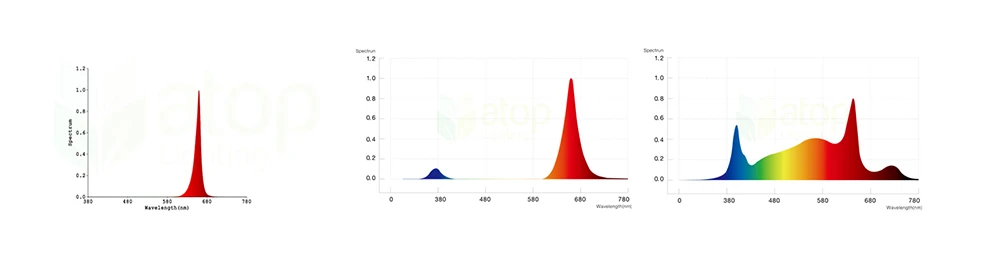
High Red vs. Balanced Full Spectrum in Commercial Cultivation
A high-red spectrum isn’t better or worse than a balanced full spectrum. The right answer depends on your crop, your growth stage, your intensity levels, and what you are trying to achieve.
Where High-Red Spectrum Performs Well
Red LEDs are more efficient than phosphor-converted white LEDs. White LEDs rely on blue chips with phosphor conversion, which introduces energy losses. In contrast, red diodes emit the target wavelength directly. As a result, increasing the red fraction is one of the most effective ways to push fixture efficacy higher on a µmol/J basis.
When electricity cost is a major factor, even small gains in efficacy translate into measurable operating savings at scale.
On the biological side, red light aligns closely with chlorophyll absorption and contributes efficiently to photosynthesis. It also regulates flowering through the phytochrome system. Phytochrome exists in two interconvertible forms, Pr and Pfr. Red light drives the conversion toward the active Pfr state, which influences flowering responses and related developmental pathways.
Where Balanced Full Spectrum Performs Better
A balanced spectrum often has about 40% red light. Balanced full-spectrum designs provide more stable morphology and a broader application range across crops and growth stages.
In cannabis production, quality risks are tied to spectrum and intensity management. Photobleaching is primarily driven by excessive photon flux at the canopy level, but spectrum composition plays a role. Red-heavy spectra, when combined with high PPFD and insufficient blue, can increase the likelihood of bleaching at the top of the canopy. This directly impacts market value, since top colas carry the highest pricing.
Balance board spectrum lighting reduces this risk. A balanced full spectrum, typically a white-leaning spectrum with a mix of blue, green, and red wavelengths, remains the safest and most versatile choice for commercial cannabis cultivation.
In greenhouse crops such as tomatoes, controlled trials have shown that increasing the red fraction beyond a certain point does not guarantee higher yield. Data from Wageningen University indicates that as the red ratio in the spectrum increased, yield decreased linearly, with broader spectrum approaches producing fruit weight increases of up to 13% compared to narrow high-red spectra.
The Right Spectrum Depends on the Growth, Not the Trend
High-red lights are typically positioned as high-efficacy or application-specific SKUs. Balanced spectra remain the default for general-purpose use due to their flexibility and lower risk profile.
This is driving demand for dynamic lighting. By combining adjustable spectrum and light intensity control across multiple channels, growers can apply the right light recipe for plants. For more on how dynamic lighting works in practice, visit our previous blog: Dynamic LED Lighting in Horticulture
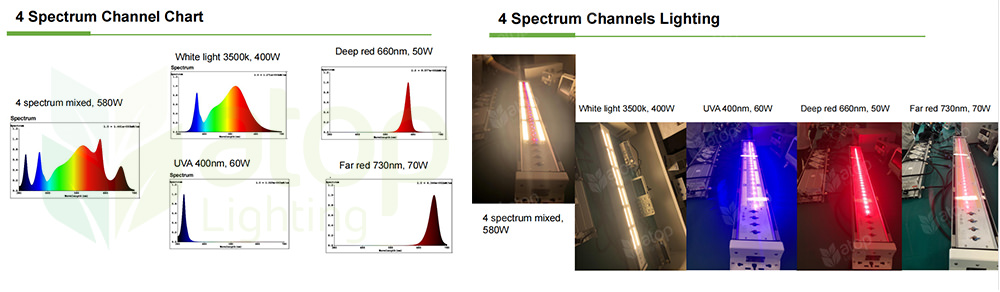
If you are developing a grow light product and want to discuss spectrum design, LED module selection, or OEM and ODM options for high red spectrum, broad spectrum, and dynamic lighting fixtures, get in touch with our team.