
Are Your Grow Lights Exposing Workers to Harmful Blue Light
Blue light wavelengths (400–500 nm) are widely used in LED grow lights and play a vital role in plant development. This part of the light spectrum supports photosynthesis, stimulates chlorophyll production, and encourages compact, healthy plant growth. Grow lights with a higher proportion of blue light are especially effective during the vegetative stage, when plants focus on building strong stems and leaves.
However, what benefits plants does not always benefit people. Prolonged exposure to high-intensity blue light has been linked to potential risks to human eye health, particularly in environments where workers spend long hours under artificial lighting.
This leads to an important and often overlooked question: Could the same blue light that optimizes crop growth be harmful to workers in greenhouses or indoor farms?
In this blog, we will examine how blue light affects human eyes, explain the relevant safety standards, and share practical ways to protect workers without compromising plant performance or yields.
Is Blue Light Safe for Humans?
Blue light is not inherently “good” or “bad” for humans. Its effects depend mainly on the intensity and duration of exposure.
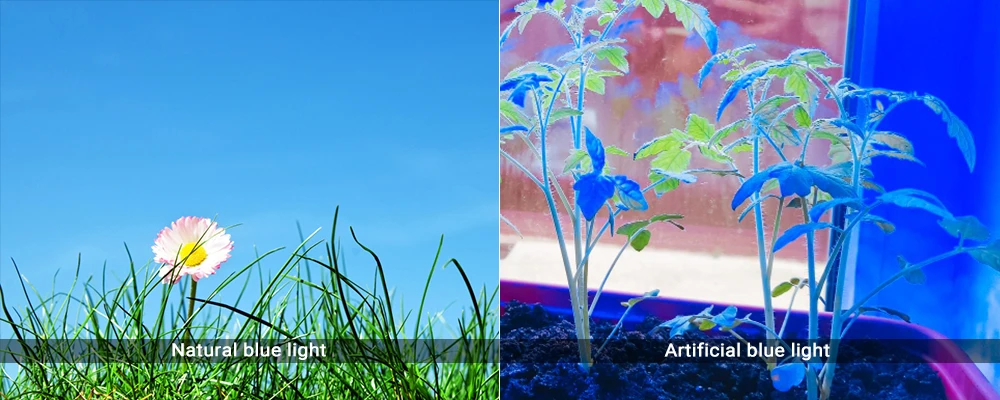
We are exposed to blue light every day from natural sunlight. In moderate amounts, it is actually beneficial: it helps regulate our circadian rhythm, improves alertness, and supports overall well-being. The human eye has evolved to handle blue light from the sun, where intensity changes throughout the day and are balanced by other wavelengths of light.
The situation is different in controlled environments such as greenhouses and indoor farms. High-intensity LED grow lights can produce concentrated blue light at levels that may exceed typical outdoor exposure. When workers are exposed to this type of lighting for long periods, often 8 to 12 hours a day, the risk of eye strain and potential long-term effects increases.
The main concern is photochemical damage to the retina. Blue light carries relatively high energy and can trigger the formation of reactive oxygen species in retinal cells. Over time, this may lead to cumulative oxidative stress. Unlike ultraviolet (UV) light, which is mostly absorbed by the cornea and lens, blue light penetrates deeper into the eye and reaches the retina, where the light-sensitive photoreceptor cells are located.
Are Your Grow Lights Exposing Workers to Harmful Blue Light?
If your lighting system has not been evaluated for photobiological safety, the honest answer is probably yes, at least at certain working distances.
The real issue is not whether blue light is present. Almost all LED grow lights contain blue light. The key question is whether the intensity of that blue light crosses the line from being productive for plants to becoming a potential hazard for people.
To address this risk, the IEC/EN 62471 standard, Photobiological Safety of Lamps and Lamp Systems, classifies light sources into four Risk Groups based on allowable exposure time and potential hazards to the eyes and skin.
- Risk Group 0 (Exempt): No photobiological hazard under normal use. Safe for unlimited exposure.
- Risk Group 1 (Low Risk): No hazard under normal behavior, since people naturally avoid staring at bright lights for extended periods.
- Risk Group 2 (Moderate Risk): Safety depends on natural aversion responses such as blinking or looking away. Brief accidental exposure is safe, but prolonged or repeated viewing can be harmful.
- Risk Group 3 (High Risk): Hazardous even with very short exposure. Requires strict controls and clear warnings.
For comparison, standard office lighting is typically classified as Risk Group 0. In contrast, many high-performance horticultural LED fixtures fall into Risk Group 2. This means the light is considered safe only for very short viewing times before the risk of retinal photochemical damage begins to accumulate.
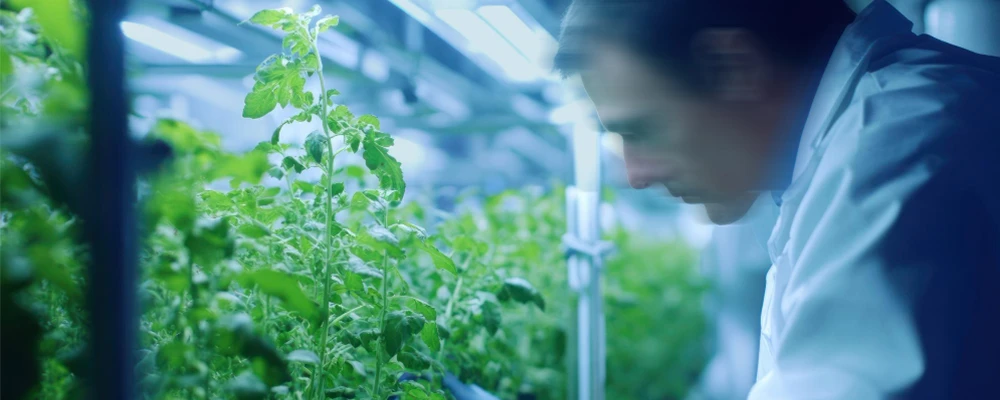
During a standard eight-hour shift, workers performing tasks such as pruning, scouting, or harvesting beneath these fixtures may be exposed to a continuous stream of high-energy blue light. These exposure levels are far beyond what the human eye evolved to handle in natural conditions.
Another important factor is the Threshold Distance (Dthr). This is the distance at which light intensity drops from a potentially hazardous Risk Group 2 level to a safer Risk Group 1 level. In many indoor farms and vertical growing systems, workers’ eyes are often closer to the fixture than this threshold distance. As a result, staff may spend much of their workday operating inside a defined hazard zone without being aware of it.
How to Reduce Blue Light Risk
When it comes to potential blue light hazards, three factors matter most: light intensity, exposure duration, and installation height of the fixtures.
Increase the Mounting Height
One straightforward approach is to increase the mounting height of LED grow lights. Hanging fixtures higher, for example, at least 8 feet above the floor, and maintaining a distance of at least 3 feet between the light source and workers’ eyes can significantly reduce light intensity at eye level. A greater distance means lower exposure, which helps reduce potential risk.
However, this approach has a clear drawback. Raising lights too high can reduce the amount of usable light reaching the crops, which may negatively affect plant growth and yields.
Protective Eyewear
Another common method is providing protective eyewear for workers. Special safety glasses designed for use under LED lighting can reduce blue light exposure. Sunglasses can also offer some protection, but they often distort color perception. This makes it harder for workers to accurately assess plant health, spot pests, or detect nutrient deficiencies.
Smarter Light Design
So, is there a better way? Yes. The most effective solution starts with lighting design and manufacturing.
At Atop, we understand the risks associated with excessive blue light exposure, and our goal is to minimize those risks without compromising crop quality or yields.
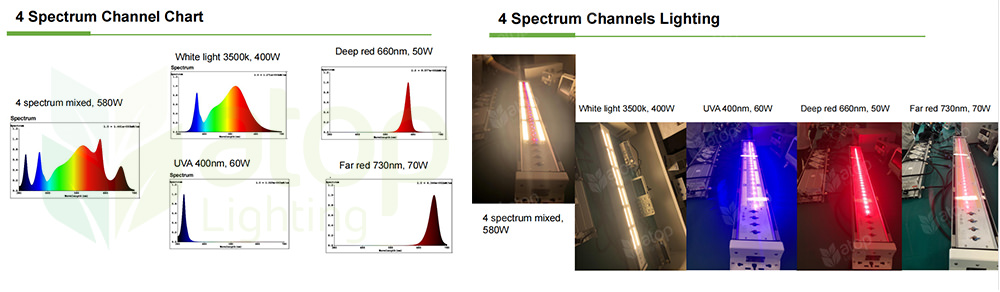
First, we focus on true wide-spectrum lighting. Fixtures that appear white or soft pink are not only more comfortable to work under, but they also tend to have better photobiological safety profiles than narrow, blue-heavy spectra. By delivering a balanced spectrum that more closely resembles natural sunlight, we support healthy plant development without oversaturating the blue wavelengths beyond what crops actually need.
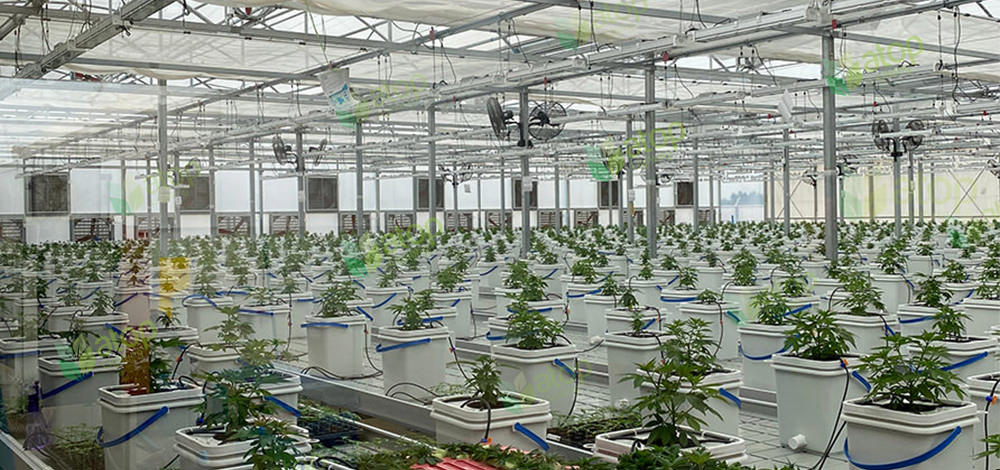
Second, we offer dynamic lighting solutions that allow both light intensity and spectrum to be adjusted. Higher levels of blue light are provided only when plants truly need it, such as during specific growth stages. At other times, blue light levels can be reduced, lowering worker exposure. This approach improves safety, reduces energy consumption, and ensures plants receive the right light at the right time, even across different crops and growth stages.
Contact Atop Lighting to learn how safer spectrum design and intelligent lighting control can help you achieve high yields while creating a healthier, more comfortable environment for your team.