
Effects of UVA, Blue Light on Vine Crop and Other Plants
Light does more than just power photosynthesis; it shapes how your crops grow, taste, and survive. UVA and blue light play critical roles in vine crop development, influencing stem thickness, internode spacing, nutrient content, and even shelf life. Whether you're growing strawberries or tomatoes, the right lighting spectrum can dramatically impact your crop performance.
In this article, we’ll explore UVA and blue light, explain their biological effects on vine crops, and share how commercial growers are using Atop’s custom lighting solutions to improve productivity and quality.
Light Spectrum and Plant Growth
Light is the most important environmental factor influencing plant growth and development. Light not only supplies energy for plant growth through photosynthesis, but is also an important regulator of plant growth and development.
The light in nature comes from the sun, and the solar spectrum is roughly divided into three parts:
- Photosynthetically active radiation 400-700nm wavelength (blue-violet light wavelength 400-500nm, green light wavelength 500-575nm, yellow-orange light wavelength 575-620nm, red light wavelength 620-700nm).
- Far-red light and infrared light>700nm ( Far-red light 700-780nm, infrared light 780nm-1000μm)
- Ultraviolet light <400nm (uv-a315-400nm, uv-b280-315nm, uv-c100-280nm). Among them, mid-ultraviolet UV-B and far-ultraviolet UV-C are mostly absorbed by the ozone layer above the Earth, and the ultraviolet light reaching the ground is mainly near-ultraviolet UV-A.
What Are Phytochromes & How Do They Affect Growth?
Phytochromes are covalently combined with a chromophore and apoprotein, including two types of far-red light absorbing (Pfr) and red light absorbing (Pr), mainly absorbing red light at 600-700nm and 700 nm - The far-red light of 760nm regulates the physiological activities of plants through the reversible effect of far-red light and red light.
In plants, phytochromes are mainly involved in the regulation of seed germination, seedling formation, establishment of photosynthetic systems, shade avoidance, flowering time, and circadian rhythm responses. In addition, it also plays a role in regulating the stress resistance physiology of plants.
How Blue Light Receptors Control Flowering & Stress
Cryptochrome is a blue light receptor that mainly absorbs blue light at 320-500nm and near-ultraviolet UV-A, and the absorption peaks are roughly located at 375nm, 420nm, 450nm and 480nm.
Cryptochromes play a major role in controlling plant flowering. In addition, it is involved in the regulation of plant tropism, stomatal opening, cell cycle, guard cell development, root development, abiotic stress, apical dominance, fruit and ovule development, programmed Cell death, seed dormancy, pathogen response, and magnetic field induction are all examples of biological processes.
Luciferin is a blue light receptor discovered after phytochrome and cryptochrome, which can be phosphorylated after binding to flavin mononucleotide. It can regulate plant phototaxis, chloroplast movement, stomatal opening, leaf extension and inhibit hypocotyl elongation of etiolated seedlings.
How Blue Light Shapes Leaf Size, Nutrients & Yield
Blue light can significantly shorten the internode spacing of vegetables, promote the lateral extension of vegetables and reduce the leaf area. At the same time, blue light can also promote the accumulation of secondary metabolites in plants.
In addition, it was found that blue light can alleviate the inhibition of red light on the activity of photosynthetic system and photosynthetic electron transfer ability of cucumber leaves, so blue light is an important factor affecting the activity of photosynthetic system and photosynthetic electron transfer ability.
There are marked species differences in the need for blue light in plants. It was found that 470nm in different wavelengths of blue light had obvious effects on the content of anthocyanins and total phenols in strawberries after harvesting.
Can UV Light Improve Resistance & Postharvest Life?
Ultraviolet light generally more of a killing effect on organisms, reducing plant leaf area, inhibiting hypocotyl elongation, reducing photosynthesis and productivity, and making plants more susceptible to infection.
However, proper supplementation of UV light can promote the synthesis of anthocyanins and flavonoids, and by adding a small amount of UV-B to the postharvest cabbage to promote the synthesis of its polyphenols; postharvest UV-C treatment can slow down the fruiting of red peppers. The process of gum dissolution, mass loss and softening can significantly reduce the spoilage speed of red peppers and prolong the shelf life, and can promote the accumulation of phenolic substances on the surface of red peppers.
In addition, ultraviolet light and blue light also affect the elongation and asymmetric growth of plant cells, thereby affecting the directional growth of plants. UV-B radiation resulted in a dwarf plant phenotype, small, thick leaves, short petioles, increased axillary branching, and changes in root/shoot ratio.
Combining Light Spectra for Optimal Growth
Combining different light spectra, especially red and blue wavelengths, has shown superior results in plant tissue culture and seedling development compared to using a single light source. For instance, blue light alone has been observed to strongly inhibit callus budding, with a budding rate as low as 3%. Similarly, tissue culture seedlings of C. chinensis treated exclusively with red or blue LEDs exhibited poor growth. In another case, strawberry sugar-free tissue culture seedlings exposed solely to blue light recorded the lowest dry and fresh weights, indicating that single-spectrum lighting may not support optimal development.
Interestingly, the ideal ratio of red to blue light can differ among plant species. Research has found that a combination of 70% red and 30% blue LED light provided the best growth conditions for both Japanese double butterfly and strawberry tissue culture seedlings. Red light is generally associated with promoting stem elongation and dry matter accumulation, while blue light supports protein synthesis and enhances antioxidant enzyme activity.
Beyond tissue culture, the combination of red and blue light has been shown to significantly improve photosynthesis and seedling growth in vegetable crops. In red bean sprouts and tobacco seedlings, blue light effectively reduced hypocotyl and stem elongation, resulting in more compact and robust plants. For lettuce seedlings, it limited leaf area and reduced the number of leaves, which redirected energy toward root development and promoted nutrient synthesis beneficial for flower bud differentiation and formation.
Blue-violet light also plays a regulatory role in plant growth by increasing the activity of auxin oxidase. This reduces the level of auxin in the plant, weakens apical dominance, and enhances tillering ability, ultimately suppressing internode elongation. These physiological changes are especially beneficial for creating dense, manageable plant structures in controlled environments.
Ultraviolet light, although often considered harmful in large doses, has nuanced effects depending on its application. While excessive UV radiation can reduce leaf area, inhibit hypocotyl elongation, and damage photosynthetic pigments, it can also stimulate the synthesis of flavonoids and activate plant defense mechanisms. In soybeans, for example, UV exposure significantly reduced plant height and dry mass, while also inducing stress responses that may contribute to disease resistance.
Case Study: Strawberry & Tomato Production with Atop HL05
Tomatoes grown indoors using plant lights containing 10µmol/m²/s UVA light, very compact internodes, short, strong stems, and a well-developed root system.
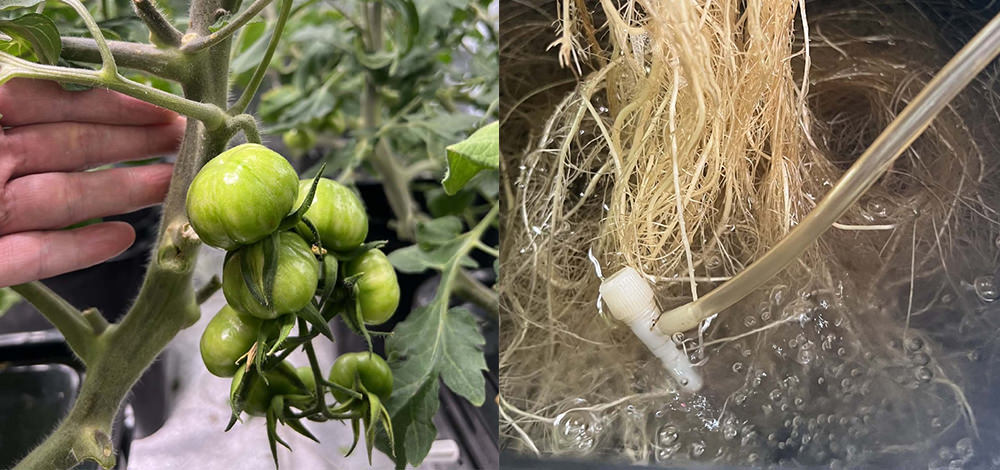
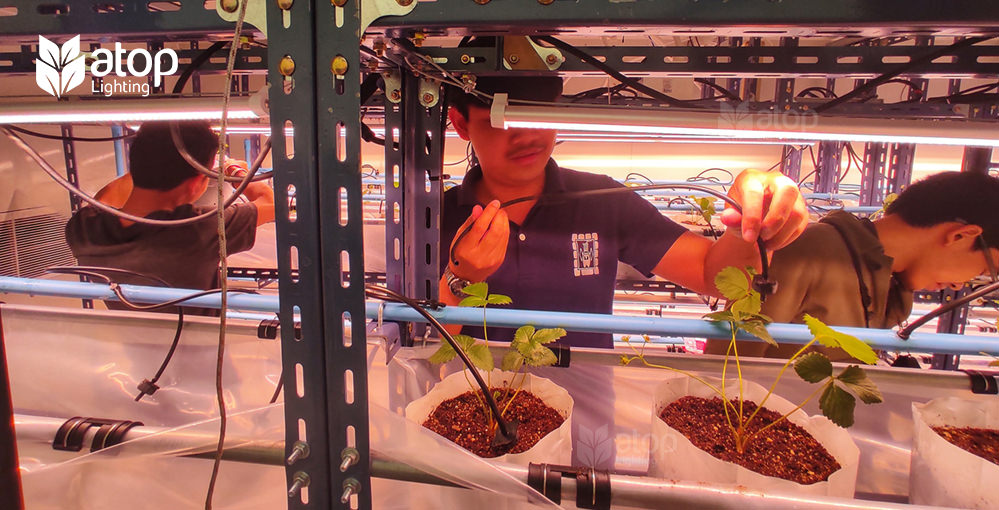
Clients use Atop HL05 single tube with a customized light recipe for strawberry; the blue and red wavelengths are working well for the plants.
Blue light can significantly shorten the internode spacing of vegetables, promote the lateral extension of vegetables, and reduce the leaf area. At the same time, blue light can also promote the accumulation of secondary metabolites in plants.
Welcome to contact us for a lighting solution.