
Effects of Far-red Light on Strawberries
Supplement lighting is critical for indoor strawberries. Optimal lighting contributes to robust growth and higher yields. Light quality and intensity are the main considerations for optimal lighting. It is well known that blue light and red light have positive effects on strawberries.
Many studies focused on the effects of photosynthetically active radiation (400 nm to 700 nm) on strawberries. This radiation range is also important for defining the light intensity. However, the wavelength of natural light is more than the PAR range. Strawberries react to far-red light as well.
Although far-red light seems to be less effective for the growth and development of strawberries, it is valuable for establishing the optimal lighting and improving production and yield. Thus, researchers also looked into the effects of far-red light on strawberries.
This post would like to talk about the effects of far-red light on strawberries and whether far-red light should be added to the light source.
What is far-red light?
Far-red light is the radiation ranging from 700 nm to 800 nm. It falls at the red end of the PAR range but ahead of infrared light. Since far-red light is at the edge of the human visible light spectrum, it is barely visible to human eyes.
Most plants absorb the far-red light from 701 nm to 750 nm, while a few plants can absorb far-red radiation up to about 780 nm. Therefore, far-red light that is effective for plant growth is defined as the radiation with a wavelength from 701 nm to 750 nm. This range of far-red light is perceivable by the photoreceptor. It is shown to boost photosynthesis and stimulate CO2 assimilation directly, proving benefits for plant growth.
Far-red light at 730 nm has the strongest impact on phytochrome absorption. As is known, a combination of blue light (400 nm - 500 nm) and red light (600 nm - 700 nm) is beneficial for plant growth. Different ratios of red to far-red light and blue to far-red light also have further effects on plant growth than solely red or blue light.
Effects of far-red light on strawberries
Previous research has shown that far-red light has positive effects for plants. When far-red light filters through the canopy of plants, it can promote the photosynthetic capacity. As a result, adding far-red light to supplement lighting has greater effects on flowering and morphology than simply providing red light and blue light for plants. For strawberries, research showed that the major effects of far-red light included regulating flowering and shaping morphology.
Regulate flowering
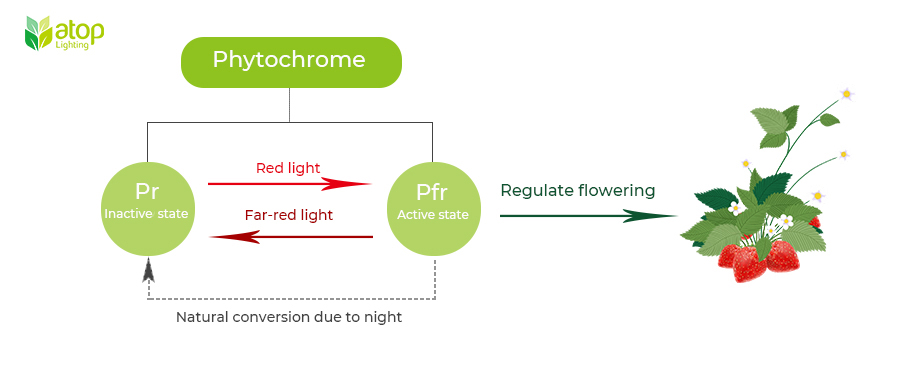
Flowering is mediated by photoperiod, which means that the duration and timing of light affect flowering. Photoperiod is regulated by photosynthetic phytochrome, Pr ( phytochrome red) and Pfr ( phytochrome far-red).
Red light, far-red light, and darkness can control the conversion of two phytochromes. Red light (660 nm) drives Pr toward its biologically active form, Pfr. In contrast, Pfr converted to Pr during the night or when it absorbs far-red (730 nm) light. The interconvertible forms of phytochrome enable growers to control and trigger the flowering of strawberries by mediating the ratio of red to far-red light.
For June-bearing strawberries, far-red light promotes flowering. With the development of LED grow lights, growers can control the flowering more effectively. LED grow lights with more far-red light have an impressive influence on day extension and night break management for strawberries.
By controlling the red to far-red light ratios and duration of lighting for strawberries, LED grow lights allow the independent control of natural seasons and target year-round production. Here is a picture of the process of phytochrome regulating the flowering of strawberries.
Shape morphology
A high far-red light ratio can increase the elongation of stems and leaf areas but reduce the leaf thickness.
Strawberries receive the same light quality and intensity from the light source when they are fully exposed to supplemental light without shading. But the plant shades change the light quality and cut down the light intensity.
For a single strawberry plant, the lighting intensity of lower leaves decreases significantly due to the shade of upper leaves. Upper leaves block most of the light in the PAR range but transmit most of the far-red light. In consequence, the red to far-red light ratio for lower leaves drops rapidly. To gain more light, lower leaves struggle to grow larger leaves and longer stems. This process is known as shade avoidance syndrome (SAS).
Although far-red light is beneficial for the elongation of leaf areas, the leaf thickness declined. There is mesophyll tissue in the leaf to control the light transmission. Mesophyll can form the palisade and spongy tissues of a leaf in different structures to regulate the light capture capacity and acclimate to various lighting environments. Under low red to far-red light conditions, the thickness of the palisade is reduced, and then resulting thinner leaf. Thus, far-red light conduces to light interception and capture capacity, shaping the tall, slim strawberry plant.
Should far-red light be added for growing strawberries?
Whether supplementing with far-red light depends on your goals for growing strawberries. Which strawberry cultivars would you like to cultivate? Jun-bearing strawberries or Everbearing strawberries? Are your goals to improve plant growth or promote flowering? Or, do you aim to grow strawberry plants with larger leaves or longer stems?
Natural sunlight has tremendous far-red light. Adding far-red light to a supplemental light source is beneficial for strawberry growth. It can stimulate flowering, extend stems, and enlarge leaf areas. Therefore, over time, far-red light can improve vegetative growth and increase the yields of strawberries.
But too much far-red light will cause serious shade avoidance syndrome, which may result in undesired morphology. More researches are required to figure out the optimal amount of far-red light for growing strawberries. Research showed that 8 to 16 µmol·m¯²·s¯¹ far-red LED light could improve the yields and production of strawberries in a greenhouse during the winter season.
But it was also cultivar-dependent. Jun-bearing strawberries respond to flowering in the presence of higher far-red light due to the large quantity of Pr. While other species are not. Differences in the dose of far-red light between species also need more research.
Thanks to the advanced LED grow lights, far-red light can work more efficiently. Year-round production can be achieved by controlling the red to far-red light ratios and duration of lighting for strawberries. Therefore, if you want to add far-red light for growing strawberries, an LED grow light is a good option.
Atop provides LED grow lights with tailored spectrums. Please feel free to contact us and own your customized lighting solution.