
Research on Houseplant Artificial Light Time
How much light do plants actually need?
What is the optimal amount of light for the best growth possible?
The time plants or crops are exposed to light is a significant factor for indoor growing. Since optimal illumination time can maximize the growth potential of plants. But overexposing them to light can also be harmful to plants. So it makes sense to research how long growers should hold LED grow lights on to make sure that plants can grow nicely.
We all know light is necessary for plants' growth. This is involved in the photosynthesis process, which is important for plants. In this process, plants will produce nutrients that are treated as the energy for later growth. Without this energy, plants may not grow as healthy as they can be, even wither and die.
Based on what people have researched, we write this post to gather some known and important information on the illumination time of plants in the hope that you can benefit from this or get some inspiration to help your indoor farming.
View A: How long growers should have their LED grow light on depends on what kind of plant they intend to grow.
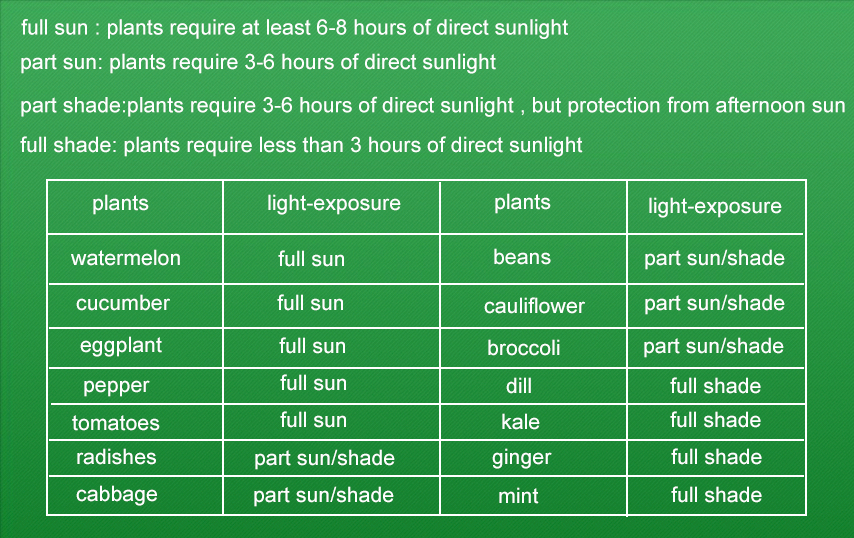
In this view, vegetables are divided into four light-exposure types ( see the following picture). Although all light-exposure time of plants is calculated based on sunlight. However, we can also roughly know that the needed illumination time of various common vegetables via this. When growing plants indoors under artificial light, this can be of valuable reference for growers.
View B: It depends on photoperiodism
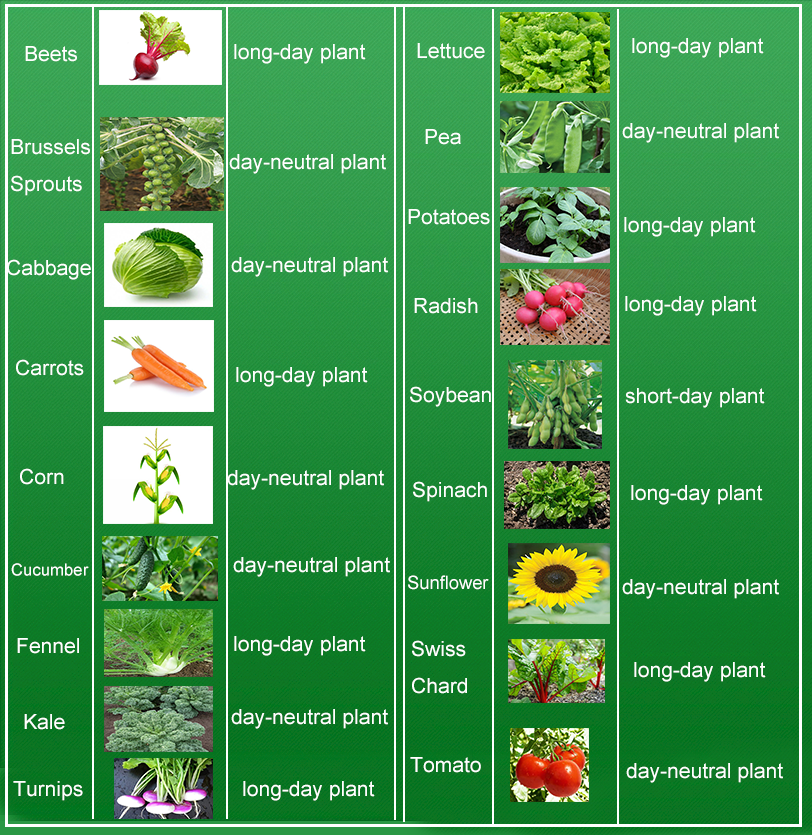
Photoperiodism can be defined as the developmental responses of plants to the relative lengths of light and dark periods in a day. They are classified into three types according to the photoperiod: short-day plants, long-day plants, and day-neutral plants. In most articles, how to distinguish long-day plants, short-day plants, and day-neutral plants has been expressed in detail. Here are some examples:
However, there are also a few focuses that we should pay attention to.
Short-day plants flower when day length is below a certain threshold, while long-day plants flower when day length is above a certain threshold. There are signs that the critical value differs between species, and it is not always divided on the account of the value "12 hours", which is special and familiar to most.
When coming to control the light-emitting time to affect the growth of plants, it is the length of darkness that a plant experiences that plays the most crucial role. Of particular note is that the darkness period means the uninterrupted time of darkness or no-light time.
Let's give an example to illustrate the point.
Intended darkness time: 14 hours
- Right: keep the planting space without light for 14 hours
- Wrong: during the intended 14 hours, occasionally providing the planting space with a short period of lighting time. The dark time is interrupted.
For some plants that are sensitive to light, such as Poinsettias, kalanchoes, and Christmas cactus, etc., they flower only when the daytime is equal to or lower than 11 hours (short-day plants). However, some plants only flower when the daytime exceeds 11 hours (long-day plants). In addition, there are also plants that are not sensitive to the length of the day at all (day-neutral plants). Besides growing plants, some seeds also appear sensitive to light.
So the plants or seeds you grow, sensitive to light or not, and the photosensitive critical point are all worth exploring and confirming before you start planting. Since when necessary, growers can stimulate plants passing from one stage to another by controlling the time of exposing to LED grow light or any other artificial lighting to reach what state they want plants to be.
If the plant you intend to grow responds to the length of dark and lighting, be sure of the optimal length of daytime or darkness time, as you may harvest more than others according to this optimum. Take cannabis, for example.
Generally speaking, most species of cannabis belong to short-day plants. That is to say, the daily hours of darkness that cannabis plants require are over 12, especially in transition from vegetative growth to flowering. It is also the key step to trigger cannabis flowering when growing them indoors under artificial light.
How do cannabis growers deal with the lighting time of their plants?
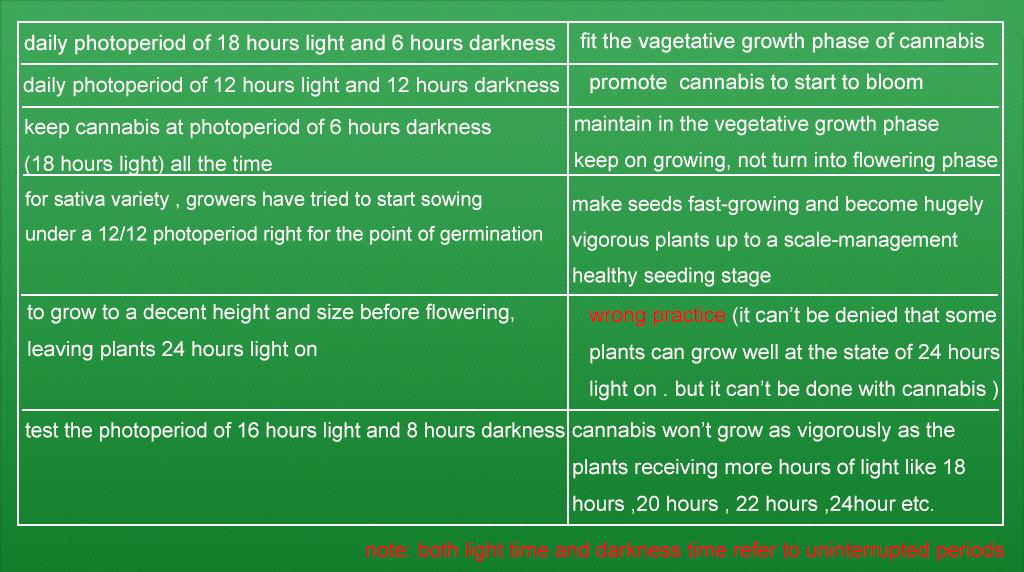
In general, they like to study the photoperiod of cannabis growing to make sure the optimal number of darkness hours and daytime hours of each cannabis species that will trigger the plant to start flowering or harvest more. In this way, they have greater control over the light output in each important phase and will be able to achieve better yields or shorten the flowering time, which helps to realize economic value fast.
Here are some results of a wide range of attempts.
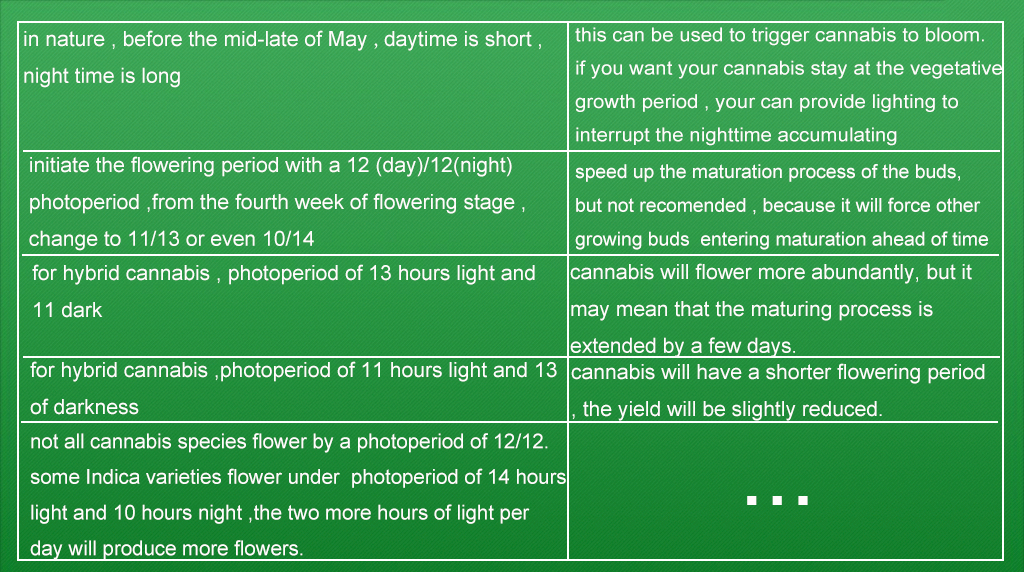
If you have any other information on this topic, please kindly send the links to us. We would like to collect more information about the exposure time of all kinds of plants and regard them as some directions of research.