
Complete Guide to 600W LED Grow Lights
LED grow lights are now widely used in both commercial and home cultivation, and they come in a wide range of wattages from about 30W to over 1000W. Among these options, 600W has become one of the most popular and versatile choices for many growers. Our Horti-King 600W LED grow light is also a strong performer and a top seller.
If you are considering choosing or using a 600W LED grow light, you may have several questions. Is 600W the right wattage for your grow space? Is it powerful enough, and can it replace your existing HPS system? How high should you hang it above your plants?
In this guide, we will address all of these questions and help you determine whether a 600W LED grow light is the best option for your needs.
Core Metrics of 600W LED Grow Lights
When choosing a 600W LED grow light, wattage alone does not determine performance. Although wattage indicates how much electrical power the fixture consumes, true growing efficiency depends on how effectively that power is converted into usable light for plants. Since the market offers many options, it is important to evaluate whether a 600W LED grow light is truly high quality. The most meaningful metrics for efficiency, yield, and return on investment are related to light output and light delivery, not power draw. Key factors include PPE, PPF, PPFD, and spectrum.
The most important metric is Photosynthetic Photon Efficacy (PPE), measured in micromoles per joule (μmol/J). PPE shows how efficiently the fixture converts electricity into photosynthetically active radiation (PAR). Modern 600W LED grow lights typically achieve 2.7 to 3.0 μmol/J or higher, compared with about 1.7 μmol/J for traditional HPS lighting. Higher PPE means lower energy costs and more light delivered to plants for every watt consumed.
PPF (Photosynthetic Photon Flux) measures the total amount of useful light the fixture emits each second, expressed in μmol/s. High-quality 600W LED fixtures usually produce between 1,600 and 1,800 μmol/s or more. PPF is important when calculating how many fixtures you need and how they should be arranged in your grow space.
PPFD (Photosynthetic Photon Flux Density) indicates the amount of light reaching a specific point on the canopy, measured in μmol/m²/s. Unlike PPF, PPFD changes depending on hanging height and distance from the center of the fixture. Reliable manufacturers like Atop Lighting provide detailed PPFD maps that show distribution across the coverage area, helping growers design efficient layouts and predict plant performance.
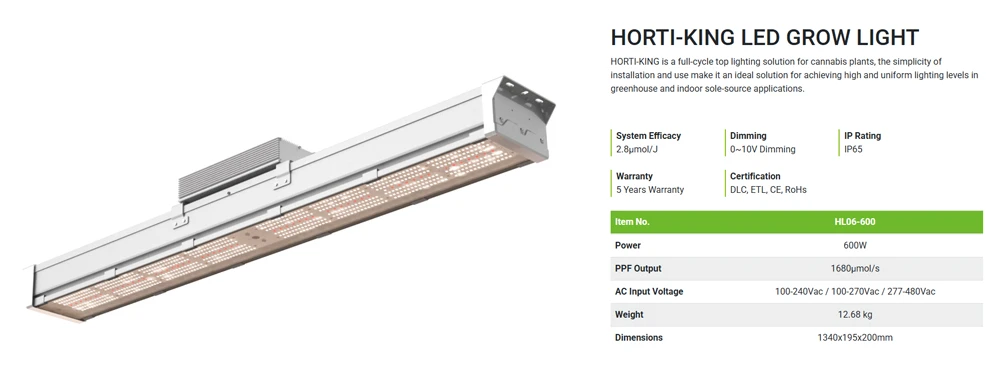
Our Horti-King 600W LED grow light offers a PPE of 2.8 μmol/J, a PPF of 1680 μmol/s, uniform light distribution, and a full spectrum suitable for all growth stages. We also provide customized spectra and personalized lighting plans to help you optimize plant performance and maximize yields.
Can I Replace My 600W HPS With a 600W LED 1:1?
The short answer is no. A 600W HPS and a 600W LED do not produce the same amount of usable light, so replacing them one-to-one while keeping the same hanging height will likely result in excessive light intensity. This can burn your plants and lead to reduced yields.
Here is a simple comparison to show why:
- A typical 600W HPS fixture has a PPE of about 1.7 μmol/J. This means it produces roughly 1020 μmol/s of PPF.
- A high-quality 600W LED grow light, with a PPE of 2.8 μmol/J, produces about 1680 μmol/s of PPF.
If you replace a 600W HPS with a 600W LED on a one-to-one basis at the same mounting height, you will deliver nearly 65% more light to the canopy. This excessive light can cause photobleaching, heat stress, and other growth problems, while also wasting energy.
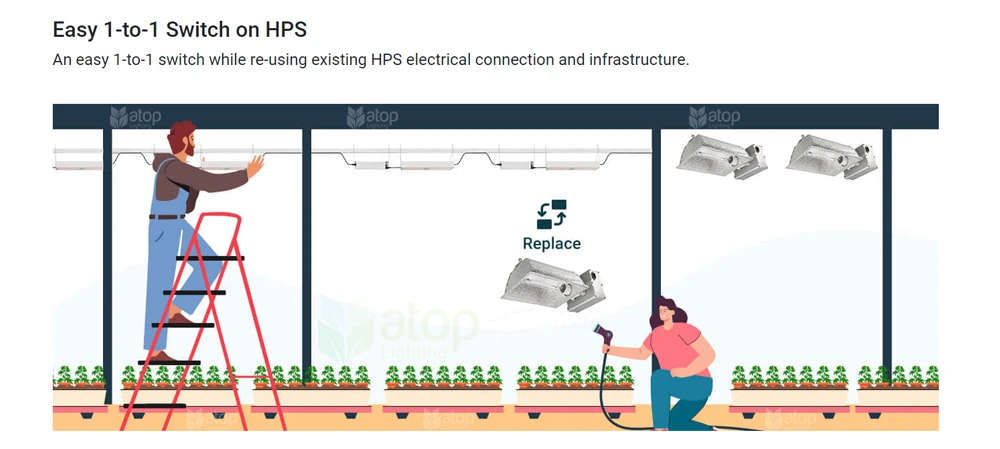
If you need a 1:1 LED replacement that focuses on easy installation while re-using your existing HPS electrical connections and infrastructure, consider our Horti-Top LED grow light. This compact top-lighting solution fits seamlessly into existing HPS setups and trellis constructions, saving both time and installation costs.
What Is the Suitable Coverage Area for a 600W LED Grow Light?
A 600W LED grow light is commonly designed to cover about 4×4 ft (1.2×1.2 m) during flowering and up to 5×5 ft (1.5×1.5 m) during the vegetative stage. However, the ideal coverage area depends heavily on your crop type and its light requirements.
Low-light crops such as leafy greens typically need 300 to 600 μmol/m²/s, depending on the species. For these crops, a 600W LED can often cover an area up to 5×5 ft.
High-light crops such as cannabis, tomatoes, and peppers require 600 to 1,200 μmol/m²/s or more during peak production. For these plants, the effective coverage area can be reduced to around 3×3 ft to 4×4 ft to ensure proper light intensity.
If you want to determine whether a 600W LED grow light from Atop Lighting can provide the right coverage and intensity for your plants, feel free to contact us. We can provide detailed PPFD maps that show light distribution at various hanging heights.
How Many Plants Can I Grow Under a 600W LED Light?
The number of plants you can grow under a 600W LED grow light varies depending on plant size, growth stage, and cultivation method. Instead of focusing on plant count, growers should consider the total canopy area that the light can adequately and evenly cover.
As mentioned earlier, a 600W LED grow light is typically designed to cover an area between 4×4 ft and 5×5 ft. Within this space, the number of plants will depend on your growing style:
Sea of Green (SOG)
This high-density method uses many small plants with short vegetative periods. In a 20 ft² area, you can typically grow 12 to 20 plants under one 600W LED. This approach maximizes canopy coverage and speeds up harvest cycles.
Screen of Green (ScrOG)
This method uses fewer plants with longer vegetative periods, allowing each plant to fill a larger portion of the canopy. In this case, you may grow only 4 to 6 plants under the same 600W fixture.
How Far Should a 600W LED Grow Light Be Hung Above Plants?
Hanging height has a major impact on light intensity, canopy penetration, and overall plant health. If the distance is incorrect, even a high-quality 600W LED grow light will not perform effectively.
A typical hanging height for a 600W LED ranges from 18 to 38 inches, depending on the growth stage. For precise recommendations, it is best to contact us with the specific light model, because different fixtures and optics in our product range require different mounting distances.
Always monitor how your plants respond to the light. Signs of excessive light include leaf curling, bleaching, or yellowing near the top of the canopy. If you notice these symptoms, raise the light slightly to reduce intensity. If plants are stretching or showing elongated internodes, lowering the fixture may help increase light density and improve growth.