
What Color LED is Truly Best for Flowering?
As a commercial floriculture grower, your customers expect high-quality cut flowers, healthy, vibrant, and consistently uniform in appearance. To meet those expectations and stay competitive, you need to produce flowers that are not only beautiful but also high-yielding and profitable.
One of the most important factors influencing your success is lighting. With the right lighting strategy, you can improve flower quality, increase yield, and even speed up the time to bloom.
You may have heard mixed messages: some say red light encourages flowering, while others claim full-spectrum light is best. So which is it? What type of light truly promotes flowering most effectively? And can the right lighting setup really help plants flower faster?
Light Color and Its Effects on Flowering
When it comes to improving flower production, the real question isn’t just “What color of light should I use?”, it’s how different wavelengths work together to guide plants through the complex process of flowering. There isn’t a single “magic” color that makes flowers bloom. Instead, it's the combined effect of multiple light spectra that drives healthy, high-quality blooms in commercial cut flowers.
Red Light: The Main Trigger for Flowering
Red light (660–670 nm) plays a key role in starting the flowering process. It activates a group of light-sensitive proteins in plants called phytochromes, which kick off the internal signals that lead to flower formation. Red light essentially tells the plant, “It’s time to start flowering.”
Far-Red Light: Boosting the Signal
Far-red light (720–740 nm) can enhance the effect of red light. When combined with red light at about a 10:1 red-to-far-red ratio, these wavelengths influence the phytochrome system by altering the Pfr/Pr balance, signaling plants to shift energy allocation from vegetative growth toward flowering. This combination helps the plant move more quickly and efficiently from leafy, vegetative growth to reproductive, flowering growth.
Blue Light: Supporting Structure, but Use with Care
Blue light (400–500 nm) supports plant structure during flowering. It helps prevent overstretching, keeping stems shorter and stronger, which improves flower density and overall quality. But too much blue light can have the opposite effect; it may delay flowering by signaling the plant to keep growing leaves instead of flowers.
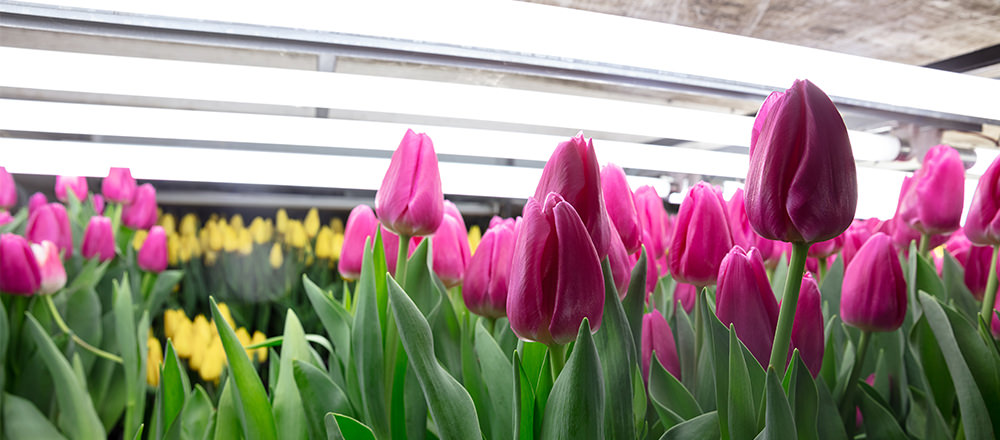
What’s the Best “Color” for Commercial Flower Production?
Are red, blue, and far-red light enough for successful floriculture? Not entirely. To answer this, we need to go back to the fundamental purpose of artificial horticultural lighting: to replicate or even improve upon natural sunlight, and to create precisely controlled lighting conditions that support healthier growth, faster development, and higher profits for growers.
Natural sunlight spans a broad spectrum of wavelengths, not just red, blue, and far-red, but also green, yellow, ultraviolet (UV), and more. Each part of the spectrum plays a role in plant physiology. This is why, for many commercial flowering crops, the most effective lighting solution is often a well-balanced full-spectrum grow light, one that mimics sunlight while being fine-tuned for specific crop needs.
But here’s the catch: not all full-spectrum LED grow lights are created equal. Just because a product is labeled "full-spectrum" doesn’t mean it will effectively promote flowering. The key is in the proportion of individual wavelengths, particularly how much red, far-red, blue, and supporting wavelengths are included, and how they're balanced for the flower and growth stage.
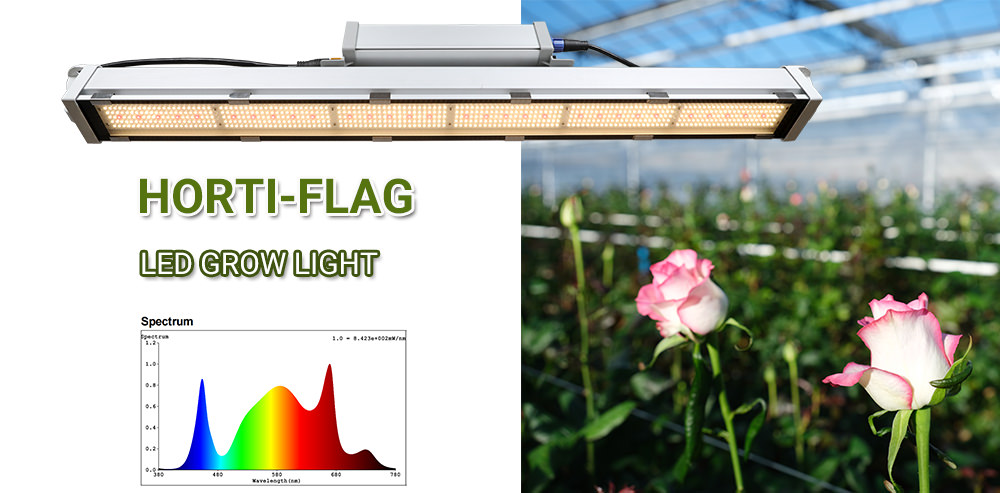
The optimal spectrum depends on the flower species and the specific stage of growth (e.g., vegetative vs. flowering). For example, here’s how the spectrum of our Horti-Flag LED grow light is tailored for rose production:
- White light supports overall plant health and photosynthesis.
- Far-red light enhances stem elongation and signals the plant to initiate flowering.
- Together, these elements promote strong stems, uniform blooms, and more vigorous flowering, ideal traits for high-quality cut roses.
We also provide tailored light spectrum for other flowers like lilies, chrysanthemum, and orchids. Just contact us for more details.