Can You Grow Lion's Mane Mushrooms in the Dark?
The idea that lion’s mane mushrooms thrive in the dark is a common myth. This misconception likely comes from observing wild mushrooms, which often appear on shaded forest floors or at the entrances of dimly lit caves.
While it’s true that lion’s mane mushrooms, like all fungi, don’t rely on sunlight for photosynthesis, light still plays a crucial role in their development. In mushrooms, light acts as a morphogenesis signal, triggering proper shape and structural formation. Without proper lighting, lion’s mane fruiting bodies tend to grow long and spindly, with underdeveloped spines, poor texture, and reduced visual appeal.
The importance of lighting extends beyond cultivation quality. The mushroom market itself is growing rapidly. For example, the UK mushroom industry has seen a CAGR of around 7–9% in recent years. For commercial growers, maintaining optimal lighting conditions can directly influence product quality, marketability, and profitability.
In this blog, we’ll explore how lion’s mane mushrooms respond to light and what their ideal lighting conditions are.
Light as a Signaling System for Lion’s Mane Mushrooms
First, it’s important to understand that lion’s mane is not a plant; it’s a fungus. Unlike plants, lion’s mane mushrooms don’t use light to produce food through photosynthesis. Instead, light serves as a critical environmental signal, a kind of communication system that guides their growth and development.
In nature, lion’s mane typically grows on dead or decaying hardwood trees in partially shaded forest environments. When the mycelium, the vegetative part of the fungus, colonizing the wood, detects light filtering through cracks in the bark or reaching exposed surfaces, it interprets this as a cue: “I’ve reached the outside world; it’s time to reproduce.”
This light signal indicates that conditions are favorable for spore dispersal, triggering a remarkable shift from vegetative growth to the formation of fruiting bodies. Specialized photoreceptors in the fungus sense the presence of light and activate a process known as morphogenesis, the transformation that shapes the visible mushroom.
The Problem with Growing Lion’s Mane in the Dark
Lion’s mane mushrooms can grow in complete or near-complete darkness, but the results are not good. The main problem with growing them in the dark is the loss of shape and structure. Instead of forming the compact, dense, and round clusters of spines that growers want, the fungus acts as if it is still deep inside a log. It stretches and elongates as it searches for light, producing pale, stringy, coral-like shapes.
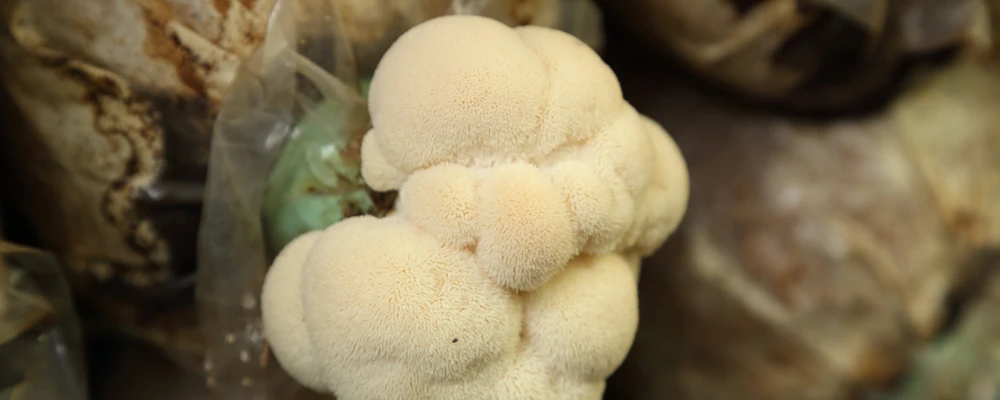
This distorted growth has three major commercial disadvantages: low density, poor appearance, and reduced weight. Stretched mushrooms are lighter and look less appealing to buyers. In commercial markets, whether for high-end restaurants or supplement producers, customers prefer the uniform, snow-white, pompom-shaped mushrooms that signal freshness and quality.
The texture also becomes worse. Without light cues to guide proper development, the flesh of the lion’s mane turns soft and fragile. This reduces shelf life and makes the mushrooms harder to transport.
In short, growing lion’s mane in the dark leads to low-quality, low-value harvests, wasting both substrate and effort that could have produced premium mushrooms.
Indoor Lighting Requirements for Lion’s Mane Mushrooms
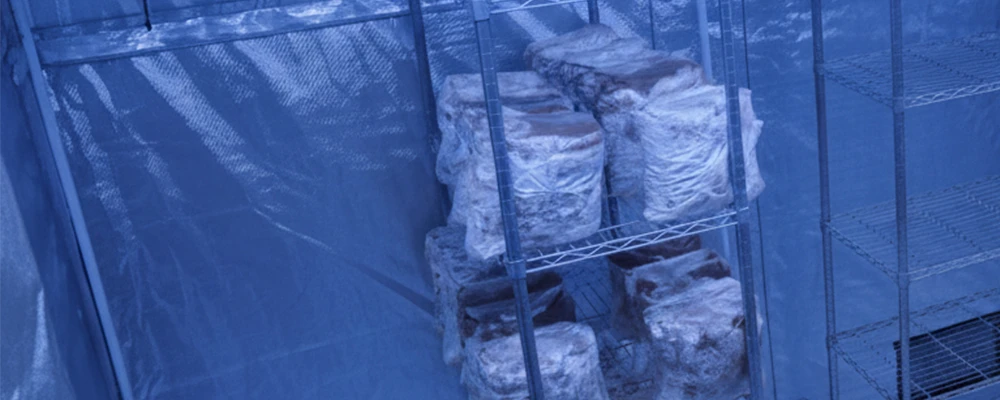
Light plays a key role in helping lion’s mane mushrooms form healthy pins and develop into full-sized fruiting bodies. For indoor cultivation, artificial lighting is essential to guide proper growth and maintain quality.
Since LED grow lights are the most popular and energy-efficient option for commercial mushroom production, we’ll use them as an example.
Gentle, blue-rich lighting with moderate exposure and consistent timing helps ensure high-quality, attractive, and market-ready lion’s mane mushrooms.
Blue light, in the range of 430 to 470 nanometers, is the most effective for lion’s mane mushrooms. This wavelength helps signal the mycelium to begin pinning and supports the development of compact, well-shaped fruiting bodies. For commercial growers, using full-spectrum LED lights with a strong blue light component is a simple and effective approach for indoor production.
Lion’s mane mushrooms require low light intensity. Aim for lighting similar to gentle daylight rather than direct sunlight. Too much light can cause the fruiting bodies to turn yellow or dry out.
A 12-hour on and 12-hour off light cycle works well. This consistent rhythm provides a reliable environmental signal that promotes uniform growth and supports multiple flushes.