
Answers to Top 5 Questions About 1000W LED Grow Lights
Lighting has always been at the core of controlled environment agriculture. In recent years, the shift from traditional HPS systems to high-efficiency LED technology has opened new possibilities for growers.
Because lighting can make up as much as 40% of total operating costs, choosing the right lighting is a decision with real financial impact. For both home and commercial growers, the key is finding the right balance between energy consumption and performance, especially when considering powerful options like 1000W LED grow lights.
In this blog, we’ll address five of the most common questions about 1000W LED grow lights to help you make an informed decision.
How Much Area Does a 1000W LED Grow Light Cover?
The coverage of a 1000W LED grow light is determined by its design and the PPFD (Photosynthetic Photon Flux Density) map.
For flowering and fruiting plants such as cannabis and tomatoes, it can cover an area of about 4’x4’ to 5’x5’ (1.2x1.2m to 1.5x1.5m) with strong and even lighting. For seedlings and vegetative plants, like leafy greens, it can cover a larger space of about 6’x6’ (1.8x1.8m) while still providing the light they need to grow and develop.
How Many Plants Can I Grow With a 1000W LED Grow Light?
The number of plants you can grow with a 1000W LED grow light depends on several factors, including the coverage area of the light, the growth stage of the plants, and the cultivation method you use.
Take cannabis as an example. A 1000W LED grow light can cover about 900 seedlings because they require very little space and light intensity in their early stage. As the plants mature and enter the vegetative phase, their need for light and space increases; the same light can cover around 100 plants. By the flowering stage, the light can only illuminate 36 plants, as each plant demands more energy and canopy space.
The growing method also plays a major role. A Sea of Green (SOG) approach allows you to cultivate many smaller plants close together, making it possible to maximize plant numbers under a single light. On the other hand, a Screen of Green (SCROG) setup focuses on training fewer plants to grow horizontally, filling out the canopy with larger individual plants. While this reduces the total number of plants, it often increases efficiency and yields per plant.
How Does a 1000W LED Grow Light Compare to a 1000W HPS?
In general, a 1000W LED grow light is more efficient than a 1000W HPS grow light.
Because LEDs produce less heat, they can convert a higher percentage of energy into usable light. The key metric here is PPE (Photosynthetic Photon Efficacy), measured in μmol/J. HPS grow lights have a PPE of around 1.7-2.1μmol/J, while high-quality LED grow lights can reach 2.5 μmol/J or higher.
Another advantage of LED is its full-spectrum output, which can be optimized for all growth stages. HPS lights emit a fixed yellow-orange spectrum with limited blue light, which can result in leggy growth.
So, can a 1000W LED directly replace a 1000W HPS?
No exactly. It can be too intense for most grow environments.
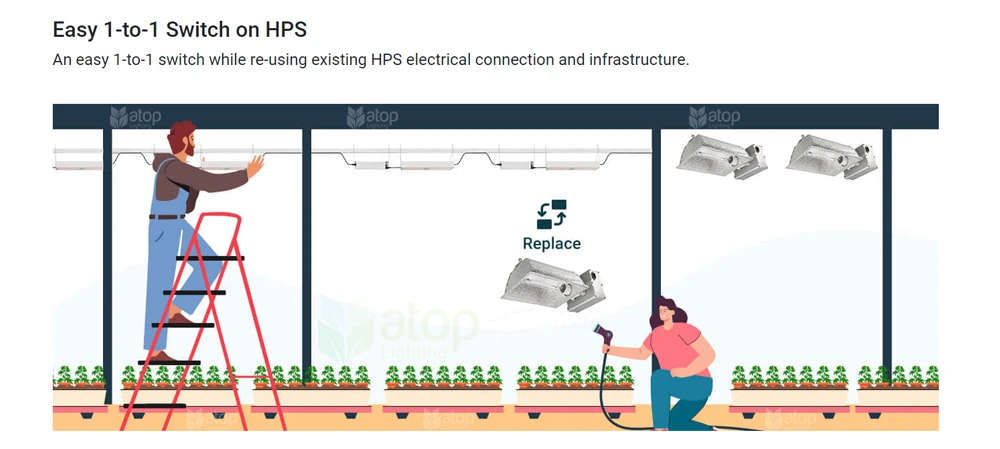
When manufacturers market “1:1 replacements”, they refer to the installation compatibility, size, and mounting, rather than matching wattages.
A lower-wattage LED can often replace a higher-wattage HPS while delivering the same or even higher light output. For example, our 800W Horti-top LED grow light can replace a 1000W HPS system on a 1:1 basis, providing better performance with reduced energy consumption.
How Far Away Should I Hang a 1000W LED Grow Light?
There is no single fixed height for hanging a 1000W LED grow light, as the ideal distance depends on the plant’s growth stage and the specific light model you are using. The best approach is always to follow the manufacturer’s guidelines, since different LEDs vary in intensity and beam spread.
As a general reference, seedlings are very sensitive to strong light and can easily suffer from stress or bleaching. To protect them, the light should be kept higher, usually between 36 and 48 inches (90–120 cm) above the canopy. During the vegetative stage, plants benefit from stronger light to encourage healthy growth, so lowering the fixture to about 24–36 inches (60–90 cm) is recommended. In the flowering stage, plants require the highest intensity to maximize bud and fruit production. At this point, the light can be lowered further to around 18–24 inches (46–60 cm) above the canopy.
What Should I Look for When Buying a 1000W LED Grow Light?
The first step is to check the actual power consumption. Many products advertise “1000W” in their name, but that doesn’t always reflect true wattage. Look at the specifications sheet for “power consumption” or “actual wattage,” since this determines both the real operating cost and the amount of light output.
Next, evaluate the spectrum quality. A full-spectrum LED grow light is the most versatile option and works well for nearly all applications. However, if you require a specific spectrum for commercial cultivation or research purposes, consider customized lighting solutions. We provide OEM/ODM services tailored to your needs.
Don’t rely solely on wattage as a measure of quality. Wattage tells you how much power a fixture consumes, but it does not reveal how efficiently that power is converted into usable light for plants. For this, you should look at three key metrics:
- PPF (Photosynthetic Photon Flux): This measures the total amount of usable light a fixture produces. A high-quality 1000W LED grow light should deliver at least 2500 μmol/s or more.
- PPE (Photosynthetic Photon Efficacy): This shows how efficiently the fixture converts electricity into plant-usable light. Look for fixtures with a PPE of 2.5 μmol/J or higher.
- PPFD (Photosynthetic Photon Flux Density): This indicates the light intensity at the plant level across the coverage area. Reviewing the PPFD map ensures the light is distributed evenly, which is critical for consistent growth.
Additional features also matter. Dimming control allows flexibility across different growth stages, certifications ensure safety and quality standards, and a solid warranty provides peace of mind and long-term reliability.